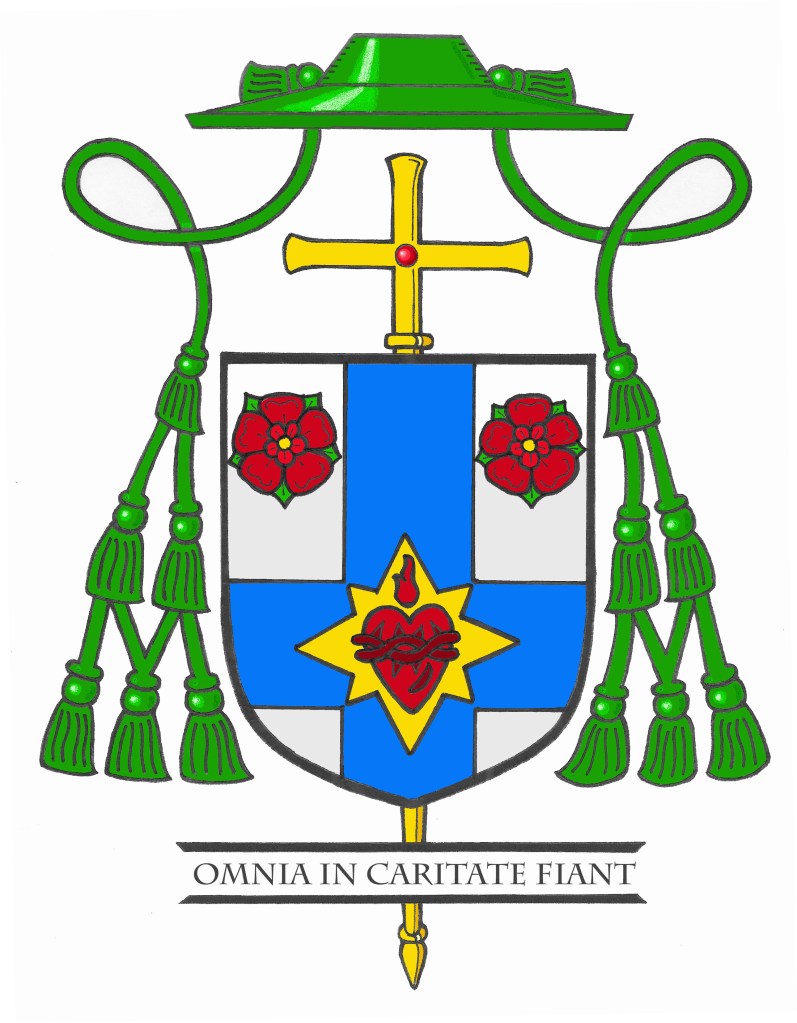
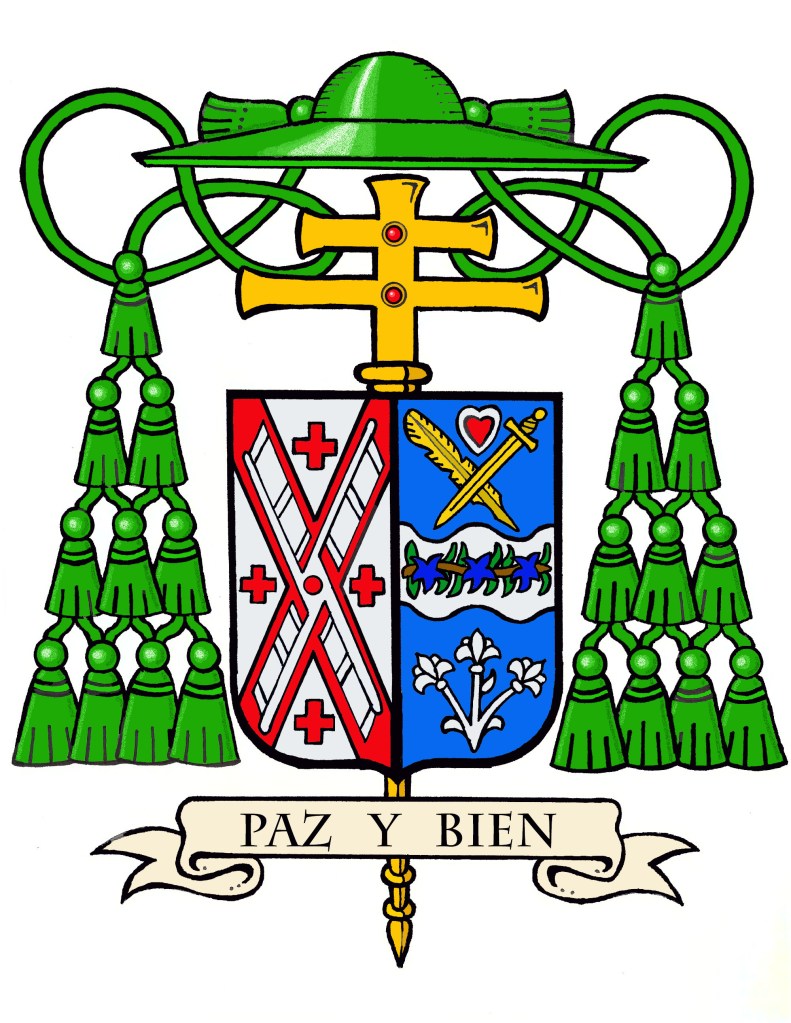
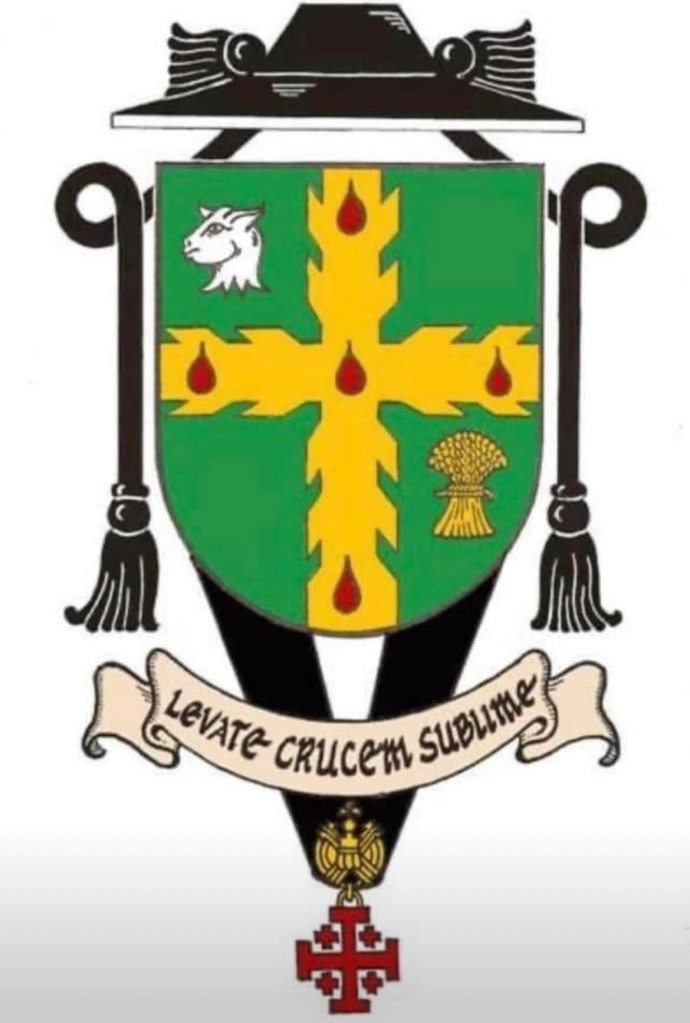
Category Archives: Fr. Guy’s designs

Bishop O’Connell of Albany

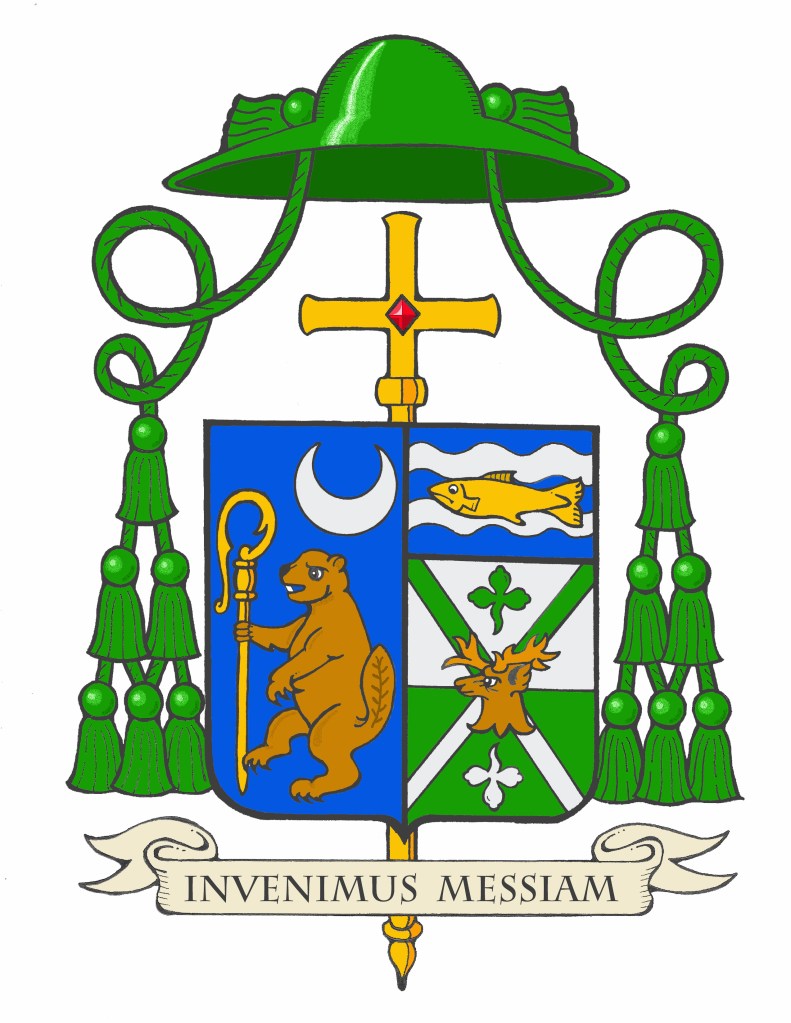
On December 5 the Most Rev. Mark William O’Connell (61), a priest and, since 2016, an Auxiliary Bishop of Boston will be installed as the 11th Bishop of the Diocese of Albany, New York.

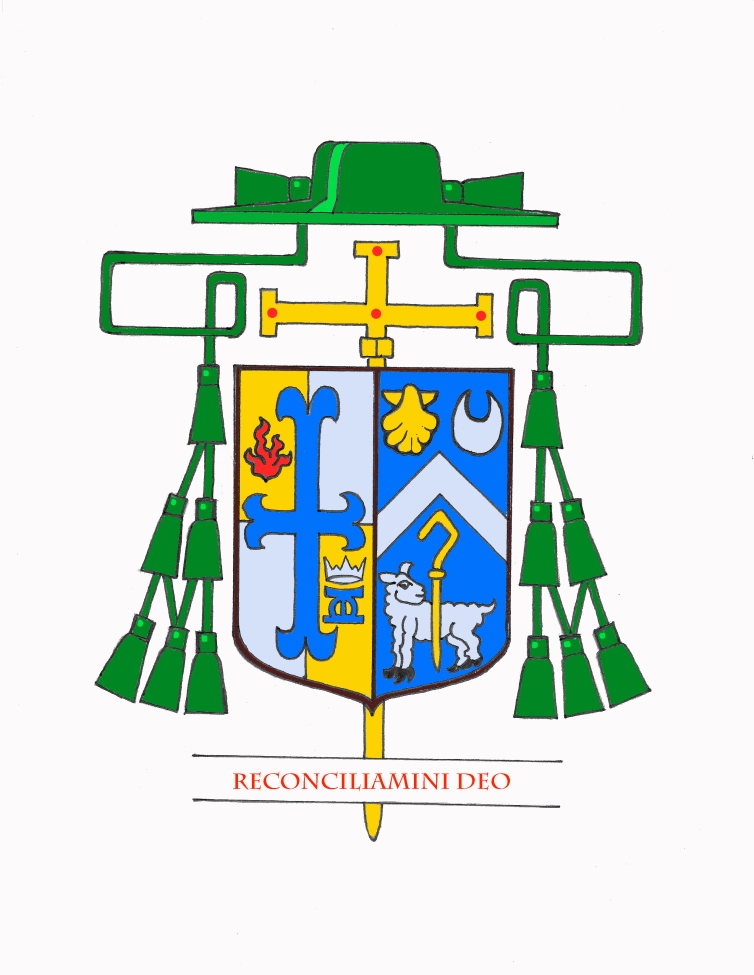
BLAZON: Arms impaled. In the dexter: Azure, a beaver springing Tenné holding in its dexter paw a bishop’s crozier Or; in chief to sinister a crescent Argent. In the sinister: per fess Argent and Vert, a saltire between in chief and in base two trefoils facing the centerpoint all Counterchanged; overall a stag’s head erased Tenné. On a chief barry wavy Azure and Argent; overall a fish naiant Or. The shield is ensigned with an episcopal cross Or and a bishop’s galero with cords and twelve tassels flanking the shield disposed in three rows of one, two and three all Vert. On a scroll below the shield is the motto, “Invenimus Messiam”.

The armorial bearings of Bishop Mark O’Connell impale the coat of arms of his episcopal See with his personal coat of arms. These evoke his family and heritage as well as his ministry. The coat of arms is composed of a shield with its charges (symbols), a motto and the external ornamentation.

The arms of the Diocese of Albany are composed of a blue field on which are placed a beaver standing on one foot and holding a bishop’s crozier below a silver (white) crescent in the upper right corner.  The beaver holding a crozier in the arms of the See come from the fact that the original name of Albany was “Beaverwyck” as it was a major outpost on the route for traders. In addition, the beaver is an animal closely associated with Canada, where the Bishop was born. It holds a crozier as an indication of Albany as the seat of a bishop. The crescent alludes to the Immaculate Conception, the titular of the cathedral church. 

Bishop O’Connell’s personal coat of arms was originally assumed when he became a bishop in 2016. That design has now been modified by the bishop so that his personal arms have a rather different appearance. I think I have commented on this blog numerous times in the past about how I generally do not favor the idea of an armiger later redesigning and changing his arms. I think it is done far too often, especially among the American episcopate. Nevertheless, it is sometimes strongly desired especially when there may be circumstances involving the adoption of the original coat of arms that influenced that original design. Upon further reflection it may sometimes occur that an armiger has second thoughts about the arms assumed, or simply has a strong desire to try to improve the coat of arms. Under such circumstances a move such as this one—being transferred to become a diocesan bishop—provide a kind of “natural” occasion to modify the existing coat of arms. In this case, the bishop had a clear desire to simplify the design of his personal arms because he was cognizant of the custom in N. America for impaling the personal arms with those of the See. Sometimes, such an impalement renders the personal arms—when they are an especially complex design—difficult to see clearly. So, right from the start of this commission the Bishop requested that some modifications be made in order to simplify the overall look of his personal coat of arms to make it more easily discernable when impaled with those of Albany. After discussing my usual attitude towards modifying existing arms I reluctantly agreed to do what I was being asked and then, I must admit, took to the task with enthusiasm.

The basic design of the main part of the field is based on the arms traditionally associated with the name O’Connell but with some significant changes in order to “difference” them from the original and make them unique to Bishop O’Connell. So, the background divided in half with the upper portion silver (white) and the lower portion green is taken from the O’Connell arms. To this is added a saltire (a cross in the shape of an “X”) as a symbol of St. Andrew, to whom the Bishop has a great devotion, and who was crucified on an X-shaped cross. This saltire is “counterchanged” meaning it’s colors are reversed with the background colors. Above and below the saltire are two trefoils (which also resemble shamrocks). These are also counterchanged to maintain the green and white color scheme. They are depicted facing each other, as it were, with their stems in an attitude towards the center of the shield. In this way they appear to be mirror images of each other. They, too, are taken from the original O’Connell arms. While there are three in the original only two are depicted here for a sense of symmetry. They allude to both the Holy Trinity and the Bishop’s Irish heritage. In addition, the color green is an allusion to the bishop being a canon lawyer because green is the academic color usually associated with Canon Law.

Placed in the center overall there is a stag’s head. This is retained from the arms the Bishop assumed in 2016 where it served there, as it does again here, as a reference to the full stag usually depicted in the arms of O’Connell. For purposes of creating another difference from the original while at the same time hearkening back to the coat of arms the Bishop first assumed, the head of the stag cut off at the neck, rather than the whole animal, has been depicted. Instead of being depicted facing the viewer and colored red it is shown in profile and is colored Tenné. This tone is used in heraldry as a representation of the color brown, which doesn’t exist in heraldic art. The closest approximation of brown that can be used while maintaining heraldic tradition is this “stain”, as opposed to a tincture, called Tenné.

On the upper third of the shield, called a “chief” we see a background composed of blue and silver (white) wavy bars. This is borrowed from the coat of arms of the Archdiocese of Boston where Bishop O’Connell served as a priest and an Auxiliary Bishop. The two white lines also represent the two rivers of Albany. Over the wavy lines there is a gold (yellow) fish. This symbol is borrowed from the arms associated with the name Delaney which was the Bishop’s mother’s name. In the Delaney arms it represents the “Salmon of Wisdom” associated with the legend of the mythical warrior, Fionn. In addition, it is worth noting that the fish was the earliest symbol used by the infant Church as a symbol of the faith. The word for fish is ICHTHUS in Greek. Using the letters of the Greek alphabet to spell the word fish, early Christians secretly bore this symbol as it created an acronym with the hidden meaning “Jesus Christ, Son of God, Savior”. The fish was a pictorial representation of this phrase and thereby formed a secret symbol for the first Christians.

The fish upon the waves, therefore, alludes to the Bishop’s maternal family, the Archdiocese of Boston, the Diocese of Albany as well as the concept of the Apostles—and their successors, the bishops—are called to be “Fishers of Men”. In a further allusion to St. Andrew we know that St. Andrew was present during the miracle of the loaves and fishes, where he identified a boy with five loaves and two fish, which Jesus then multiplied to feed a crowd of five thousand people. This event highlights Andrew’s role in bringing others to Jesus and his participation in the early ministry of Christ.

The external ornaments include a gold episcopal cross placed vertically behind the shield. This is often mistaken for a processional cross like the one used in liturgical processions. However, like other heraldic ornaments the episcopal cross has its origins in something which is no longer actually used. At one time all bishops had, in addition to the processional cross at the head of the procession, another cross carried directly in front of them by a cleric. This other cross was a sign of the office of bishop. While no longer actually used it has remained a symbol of the episcopal office in heraldry.

Similarly, the broad-brimmed green galero was, at one time, worn by bishops in outdoor processions and cavalcades. No longer used it remains a heraldic symbol of the office of bishop and takes the place of the helmet, mantling and crest that would appear in the coat of arms of a layman. In Catholic heraldry the color and number of tassels on the galero indicates the rank of the bearer. The single barred episcopal cross and the green galero with twelve tassels signifies the coat of arms of a bishop according to the Instruction of the Holy See, “Ut Sive” issued in 1969.

The motto chosen by Bishop O’Connell appears on a scroll below the shield. “Invenimus Messiam” which translates to “We Have Found the Messiah” is taken from John 1:41. The words are attributed to Saint Andrew who purportedly used them when greeting people for the first time as a way of announcing the coming of the Lord, His great work of Redemption, and his Resurrection. Bishop O’Connell’s spirituality is deeply rooted in this spiritual dictum.

I was very pleased to assist the Bishop with the modifications to his original coat of arms and to do the current artwork as well.

Passing of an Excellent Priest

The Rev. Daren Zehnle, 47, a priest of the Diocese of Springfield in Illinois died on November 27 after suffering a stroke the day before. He was a truly exceptional priest who had served his diocese as a parochial vicar, high school chaplain, pastor, vocation director and recently as a college chaplain. He has engaged in studies in both liturgy and canon law. Shortly after he was ordained years ago he asked me to design a coat of arms for him. He was an enthusiastic armiger frequently making use of his armorial banner. May he rest in a very well-deserved peace.

Checchio to be Coadjutor of New Orleans

Today it was announced that the Most Rev. James Checchio (59), the 5th Bishop of Metuchen, New Jersey has been appointed by Pope Leo XIV to become the Coadjutor Archbishop of New Orleans, Louisiana. He expects to take up his new responsibilities in late November. His current coat of arms will need slight modification to add another row of tassels to the galero and a second horizontal bar to the cross. However, it is customary for a Coadjutor Archbishop or Bishop to use his personal arms alone on the shield until such time as he succeeds to the See and then he may marshal his personal arms with those of the See on the same shield.

Bishop Checchio has served as Bishop of Metuchen since 2016. He will assist the Most Rev. Gregory Aymond (75) in the duties of shepherding the Archdiocese of New Orleans until the conclusion of their current bankruptcy proceedings which are expected to last until the end of this year. As Coadjutor Archbishop, Checchio will then automatically have the right immediately to succeed to the See.

It just so happens that it was my great privilege and pleasure to prepare the armorial bearings for Archbishop Aymond when he became Archbishop of New Orleans in 2009.

Parish of St. Matthew

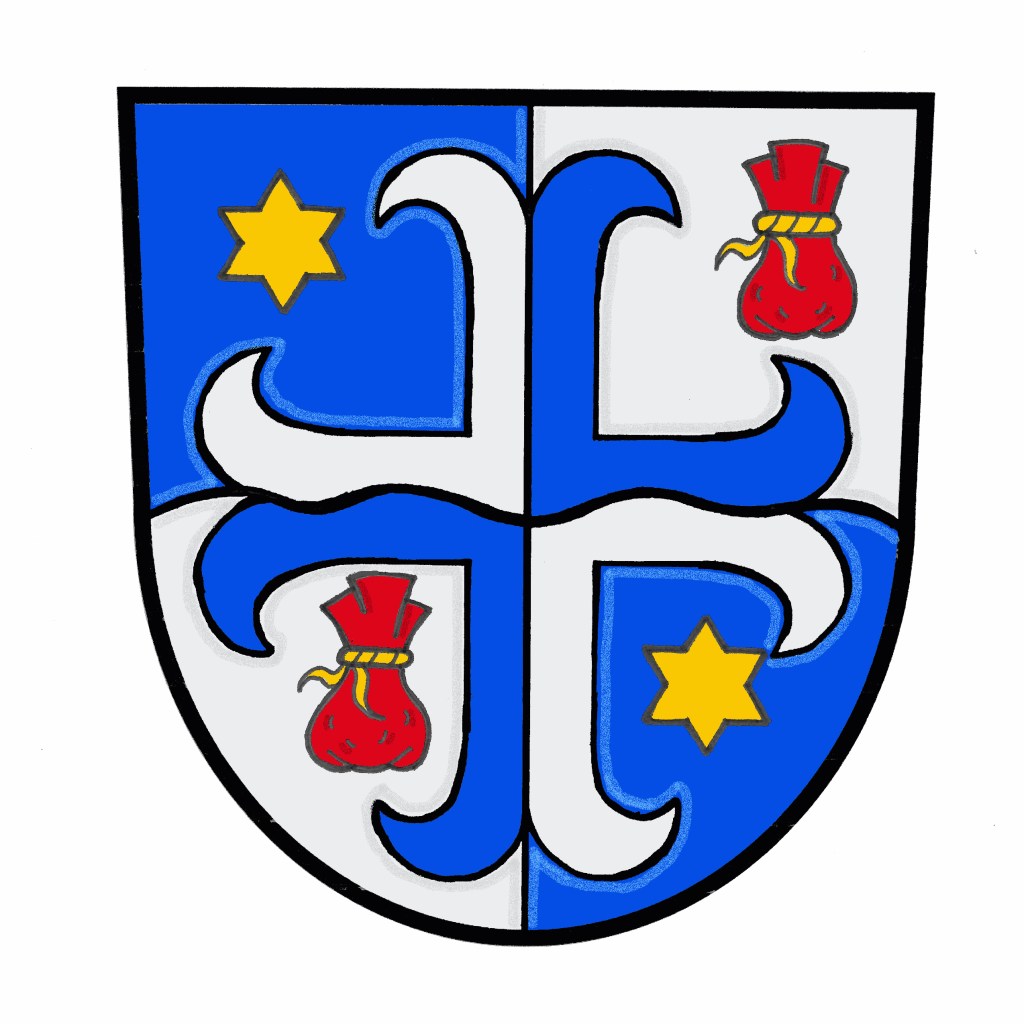
I recently was commissioned to design a coat of arms for the Parish of St. Matthew in Flint, Michigan.

BLAZON:Quarterly, the horizontal line wavy, Azure and Argent overall a cross moline quartered and Counterchanged;  in the first and fourth quarter a mullet of six points Or; in the second and third quarter a money bag Gules bound Or.

EXPLANATION: The armorial bearings of the Parish of Saint Matthew, Flint, Michigan in the Diocese of Lansing reflect its location and it titular patron saint. The cross is not only the symbol of our faith and of the center of activity in any parish but in this form is borrowed from the diocesan coat of arms to indicate the parish is located in that diocese. The horizontal division line has been made wavy as a reference to the Flint River, and so as a reference to the city in which the parish is located. The money bags are a symbol of the parish’s patron, St. Matthew who was a tax collector before he became a disciple. The six-pointed star is from the arms of St. Pius X who was pope at the time the parish was erected. In addition, part of the former parish of St. Pius X has been incorporated into the parish of St. Matthew, so it alludes to that as well.

The blue and white motif from the diocesan coat of arms predominates throughout. The money bags are red to recall St. Matthew’s martyrdom. By means of these symbols the coat of arms of the parish alludes to both its patron and the local church in which it is located.

Bishop Chau

On September 8 the Rev. P. Bismarck Chau (58) will be ordained a Bishop in the Church and become the Titular Bishop of Catrum and Auxiliary Bishop to HE, Joseph Cardinal Tobin, Archbishop of the Metropolitan See of Newark, NJ.

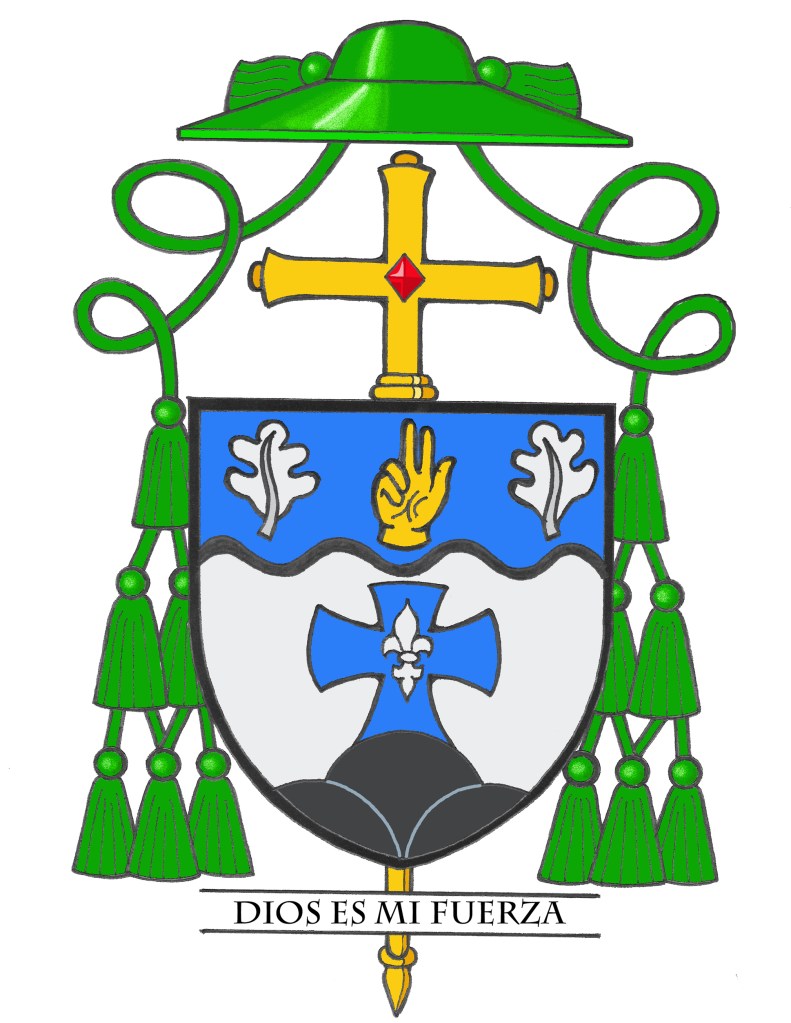
BLAZON: Argent on a triple mound issuant in base Sable a Latin cross Azure charged with a fleur-de-lis Argent; on a chief wavy Azure flanked by oak leaves Argent a human hand couped with the first two fingers raised in an attitude of benediction Or. Shield ensigned with an episcopal cross Or behind the shield and a bishop’s galero Vert cords and twelve tassels disposed in three rows of one, two and three all Vert. On a scroll below the shield the motto: “Dios Es Mi Fuerza”. (God is my strength)

EXPLANATION: The armorial bearings of Bishop Bismarck Chau reflect his family name, his Baptismal patron, the country of his birth and his ministry. The shield is composed primarily of the colors blue and white. These are the colors of the flag of Nicaragua where the bishop and his family originate. In the lower portion of the shield on a silver (white) background we see rising from the bottom of the shield a mound of three black hillocks. The three stylized hills represent that Nicaragua is known as a land of volcanoes. The hills create a kind of stylized mountain and the black color represents the black volcanic ash.

In addition, this stylized mound of rocks is also a nod to St. Peter whom Jesus called “the rock” on which He would build His church. Pedro (Peter) is the Bishop’s baptismal name. The black color of the rocks also has another meaning. The Chau–or Zhou–dynasty in China from which the family name is derived, was known for establishing an
extensive system of bronze metal-working. The black color emulates the dark color of bronze and so pays tribute to the Bishop’s family name.

Rising from the mound is the blue cross of faith charged with a silver (white) fleur-de-lis. The Bishop sees this as symbolizing the fact that he is who he is because of Christ; because he died on the Cross to give us life and made us all into a new creation. The cross not only symbolizes salvation and freedom, but also strength. God gave Jesus strength to carry his cross to the end. The fleur-de-lis has long been used in heraldry as a symbol of Our Lady. Mary was also a source of strength for Jesus, at calvary especially, at the foot of the Cross. It is worth noting that of all the symbols of Our Lady that could have been chosen the fleur-de-lis was used because it is a heraldic charge that also appears in the coat of arms of Pope Leo XIV who appointed Bishop Chau to the episcopacy as well as the coat of arms of Cardinal Tobin, whom the Bishop will serve and support by his own episcopal ministry. Thus, it honors those two figures important in the life of Bishop Chau.

The upper third of the shield, called a “chief” is separated from the rest by a wavy line representing water. The water alludes to Nicaragua being also known as a land of lakes, and is also symbolic of the waters of Baptism through which we all pass to become part of the Body of Christ. On this chief we see a gold (yellow) colored hand in blessing. This is symbolic of the divine blessing on all the Bishop’s endeavors. Gold is a color often used in heraldry to evoke divinity. In addition, this divine hand in blessing is also an allusion to the Bishop’s work with the Deaf Community. American Sign Language uses the hands arranged in different gestures to communicate. The hand is flanked by two silver (white or gray-ish) oak leaves. These are borrowed directly from the coat of arms of Bismarck as a representation of the Bishop’s given middle name which he most often uses and by which he is most commonly known and called.

The motto below the shield is taken from Isaiah 49:5 saying (in Spanish), “Dios Es Mi Fuerza”,  which, in English, translates to: “God is My Strength”.

It was my great pleasure and honor to design the Bishop’s armorial bearings and to prepare the artwork as well.

Archbishop Rivituso of Mobile, Alabama

September 3 will see the Installation of the tenth Bishop and third Metropolitan Archbishop of Mobile, Alabama. The Most Rev. Mark Steven Rivituso (63), a priest and, since 2017, an Auxiliary Bishop of St. Louis, MO will be installed at the Cathedral-Basilica of the Immaculate Conception.

I had marshaled and emblazoned the coat of arms of his immediate predecessor, Archbishop Thomas Rodi, and so the archdiocese contacted me about doing the same thing for the new archbishop.

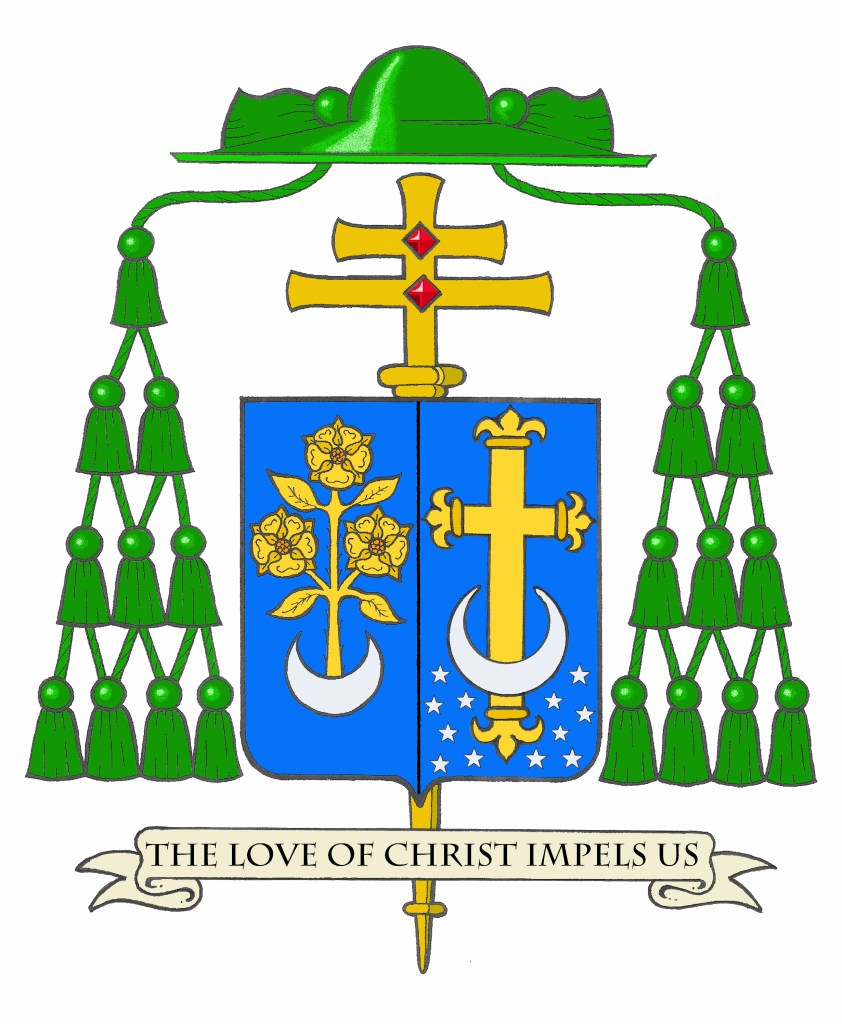
BLAZON: Arms impaled. In the dexter: Azure issuant from a crescent in base Argent a rosebush with three blossoms all Or. In the sinister: Azure, a cross fleuretty Or, charged near its base with a crescent Argent and in base twelve mullets of five points, six to dexter and six to sinister Argent. The shield is ensigned with an archiepiscopal cross Or and an archbishop’s galero with cords and twenty tassels flanking the shield disposed in four rows of one, two, three and four all Vert. On a scroll below the shield is the motto, “The Love of Christ Impels Us”.

EXPLANATION: The armorial bearings of Archbishop Rivituso impale the coat of arms of his archiepiscopal See with his personal coat of arms. The coat of arms is composed of a shield with its charges (symbols), a motto and the external ornamentation. The shield is described (blazoned) in terms that are archaic to our modern language, and this description is presented as if viewed by the bearer with the shield being worn on the arm. Thus, where it applies, the terms dexter (right)  and sinister (left) are reversed as the device is viewed from the front.

It is customary in heraldry that the arms of a Diocesan Bishop, or Ordinary, are joined side by side on the same shield with the arms of his See. In this case, these are the arms of the Archdiocese of Mobile. Such marshaling is called impalement and employs the same method used when joining the coats of arms of two people who are married. In this way, the coat of arms, like the episcopal ring, is symbolic of the archbishop being “married” to his archdiocese.

The arms of the Archdiocese of Mobile depict a blue background on which is a silver (white) crescent moon toward the bottom. This is a symbol of Our Lady’s Immaculate Conception which is the titular of the cathedral-basilica. From this crescent springs a rosebush that has three roses . The blossoms, leaves and stem are all gold (yellow).

The personal coat of arms of Archbishop Rivituso symbolize his origins, his personal devotion and the place in which he has spent his ministry as a priest and auxiliary bishop.The shield is blue with a gold (yellow) cross with the ends of the arms terminating in fleurs-de-lis borrowed from the coat of arms of the Archdiocese of St. Louis where the Archbishop served as both a priest and Auxiliary Bishop.

At the bottom of the cross is a silver (white) crescent moon with a scattering of twelve silver (white) stars on either side. This alludes to Our Lady under her title of the Immaculate Conception, patroness of the United States. In the Book of Revelation she is described as having the moon under her feet and a crown of twelve stars on her head.

In addition, the crescent is placed near the bottom of the cross to signify Mary at the foot of the cross where Jesus asked St. John to care for her. In giving His mother to His Beloved Disciple, Christ also gave her to all of us as the Mother of the Church. In addition, the crescent and twelve stars symbolize the twelve apostles along with Mary, the Queen of the Apostles.

On a scroll below the shield is the Archbishop’s motto, “The Love of Christ Impels Us” taken from St. Paul’s Second Letter to the Corinthians (Chapter 5; verse 14). It means that as Christians and believers in Jesus as the Christ in all that we do and are the love of Christ impels us.

It was my great pleasure and privilege to prepare the Archbishop’s new coat of arms.

Bishop Pham of San Diego

On July 17, 2025 the Most Rev. Michael Pham (58), a priest of the Diocese of San Diego who, since 2023 has also served as Auxiliary Bishop there, will be installed as the VII Bishop of San Diego.

The arms that he assumed when he became a bishop in 2023 remain unchanged, as is most correct. They have, however, simply been marshaled with the existing, and very nice, coat of arms of the diocese.

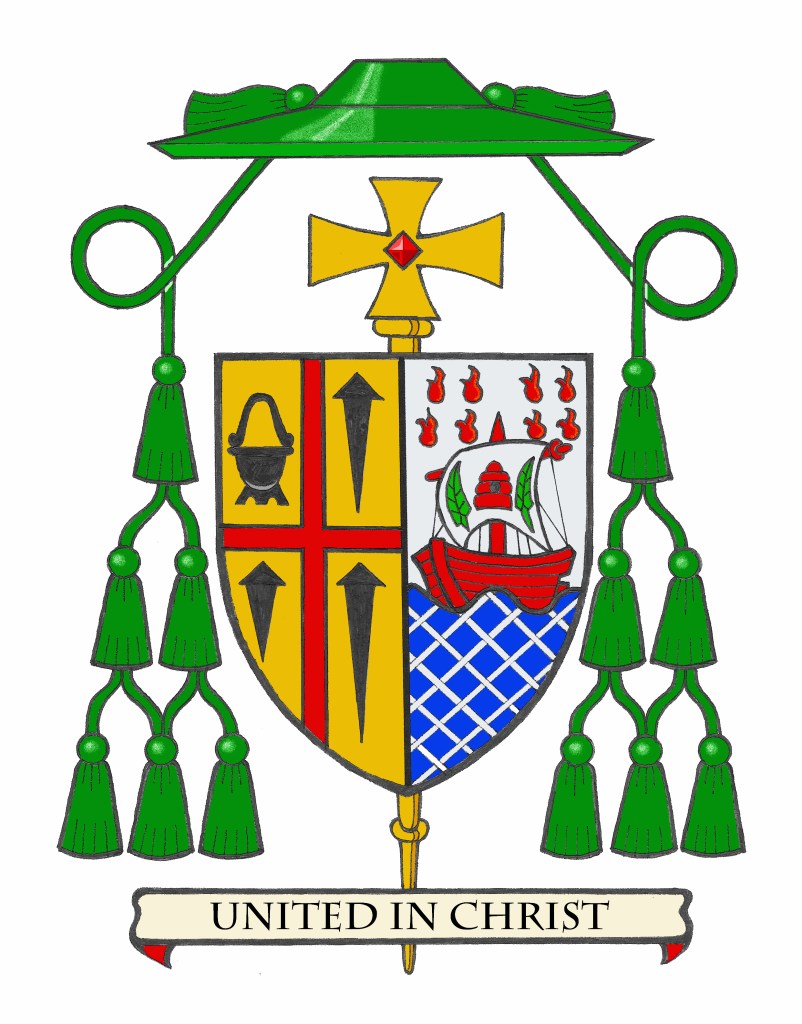
BLAZON: Arms impaled. In the dexter: Or, a cross throughout Gules between in the dexter chief quarter a Spanish stew pot and in the other three quarters a nail all Sable (San Diego) In the sinister: Per fess wavy Argent and Azure; in base fretty Argent; in chief a fishing boat Gules with a sail unfurled Argent charged with a beehive Gules flanked by two palm branches to dexter and sinister Vert; in chief eight tongues of fire all Gules. Shield ensigned with an episcopal cross Or behind the shield and a bishop’s galero Vert cords and twelve tassels disposed in three rows of one, two and three all Vert. On a scroll below the shield the motto: “United in Christ”.

EXPLANATION: The Bishop’s coat of arms, is composed of a shield upon which there are symbolic charges, a motto and the external ornaments of rank. The shield which is the most important feature of any heraldic device is blazoned (i.e. described) in heraldic language from the point of view of the bearer with the shield being held on his arm. Thus, where it applies, the term “dexter” (right) and “sinister” (left) are reversed as the device is viewed from the front.

By heraldic custom observed in North America, the arms of a diocesan bishop are “impaled” side by side on the same shield to the arms of his jurisdiction, in this case, the Diocese of San Diego. This signifies that the diocesan bishop is “married” to the See. The same method of impalement is employed in the coat of arms of two married people who are armigerous.

The coat of arms of the See of San Diego is composed of a gold (yellow) field and symbols of San Diego (St. Didacus in Latin), the diocesan patron saint. Diego was born to poor Spanish parents shortly before the year 1400. His love of poverty never left him. As a Franciscan brother he was a selfless servant of the poor and was known to heal the sick with the Sign of the Cross, the central charge of the diocesan coat of arms. The Spanish stew pot in the upper left quadrant indicates Diego’s boundless charity and tireless efforts to feed the hungry. San Diego had a special devotion to the Lord in his Passion, symbolized by the three nails in the other three quadrants. Diego died on Nov. 12, 1463, at the Franciscan monastery in Alcalá, Spain, pressing a crucifix to his heart and repeating the words of the Good Friday chant: “Dulce lignum, dulce ferrum, dulce pondus sustinet” (Precious the wood, precious the nails, precious the weight they bear.)

The personal coat of arms assumed by Bishop Pham when he was made Auxiliary Bishop in 2023 combines symbols that are meaningful to him. The shield is divided horizontally to depict a silver (white) sky above a blue wavy ocean. The ocean is criss-crossed by diagonal lines in order to create a pattern suggestive of a fisherman’s net. It represents that after 1975 while still living in Vietnam the bishop’s father became a fisherman to provide for his family. In addition, the net indicates not only the task of an apostle (or a successor to an apostle) of being a “fisher of men” but it also alludes to the New Evangelization where we are exhorted to put out into the deep (Duc in Altum). This symbolizes both the bishop’s priestly and episcopal ministry. 

In the upper part of the shield the boat also alludes to the work of a fisherman. In addition, a boat, in heraldry, is often used as a symbol of the Church itself, often referred to as the barque of Peter, who was himself, a fisherman. On the sail of the boat in the center is a red beehive flanked by two green palm branches. The beehive is a symbol of St. John Chrysostom, the bishop’s baptismal patron saint who was renowned for his inspiring preaching. So, he was known as a “honey-tongued” preacher. The palm branches are an ancient symbol of martyrdom. The bishop’s family comes from the first diocese in the north of Vietnam where his ancestors were among the first martyrs for the faith in that part of the world.

On either side and above the boat are eight red tongues of fire. They are symbols of the Holy Spirit which descended on the Apostles as tongues of fire at Pentecost. This was the beginning of their ministry to go out into the world to preach the Gospel so it is another symbol of Evangelization. Several flames represent a diversity of communities. Bishop Pham strengthened the cultural communities found in the diocese and shared them with the larger Catholic community. He has served as Episcopal Vicar of the Office of Ethnic & Intercultural Communities. So, symbols of the Holy Spirit were seen to appropriately reflect this ministry. It also reflects how, on Pentecost, when the Holy Spirit descended, people from different places, languages and cultures heard the Apostles speaking in their own languages. The red of the boat, the beehive and the tongues of fire is a further allusion to the blood of the martyrs.

It was my great pleasure to design and emblazon the bishop’s arms in 2023 when he became a bishop. At this time it was also my pleasure to marshal them to the arms of the See and emblazon them once again.

Archbishop McKnight

The Most Rev. Shawn McKnight (56) was installed as the fifth Archbishop of Kansas City in Kansas on May 26. I already talked about the very nice version of his coat of arms prepared for that occasion by Matthew Alderman. Immediately after his installation, the archbishop contacted me and asked for another rendering of his arms done by me. While that is somewhat unusual it is not unprecedented. It’s not uncommon for an armiger to have and use different renditions of his coat of arms done by different artists.

So, I undertook to do an emblazonment of the archbishop’s coat of arms for his use.

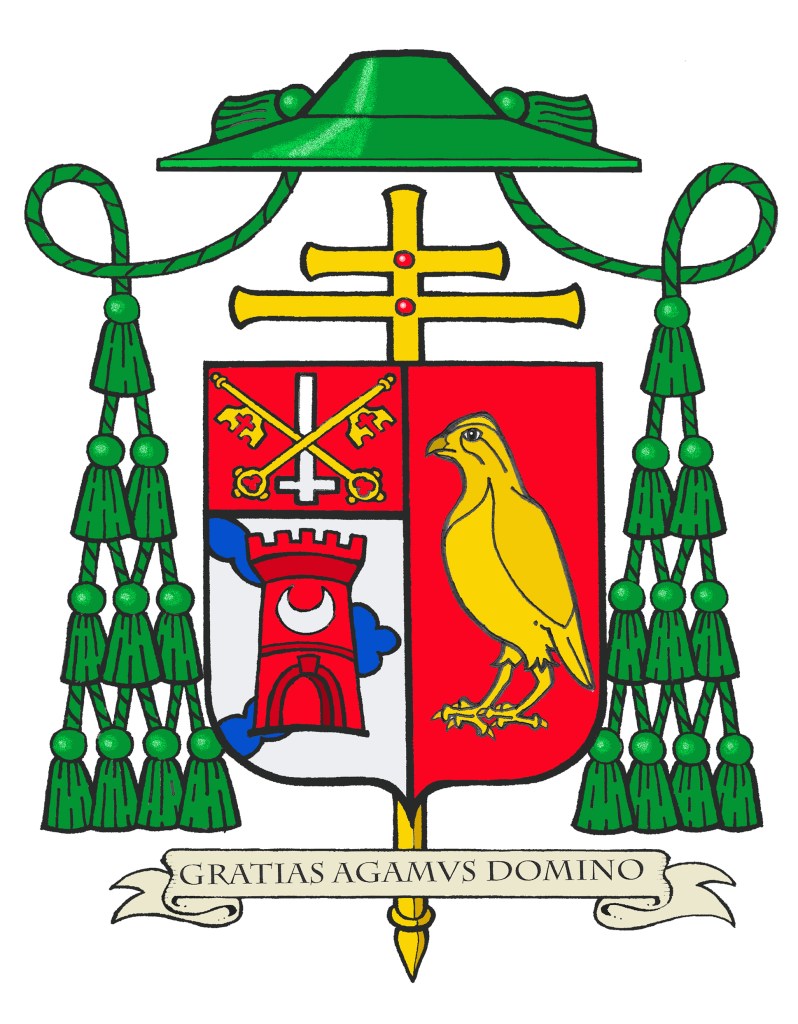
BLAZON: Arms impaled. In the dexter: Argent, a chevron invected issuant from the dexter, overall a tower embattled Gules charged with a crescent Argent; on a chief Gules a Latin cross reversed Argent surmounted by two keys in saltire Or. In the sinister: Gules a quail statant Or. The shield is ensigned with an archiepiscopal cross Or and an archbishop’s galero with cords and twenty tassels flanking the shield disposed in four rows of one, two, three and four all Vert. On a scroll below the shield is the motto, “Gratias Agamus Domino”.


EXPLANATION: The armorial bearings of Archbishop McKnight impale the coat of arms of his archiepiscopal See with his personal coat of arms. The coat of arms is composed of a shield with its charges (symbols), a motto and the external ornamentation. The shield is described (blazoned) in terms that are archaic to our modern language, and this description is presented as if given by the bearer with the shield being worn on the arm. Thus, where it applies, the terms dexter (right) and sinister (left) are reversed as the device is viewed from the front.


It is customary in heraldry that the arms of a Diocesan Bishop, or Ordinary, are joined side by side on the same shield with the arms of his See. In this case, these are the arms of the Archdiocese of Kansas City. Such marshaling is called impalement and employs the samemethod used when joining the coats of arms of two people who are married. In this way, the coat of arms, like the episcopal ring, is symbolic of the archbishop being “married” to his archdiocese. The arms of the Archdiocese of Kansas City are composed of a silver (white) field on which there is a blue chevron issuing from the side. The sides of the chevron are “invected” which means a line that consists of a series of circular arcs curving in the same direction, meeting at angles, forming points inward. This is to symbolize the Missouri River. Laid over this chevron is a red tower with an open archway and an embattled top. Imposed on the tower is a silver (white) crescent. The tower is a symbol of Fort Leavenworth. The original designation of the Archdiocese was the Diocese of Leavenworth (1877) and the church of the Immaculate Conception was the titular of the cathedral there. The crescent moon in heraldry is a symbol of Our Lady’s Immaculate Conception. The upper third of the shield, called a “chief” contains two crossed gold (yellow) keys superimposed over a silver (white) Latin cross upside down. These are symbols of St. Peter, the titular patron of the cathedral church. The keys are the “keys of the kingdom” bequeathed by Christ to St. Peter and the upside down cross recalls the manner of his crucifixion.


The personal coat of arms of Archbishop McKnight illustrates his personal devotion. The field is red and the one and only charge is a large gold (yellow) quail. The red color alludes to the devotion of Archbishop McKnight to the Sacred Heart of Jesus as well as the Immaculate Heart of the Blessed Virgin Mary. Quail are a symbol of God’s providential blessing and an Old Testament prefiguration of the Eucharist, as the Lord provided for his people in the desert with manna in the morning and quail in the evening (see Exodus 16:11-13; Numbers 11:31-32; Psalm 78:27 and Psalm 105:40). Quail-hunting is also a favorite sport of the Archbishop, an activity which requires the use of pointing, flushing and retrieving hunting dogs, and through which he experiences the beauty, harmony and providence of God in nature.

The external ornaments include a gold archiepiscopal cross with two horizontal bars (sometimes referred to as a patriarchal cross) placed vertically behind the shield decorated with red jewels. This is often mistaken for a processional cross like the one used in liturgical processions. However, like other heraldic ornaments the archiepiscopal cross has its origins in something which is no longer actually used. At one time all bishops had, in addition to the processional cross at the head of the procession, another cross carried directly in front of them by a cleric. This other cross was a sign of the office of bishop. It originated as a custom that such a cross was carried before archbishops only. Later, the cross was adopted for use by all bishops so archbishop’s added a second horizontal bar to their crosses to distinguish them from the episcopal cross of simple bishops. While no longer actually used it has remained a symbol of the archiepiscopal office in heraldry. Similarly, the broad-brimmed green galero was, at one time, worn by bishops in outdoor processions and cavalcades. No longer used it remains a heraldic symbol of the office of bishop and takes the place of the helmet, mantling and crest that would appear in the coat of arms of a layman. In Catholic heraldry the color and number of tassels on the galero indicates the rank of
the bearer. The double barred archiepiscopal cross and the green galero with twenty tassels signifies the coat of arms of an archbishop according to the Instruction of the Holy See, “Ut Sive” issued in 1969.


The motto chosen by Archbishop McKnight appears on a scroll below the shield, “Gratias Agamus Domino”. This is taken directly from the opening dialogue of the preface at the beginning of the Eucharistic Prayer at Mass (“Let us give thanks to the Lord”), and is derived from Psalm 107:1 and Psalm 118:1 (“Give thanks to the Lord Who is good, Whose love endures forever”).

Arms for a Basilica

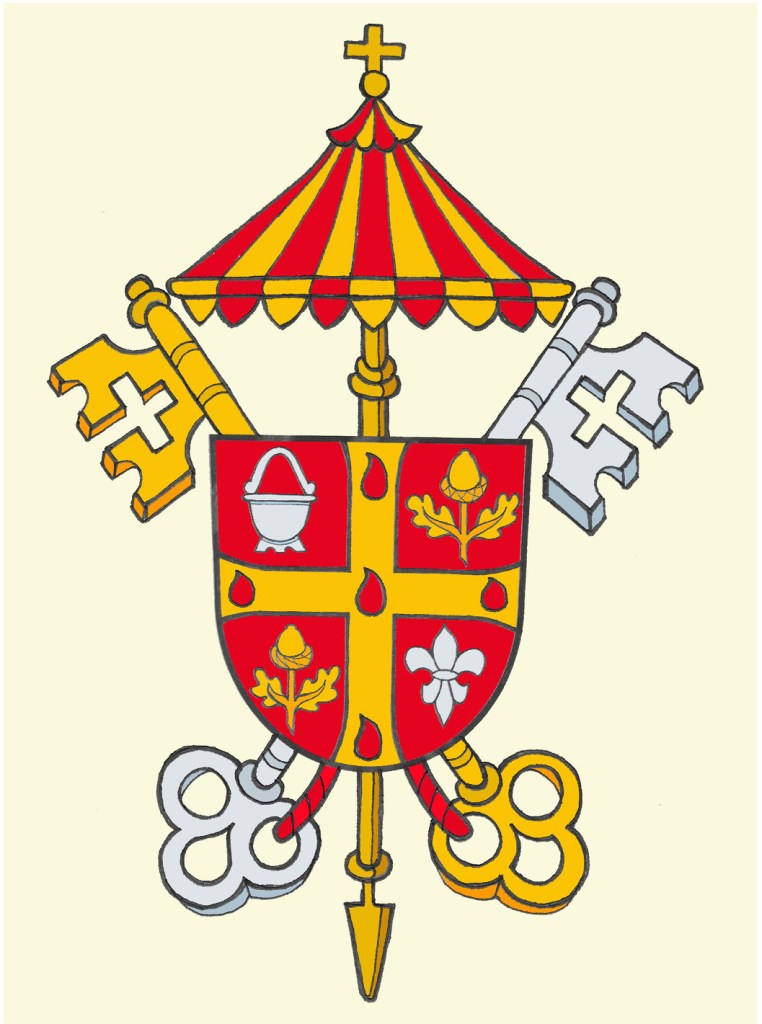
The Mission Church of San Diego (St. Didacus) de Alcalá was the second Spanish Mission church founded in 1769 by St. Junípero Serra. The present (5th) church building was designated a Minor Basilica by St. Paul VI in 1976. Going without any armorial bearings of its own for several decades I was approached some time ago by one of the priests of the Mission basilica to design a coat of arms for the church. This was done with the approval of the (then) Bishop of San Diego, Robert Cardinal McElroy, now the Metropolitan Archbishop of Washington, DC.

The blazon of the coat of arms is: Gules, a cross formy throughout Or charged with five gouttes de sang at the center point and extremities; between in the dexter chief quarter a Spanish stew pot Argent; in the sinister base quarter a fleur-de-lis Argent and in the other quarters an acorn slipped Or. The shield is ensigned with the ornaments of a Minor Basilica which are, two keys crossed in saltire behind the shield to dexter Argent and to sinister Or, and an ombrellino Proper standing behind the shield.

The basic design borrows, and reverses the colors from the coat of arms of the Diocese of San Diego. Instead of a gold (yellow) field with a red cross there is now a red field with a gold cross. The cross, which has slightly flared ends, is charged with five drops of blood. These represent the founder of the Mission, Junípero Serra, who was a Franciscan friar. So, the five drops recall the five wounds of the stigmata received by St. Francis of Assisi. Serra, the founder of the Mission, is symbolized by making a  reference to the Order to which he (and San Diego) belonged. That also honors all the other Franciscan missionaries who carried on the work at the Mission throughout the centuries. In addition, the present Mission church–the one designated a basilica–is the fifth church building used by the Mission. So, the five drops of blood also allude to the basilica itself being the fifth building in use as a church.

In the upper left corner is the pot that is a symbol of San Diego (St. Didacus), the patron of the Mission Basilica (as well as the diocese). As a Franciscan brother he was a selfless servant of the poor and was known to heal the sick with the Sign of the Cross, the central charge, and the Spanish stew pot in the upper left also symbolizes him. It indicates Diego’s boundless charity and tireless efforts to feed the hungry. In the lower right corner we see a fleur-de-lis which is borrowed from the coat of arms of St. Paul VI, the pope who raised the Mission church to the rank of Minor Basilica in 1976. Both of these are silver (off-white). 

The other two quadrants are charged with a gold (yellow) acorn. This is to give the Native Americans, who received the Gospel from the Franciscans and became their collaborators throughout the Mission era, representation on the coat-of-arms. It is a symbol of the agrarian traditions of the Native Americans, and also represents the potential for spiritual growth and transformation. Just as an acorn can grow into a mighty oak tree, it represents the idea that even small acts of faith and virtue can lead to great spiritual maturity and strength. This aligns with the Catholic teaching on the importance of nurturing one’s faith and virtues over time and refers to the Mission’s humble beginnings and growth. In addition, the acorn’s humble beginnings remind Catholics of the virtues of humility and simplicity. These qualities are highly valued in Catholic teachings, as exemplified by the lives of saints, such as St. Francis, St. Didacus, St. Junipero Serra, and the Franciscan Padres who often started with humble beginnings and grew in holiness and influence through their faith and actions. The acorn also symbolizes God’s provision and sustenance as a reminder of His care and providence, ensuring that His creation is provided for.

The external ornaments are the two crossed keys (one gold and one silver) bound together by a red cord and the ombrellino. The keys are an ornament granted to basilica churches to show their connection to the Holy See. They are the same as the keys seen in the coat of arms of the Holy See and of the Pope, recalling the “keys to the kingdom” given by Christ to St. Peter; one to bind and one to loosen. The ombrellino, a large red and gold canopy, is also a symbol of the Holy See and used as a symbol of such whenever the See is vacant. It also used to be employed as a symbol of papal administration in the time of the Papal States. Originally, it was a ceremonial canopy carried in procession to cover a dignitary such as the pope while walking or riding in a cavalcade. It is primarily symbolic now but all basilica churches are expected to have one which is to be carried in procession in the event of a papal visit. 

This was a fun and interesting project which I completed, coincidentally, on the same day that the Pope appointed a new Bishop of San Diego to succeed Cardinal McElroy.

Episcopal Diocese of Wisconsin

A few months ago I was approached about providing assistance to the Episcopal Diocese of Wisconsin on a redesign of their coat of arms. The diocese encompasses the entire state of Wisconsin and is composed of a reunification of three dioceses in the state—Milwaukee, Eau Claire, and Fond Du Lac— into one jurisdiction. Each of the former dioceses had its own armorial bearings and the task at hand was to come up with an entirely new design that could please everyone and borrow some design elements from all three. Not an easy task.

A commission was put together of people from within the state who had some background in various fields like art, communications, web design, or Episcopal Church history, and the bishop (the former bishop of Fond Du Lac). I was asked to be the heraldic consultant and we gathered via zoom for several meetings and exchanged numerous pieces of correspondence with quite a few sketches going back and forth. After identifying themes, common characteristics and ideas for what the new arms should express we began to hone it down to just a few, which quickly became two and then we made final tweaks until we got to the result. I didn’t provide the artwork this time but simply guided the process of designing the coat of arms.

The end result is:

The use of blue was common in all three existing arms, as was images of water. So, the blue field contains two wavy lines as symbolic of the lakes and rivers of Wisconsin as well as a reference to the waters of Baptism. The two crosses fleury in chief are for the Christian faith that undergirds every effort of the people in the diocese and has a subtle nod to the French influence on the region. The fret of three fish is an obvious Trinitarian symbol and also alludes to the three former jurisdictions being united into one. The fish is, of course, an early Christian symbol and is, therefore, a fitting element to use to symbolize three Christian communities now united as one.

I would blazon this: Azure, two barrulets wavy Argent; in chief between two crosses fleury Argent a fret of three fishes Or. The shield is ensigned with a bishop’s miter and a crozier and key in saltire behind the shield all Or.

My favorite little “cheeky” thing that was snuck in are the two crosses on the ends of the fanons that hang from the bishop’s mitre. They are composed of four triangles conjoined at the center…looking slightly like four wedges of cheese since Wisconsin is known as a very large dairy-producing state. The nickname of someone from Wisconsin is the affectionate term: “Cheese-Head”.

This was a long process but one that undertaken seriously by people dedicated to their task. My gratitude to Fr. Chris Corbin for shepherding the commission along as its chair and for providing the final artwork as well! The arms is also used by the diocese on its diocesan seal.

Cardinal McElroy Installed in the Capital

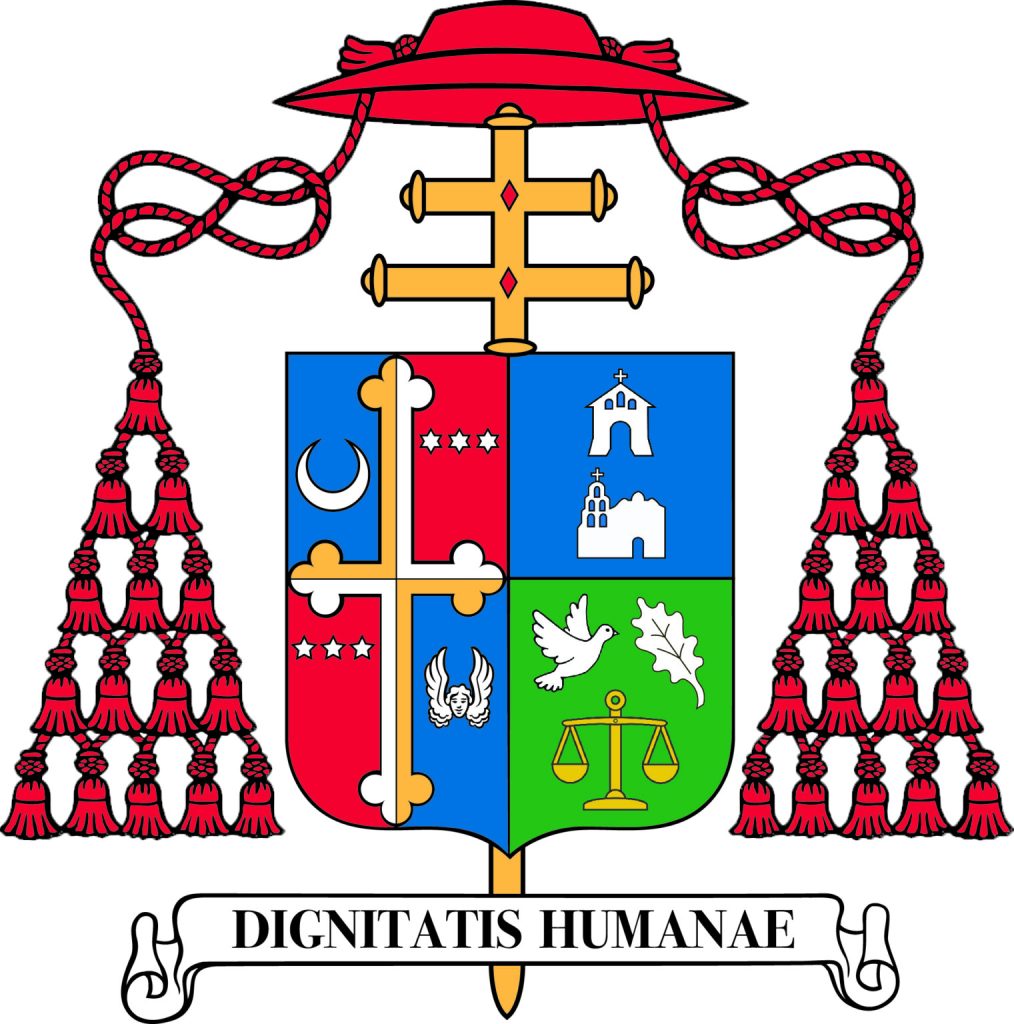
On March 11, His Eminence Robert Cardinal McElroy (71), Cardinal Priest of San Frumenzino ai Prati Fiscali, previously Bishop of San Diego (2015-2025) and originally a priest and Auxiliary Bishop (2010-2015) of San Francisco, was installed as the 8th Archbishop of Washington, DC.

At his appointment as Auxiliary Bishop he assumed a coat of arms which he then substantially changed when he moved to San Diego. In 2022 when he was created Cardinal I was privileged to assist him in preparing his coat of arms and at that time some further revisions and improvements to the design were made. At this most recent move, his personal arms, unchanged any further, were marshaled to those of the archdiocese and the episcopal cross was changed to an archiepiscopal cross.

From the website of the archdiocese we find the following:

Arms impaled. In the dexter: Quarterly Azure and Gules, a cross bottony over all quarterly Or and Argent; 1, a crescent Argent; 2, three mullets of six points fesswise in chief Argent; 3, as many mullets of five points fesswise in chief Argent; 4, a head erased affronté and winged all Argent. In the sinister: Per fess Azure and Vert, in chief the stylized silhouette of Mission San Francisco de Assis above, in base, that of Mission San Diego both Argent; in base below to dexter a dove turned to sinister volant wings addorsed and to sinister, an oak leaf both Argent scales Or.

The shield is ensigned with an archiepiscopal cross Or in pale behind the shield and surmounted by a cardinal’s galero with cords and fifteen tassels on either side in five rows of one, two, three, four and five all Gules.

On a scroll below the shield is the motto: “Dignitatis Humanae.”

The arms of the Archdiocese of Washington were devised in 1947 by William F. J. Ryan and modified in 2001 by Anthony W. C. Phelps, when the cross bottony was substituted for the original cross of chain links in silver. Cardinal McElroy’s arms were devised originally by Rev. Timothy Pelc. The present blazon of his arms was done by Rev. Guy Selvester. The rendering of the impaled arms was done by Georgina Wilkinson.”

One of “The Quints” for Chicago

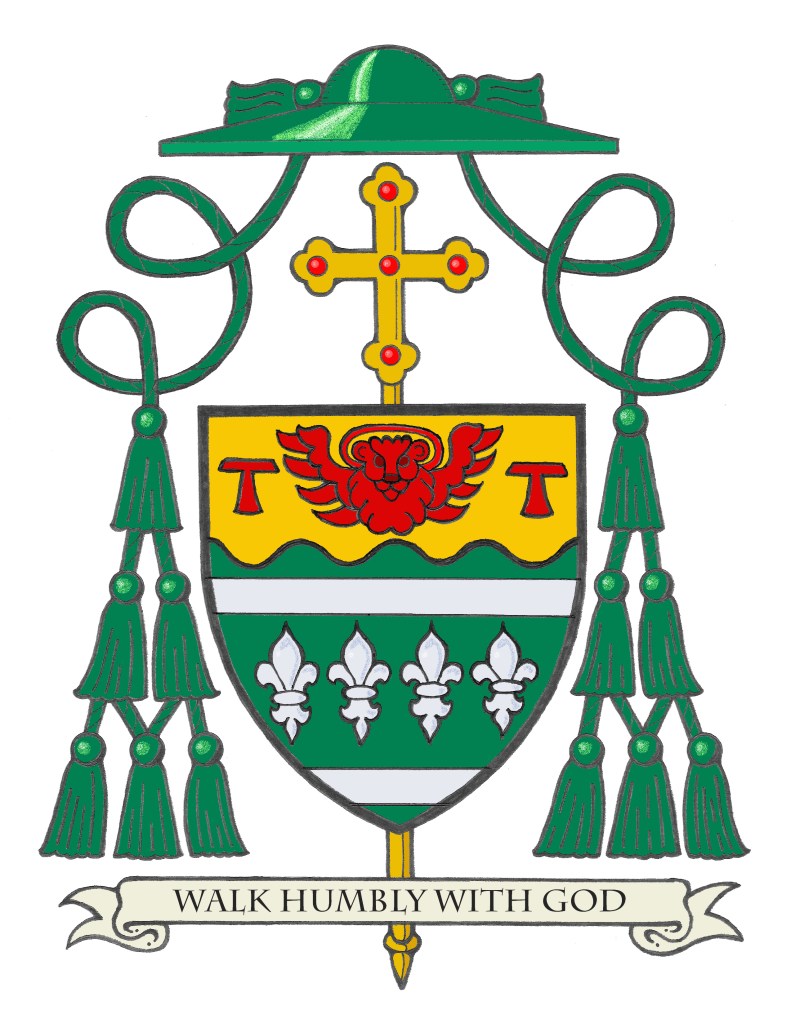
On Wednesday, February 26 the Most Rev. Lawrence John Sullivan (59), a priest of the Archdiocese of Chicago for the last 33 years, will be ordained as the Titular Bishop of Lamphua and Auxiliary Bishop of the Archdiocese of Chicago. Bishop-Elect Sullivan is one of five new auxiliary bishops appointed for the archdiocese by Pope Francis.

The blazon of the arms is: Vert, between two bars in chief and in base, four fleurs-de-lis fess wise all Argent; on a chief wavy Or between two Tau crosses the winged head of the lion of St. Mark all Gules.Shield ensigned with an episcopal cross Or behind the shield and a bishop’s galero Vert cords and twelve tassels disposed in three rows of one, two and three all Vert. On a scroll below the shield the motto: ”Walk Humbly With God”.

The armorial bearings of Bishop Sullivan symbolize his birthplace, his personal devotions and the place in which he has spent his life and ministry as a priest.

The basic design of the field echoes the design on the flag of Chicago, his native place. The background color has been changed to green as a nod to the Irish heritage of the Bishop. The two blue bars and four red stars on the Chicago flag have been differenced here and changed to two silver (white) bars and four silver (white) fleurs-de-lis. These fleurs-de-lis represent multiple things. One fleur-de-lis is taken from the coat of arms of Joseph Cardinal Bernardin who ordained the Bishop a priest; the second is taken from the coat of arms of Blaise Cardinal Cupich who will be the principal consecrator ordaining him to the episcopacy; the third is from the coat of arms of Mundelein Seminary where he received his priestly formation; the fourth is not from a coat of arms but is a heraldic symbol of St. Joseph, the patron saint of his College Seminary. It goes without saying that the fleurs-de-lis also figure prominently in the coat of arms of the archdiocese of Chicago. So, the design combines symbols from the city and the archdiocese where Bishop Sullivan was born, grew up and has served as a priest and will now serve as a bishop. Lastly, the fleur-de-lis is, itself, a heraldic symbol of Our Lady.

The upper third of the shield, called a “chief” is separated from the rest of the field by a wavy line alluding to both Lake Michigan and the Chicago River. On this gold (yellow) chief are two red crosses in the famous Tau shape. These represent the Bishop’s devotion to St. Francis of Assisi. This shape of cross is associated with the saint because he himself used it. Whenever writing anything, St. Francis placed a Tau cross at the top of the page.

Between these two crosses is the haloed head and wings of the Lion of St. Mark also depicted in red. This magnificent creature is symbolic of St. Mark as referenced in the prophecy of Ezekiel 1-2 and also in the Book of Revelation. St. Mark is the Bishop’s favorite evangelist and he likes and is drawn to the very human side of Christ depicted so well in Mark’s gospel. In addition, in his own personal spirituality Bishop Sullivan feels we are called to see Christ present in the world and that we see this in others and we, too, are called to be that presence of Christ for others, revealing the face of God–the very human God in Christ– to them. The combination of the colors green, gold and red are also used on the national flag of Lithuania and so they are a recognition of the Bishop’s Lithuanian ancestry as well. 

The motto below the shield is “Walk Humbly With God

The shield is also ensigned with those external ornaments that indicate the bearer is a bishop. The gold (yellow) episcopal cross, not to be confused with a processional cross, is placed vertically behind and extending above and below the shield. In former times archbishops, and later all bishops, had a cross mounted on a staff carried immediately in front of them while in procession or on solemn occasions. This cross was a symbol of their rank as bishop. While such an episcopal cross is no longer used practically it has been retained heraldically. In fact, there are other clerics who make use of the ecclesiastical hat with its many tassels but the one true heraldic emblem of a bishop, and the only essential one, is the episcopal cross placed behind the shield.

Above the shield is the ecclesiastical hat, called a galero which, in heraldry, replaces the martial helmet, mantling and crest. “The hat with six pendant tassels (green, purple or black) on each side is universally considered in heraldry as the sign of prelacy. It, therefore, pertains to all who are actually prelates.” (Heim, Bruno B., Heraldry in the Catholic Church 1978, page 114) The galero is green with green cords pendant from it and twelve green tassels arranged in a pyramid shape on either side of the shield. At one time in history bishops and archbishops wore green before adopting the more Roman purple we see today. In heraldry the green hat and tassels was retained for prelates with the rank of bishop according to the Instruction of the Secretariat of State, “Ut Sive” of March, 1969.

It was my pleasure and my privilege to assist Bishop-Elect Sullivan with the creation of his coat of arms. I was responsible for the design and also provided the artwork.

Native Cheesehead Goes Back to Wisconsin

On January 14, 2025 the Most Rev. Jeffrey Grob (63), a priest and, since 2020 an Auxiliary Bishop of Chicago, will return to his native Wisconsin and be installed as the 12th Archbishop of Milwaukee, Wisconsin. The armorial bearings he assumed in 2020 were slightly modified and impaled with those of Milwaukee and are:

The blazon is: Arms impaled. In the dexter: Gyronny of eight Gules and Argent, at the counterpoint a hurt charged with an eagle displayed abaissé Argent. In the sinister: Azure in base an antique plow Or; in chief between two fleur-de-lis a crescent all Argent. The shield is ensigned with an archiepiscopal cross Or and an archbishop’s galero with cords and twenty tassels flanking the shield disposed in four rows of one, two, three and four all Vert. On a scroll below the shield is the motto, “Jesus The Vine”.

The armorial bearings of Archbishop Grob impale the coat of arms of his archiepiscopal See with his personal coat of arms. The coat of arms is composed of a shield with its charges (symbols), a motto and the external ornamentation. The shield is described (blazoned) in terms that are archaic to our modern language, and this description is presented as if given by the bearer with the shield being worn on the arm. Thus, where it applies, the terms dexter (right)  and sinister (left) are reversed as the device is viewed from the front.

It is customary in heraldry that the arms of a Diocesan Bishop, or Ordinary, are joined side by side on the same shield with the arms of his See. In this case, these are the arms of the Archdiocese of Milwaukee. Such marshaling is called impalement and employs the same method used when joining the coats of arms of two people who are married. In this way, the coat of arms, like the episcopal ring, is symbolic of the archbishop being “married” to his archdiocese.

The arms of the Archdiocese of Milwaukee are composed of a field composed of eight sections in alternating colors of red and silver (white). The colors are taken from the flag of Switzerland, the birthplace of Milwaukee’s first Archbishop, John Henni. The four red sections meet at the center in a symbolic reference to the meeting of waters, the Milwaukee and Menomonee rivers and Lake Michigan in Milwaukee. Over the center point is a blue roundel called a “hurt” in heraldry. This, in turn, is charged with a silver (white) eagle with its wings spread out. This is a symbol of St. John, the titular patron of the cathedral church.

The personal coat of arms of Archbishop Grob symbolize his origins, his personal devotion and the place in which he has spent his ministry as a priest and auxiliary bishop. The field is blue and the main charge is a large gold (yellow) antique plow. This not only alludes to the ministry of spreading the Gospel as symbolized by plowing a field to prepare for seed to be sown but is an allusion to the bishop’s early life growing up on a Wisconsin dairy farm.

Above the plow are a silver (white) crescent, a symbol of Our Lady under her title of the Immaculate Conception who is the patroness of the USA. The two silver (white) fleur-de-lis represent several things. First, they are a symbol of St. Joseph to whom the bishop has a special devotion as a kind of patron saint because he was born on the Solemnity of St. Joseph (March 19). The fleur-de-lis is a stylized version of the lily and St. Joseph is often depicted holding a staff from which lilies are blossoming. Second, they allude to St. John XXIII who used them in his own coat of arms. The bishop has a devotion to this great 20th Century saint. Finally, there are two fleur-de-lis in the coat of arms of the Archdiocese of Chicago where the bishop had served as a priest and bishop.

The external ornaments include a gold archiepiscopal cross with two horizontal bars (sometimes referred to as a patriarchal cross) placed vertically behind the shield decorated with red jewels. This is often mistaken for a processional cross like the one used in liturgical processions. However, like other heraldic ornaments the archiepiscopal cross has its origins in something which is no longer actually used. At one time all bishops had, in addition to the processional cross at the head of the procession, another cross carried directly in front of them by a cleric. This other cross was a sign of the office of bishop. It originated as a custom that such a cross was carried before archbishops only. Later, the cross was adopted for use by all bishops so archbishop’s added a second horizontal bar to their crosses to distinguish them from the episcopal cross of simple bishops. While no longer actually used it has remained a symbol of the archiepiscopal office in heraldry.

Similarly, the broad-brimmed green galero was, at one time, worn by bishops in outdoor processions and cavalcades. No longer used it remains a heraldic symbol of the office of bishop and takes the place of the helmet, mantling and crest that would appear in the coat of arms of a layman. In Catholic heraldry the color and number of tassels on the galero indicates the rank of the bearer. The double barred archiepiscopal cross and the green galero with twenty tassels signifies the coat of arms of an archbishop according to the Instruction of the Holy See, “Ut Sive” issued in 1969.

The motto chosen by Archbishop Grob appears on a scroll below the shield, “Jesus The Vine”.

It was my privilege and my pleasure to design the archbishop’s original coat of arms in 2020 as well as to modify them (the original plow-blade alone was replaced with an entire antique plow) and marshal them to the arms of his See.

Cardinal McElroy Translated to Washington, DC

Today, the Holy Father announced to transfer of Robert Cardinal McElroy (70), the Bishop of San Diego, to succeed Wilton Cardinal Gregory (77) as Metropolitan Archbishop of Washington, DC.

I did not design the Cardinal’s coat of arms but I did prepare the current emblazoning on his elevation to the College of Cardinals.

In addition to a new impalement and the addition of an archiepiscopal cross it will be interesting to see if the Cardinal modifies his personal arms at all. The two charges in chief represent two California historic Mission Churches in San Francisco (where he served as a priest) and in San Diego (where he has been serving as diocesan bishop).

Of course I’m no fan of bishops modifying their arms when they move but I could see how he might wish to eliminate these two very Californian references. On the other hand, they both also serve to honor the places of his origin and previous ministry. So, retaining them could also be a good thing. Time will tell.

Below is how his coat of arms may appear after he is installed in Washington:

Cardinal Bychok

His Eminence, Mykola Bychok, CSsR (44) is a Ukrainian Catholic who serves as Eparch of Ss. Peter & Paul of Melbourne since 2020. On December 7 he will become the Church’s youngest cardinal.

The arms he assumed upon becoming a bishop were designed by others for him and he was not entirely satisfied with them. With his upcoming creation as a cardinal he saw this as an opportunity to tweak the design of his coat of arms.

The redesigned coat of arms does not depart that much from what he originally had but cleans it up a bit and adds the external ornament unique to Cardinals.

The blazon is: Tierced in pall; in chief, Gules a rose Argent, barbed and seeded Or between three bezants; in dexter base Azure a trident (tryzub) topped with a Greek cross, all Or; in sinister base Or a Latin cross on a perch of a staff topped by a sponge in bend and a spear in sinister bend all Azure. The shield is ensigned with the galero of a cardinal of the holy Roman Church with cords and 30 tassels disposed in five rows of one, two, three, four and five all Gules; the whole within a mantle Gules lined ermine surmounted by the Eastern mitra Gules; in saltire behind the mantle a crozier and a cross both Or.

The charges in chief symbolize the place he is from; the trident (differenced by the addition of a cross) is a symbol of Ukraine; the cross, sponge and spear are borrowed from the arms of the Redemptorist Order of which he is a member.

I was very happy to consult on this redesign and work to put it together with Mr. Richard d’Apice of the Australian Heraldry Society. As with all our collaborations the artwork has been deftly provided by Mr. Sandy Turnbull, also of the Australian Heraldry Society.

Bishop Dennis Spies

On November 6, 2024 the Most Rev. Dennis Spies, (56) a priest of the Diocese of Joliet in Illinois will be ordained as the Titular Bishop of Cenculiana and Auxiliary Bishop of Joliet. The Bishop-Elect’s appointment by the Pope was announced only on September 27 and he will very quickly be ordained to the office of bishop, well before Advent and the holiday season is upon us.

The armorial bearings he will be assuming are as follows:

The blazon of his coat of arms is: “Per saltire Or and Azure; overall two spears in saltire points upward tipped with fleurs-de-lis Counterchanged between, in chief and in base a heart facing the centerpoint Gules; and to dexter and sinister a garb of wheat, Or. Shield ensigned with an episcopal cross Or behind the shield and a bishop’s galero Vert cords and twelve tassels disposed in three rows of one, two and three all Vert. On a scroll below the shield the motto: “I Call You Friends”.

The main colors of the shield, blue & gold, are the colors primarily used in the coat of arms of the Diocese of Joliet. So, by means of their use the diocese the bishop has served as a priest (and now as a bishop) is alluded to. The shield is divided in a saltire (an “X” shape) and the two main charges are two spears crossed in saltire. The surname Spies is German in origin and in German and Dutch it is a metonymic occupational name for a spear maker. It is derived from Middle High German “spiez”, meaning ‘spear pike’ or an occupational name from the same word in the sense of a ‘soldier armed with a spear’. So, the two spears allude to the family name. They appear slightly different from the typical spear in that their heads, rather than depicting the usual blade, have heads that are shaped like the fleur-de-lis. This, too, is taken from the coat of arms of the Diocese of Joliet where two fleurs-de-lis appear. This is an ancient heraldic symbol of both the Blessed Virgin Mary and the Most Holy Trinity. Counterchanging (where the color of an object and the background are alternated) serves as a symbol of conversion…the daily conversion to which we are all called as followers of Christ.

Above and below are two red hearts symbolizing the Sacred Heart of Jesus and the Immaculate Heart of Mary. The hearts are depicted with their points toward the center of the shield. The two hearts–in a sense–“facing each other” symbolize the love that God has for all His creation and the love that His children return to Him by their faith and devotion. Love is both given and received. The disposition of the hearts indicates this.

A heart shape, although with different symbolism, also appears in the coat of arms of Bishop Hicks, the Diocesan Bishop whose ministry Bishop Spies will assist and support. It is an old custom in heraldry to borrow a charge from the coat of arms of a superior or patron as a way of honoring them. So, the heart shape being repeated in the coat of arms of Bishop Spies honors this custom.

To the left and right are two gold (yellow) garbs of wheat. The garbs of wheat are symbolic of agriculture generally and the Bishop grew up on a farm. In addition, they are also symbolic of the Eucharist, the center of our lives as Christians. So, they are a fitting symbol of both his background and his faith.

The motto below the shield is, “I Call You Friends” from John 15:15 where Jesus says, “I no longer call you slaves, because a slave does not know what his master is doing. I call you friends, because I have told you everything I have heard from my Father.”

The shield is also ensigned with those external ornaments that indicate the bearer is a bishop. The gold (yellow) cross is placed vertically behind and extending above and below the shield. This is often mistakenly thought to be a processional cross like those used in liturgical processions. That is not entirely right. In former times archbishops, and later all bishops, had a second cross mounted on a staff carried immediately in front of them while in procession or on solemn occasions. This cross was a symbol of their rank as bishop. While such an episcopal cross is no longer used practically it has been retained heraldically. In fact, there are other clerics who make use of the ecclesiastical hat with its many tassels but the one true heraldic emblem of a bishop, and the only essential one, is the episcopal cross placed behind the shield.

Above the shield is the ecclesiastical hat, called a galero which, in heraldry, replaces the martial helmet, mantling and crest. “The hat with six pendant tassels (green, purple or black) on each side is universally considered in heraldry as the sign of prelacy. It, therefore, pertains to all who are actually prelates.” (Heim, Bruno B., Heraldry in the Catholic Church 1978, page 114). The galero is green with green cords pendant from it and twelve green tassels arranged in a pyramid shape on either side of the shield. At one time in history bishops and archbishops wore green before adopting the more Roman purple we see today. In heraldry the green hat and tassels was retained for prelates with the rank of bishop according to the Instruction of the Secretariat of State, “Ut Sive” of March, 1969.

It was my great privilege and pleasure to work with Bishop Spies on the design and execution of his armorial bearings and also preparing the blazon and explanation.

Archbishop Henning of Boston

It has been very gratifying as a heraldist to have one project that I have been able to stay with through all its permutations. On October 31, the Most Rev. Richard G. Henning (60) who has served for the last 17 months as Bishop of Providence, R.I. and who was also Coadjutor of Providence for a further four months before that, and who was previously Auxiliary Bishop of Rockville Centre, N.Y., his native diocese where he became a priest in 1992, will be installed as the 10th Bishop and 7th Metropolitan Archbishop of the See of Boston, Massachusetts.

Back in 2018, the then Bishop-elect Henning contacted me to design a coat of arms for him. That’s not an unusual thing for me (I have designed coats of arms for three other bishops from Rockville Centre) but this one was more personal. I’m also a Long Island native and Archbishop Henning and I attended the same high school, Chaminade in Mineola, and we graduated together in the class of 1982. While not close friends, we have been acquainted with one another since we were teenagers. I was very happy to design his coat of arms for him. He entered the task with great enthusiasm and I think the coat of arms that we ended up with was simple, bold and very clear, all marks of good heraldry. On a personal not: at his episcopal ordination which I attended, the new Bishop, in his post-Communion remarks, thanked me publicly for assisting him in preparing his coat of arms. As I told him afterwards, that was very gratifying because in 39 years of doing this kind of work no bishop had ever done that before. I think it speaks volumes about what kind of person he is.

In late 2022 after he received the news of his appointment as Coadjutor of Providence I actually reached out to him to let him know that, as a Coadjutor, his coat of arms wouldn’t need any changes but that at some point in the future when he succeeded to the See, he’d have to modify his arms by marshaling them to the arms of the Diocese of Providence. He then asked me to begin on that right away because it was not certain when his succession would occur and he wanted to be prepared for that eventuality. I also thought that was “done and dusted” as they say and he was now set for the rest of his life.

However, in August of this year I was surprised and delighted to hear that the Holy Father had appointed him Archbishop of Boston. For the third time he contacted me. He said that several people in Boston assisting him with the needs of his transition had proposed people to prepare his coat of arms. But, he politely declined all those and said that he already had someone in mind. Again, I was really very pleased and honored at that. I see my designs as sort of my intellectual property. True, the coat of arms, once designed, is given over to the armiger to whom it truly belongs, but I feel like I still have a stake in it. So, I was very glad that I’d be able to assist Archbishop Henning yet again.

He retains the arms he first assumed in 2018. For this version, the escallop shell has been redrawn to a slightly more round shape and the bordure wavy has been slightly reduced in order to make more room for the shell which now occupies a much smaller field on one half of the shield. This is impaled with the arms of the See of Boston, designed by the great Dom Wilfrid Bayne, OSB of Portsmouth Abbey, R.I. in 1944. Because of the preponderance of blue in both coats of arms, the division line between the two is rendered in dark blue. It was decided that a black line looked a bit too jarring and the solution used for the same problem with the arms of the See of Providence which also has a blue field—a light, “bleu celeste” line—was seen as undesirable this time around. The blazon and explanation of the arms is as follows:

BLAZON: Arms impaled. In the dexter: Azure, a Latin cross fleurettée Or, in base barry wavy of five Azure and Argent, issuing therefrom a mound of three coupeaux Or; In the sinister: Azure, within a bordure wavy parted wavy Argent and Gules an escallop shell Argent. The shield is ensigned with an archiepiscopal cross Or and an archbishop’s galero with cords and twenty tassels flanking the shield disposed in four rows of one, two, three and four all Vert. On a scroll below the shield is the motto, “Put Out Into The Deep”.

EXPLANATION: The armorial bearings of Archbishop Richard Henning impale the coat of arms of his archiepiscopal See with his personal coat of arms. These evoke his birthplace, his ministry and his personal devotion. The coat of arms is composed of a shield with its charges (symbols), a motto and the external ornamentation. The shield is described (blazoned) in terms that are archaic to our modern language, and this description is presented as if given by the bearer with the shield being worn on the arm. Thus, where it applies, the terms dexter (right)  and sinister (left) are reversed as the device is viewed from the front.

It is customary in heraldry that the arms of a Diocesan Bishop, or Ordinary, are joined side by side on the same shield with the arms of his See. In this case, these are the arms of the Archdiocese of Boston. Such marshaling is called impalement and employs the same method used when joining the coats of arms of two people who are married. In this way, the coat of arms, like the episcopal ring, is symbolic of the archbishop being “married” to his archdiocese.

The arms of the Archdiocese of Boston are composed of a blue field on which are placed a gold (yellow) cross fleurettée, that is a Latin cross the arms of which are decorated on the ends with fleurs-de-lis. This is in honor of the titular of the cathedral, the Holy Cross as well as the  first Bishop of Boston being from France. The cross is above a gold (yellow) mound composed of three smaller hills as a reference to Boston’s original name: Trimountaine which is, itself, a reference to the three hills on which the city is said to have been built. At the bottom the five wavy lines of blue and silver (white) alludes to Boston being a port city and that it is populated by people who arrived here from across the sea.

Bishop Henning’s personal coat of arms is composed of a design depicted in red (Gules), white (Argent) and blue (Azure) which are the national colors of the United States.

Both the blue background and the single escallop shell allude to the sea as evoking the Bishop’s own background and the shell is also borrowed from the coat of arms of the See of Rockville Centre, the diocese in which he was born and raised and which he served as a priest and auxiliary bishop. In addition, this same field of blue also recalls the blue field of the coat of arms of the See of Providence where he served as Coadjutor Bishop and later Diocesan Bishop. The shell image also recalls the Bishop’s heritage in the Diocese of Brooklyn, dedicated to its patron, St. James. The episcopal ordination of Bishop Henning took place on the eve of the Feast of St. James. In concert with the Bishop’s motto, the shell is a traditional symbol of baptism and pilgrimage. It is in the depths of these waters that Christians find their salvation in Jesus Christ.

The white wavy line surrounding the blue field is also taken from the arms of Rockville Centre and it alludes to the diocese’s location on Long Island, NY. Furthermore, it indicates the sea as the place where the barque of St. Peter, an image used to evoke the Church, is located.

The blue background also evokes the Bishop’s devotion to the Blessed Virgin Mary and his years of service as a Professor and Rector at the Seminary of the Immaculate Conception in Huntington, NY. The red wavy portion of the border evokes the Bishop’s devotion to the Most Sacred Heart of Jesus and his former service as the Director of the Sacred Heart Institute for the Ongoing Formation of the Catholic Clergy.”

It was, indeed, my profound pleasure , and my honor, once again to assist my old classmate, Archbishop Henning, with the preparation of his coat of arms.

Bishop Forbes of Roseau

On July 25, the Feast of St. James the Apostle, the Most Rev. Kendrick J. Forbes (48), a priest of the Archdiocese of Nassau, Bahamas was ordained a bishop and installed as the tenth Bishop of Roseau, Dominica in the Antilles (West Indies).

Upon his ordination to the episcopacy he has assumed the following coat of arms:

The personal coat of arms assumed by Bishop Forbes combines symbols that are meaningful to him reflecting his, origins, his spiritual life and priestly ministry. At present, the Bishop has elected to assume a personal coat of arms only. In the Catholic Church it is often customary for a diocesan bishop to combine his personal coat of arms side by side on the same shield with the coat of arms of his diocese in a form of marshaling called “impaling”. It represents his marriage to the diocese and his jurisdiction over it. However, this custom is far from a universal one and, at present, the Diocese of Roseau does not employ a unique coat of arms as a diocesan corporate symbol. 

The main part of the shield shows a light blue field on which there is a silver (white) anchor. On either side of the anchor are two eight-pointed stars. For centuries, the anchor has been a symbol of hope used in art, in the liturgy and in heraldry. The eight-pointed star is borrowed from the coat of arms of Pope Francis who named Bishop Forbes to the episcopate. There are two for balance and symmetry. The upper third of the shield is called a “chief” in heraldry and it depicts the black and gold (yellow) checkered pattern borrowed from the coat of arms of the Archdiocese of Nassau where Bishop Forbes was ordained and served as a priest before becoming a bishop.

The motto below the shield is,“Mane Nobiscum Domine” taken from Luke 24:29 meaning “Stay with us Lord.” 

It was both my privilege and my pleasure to design and to emblazon the bishop’s coat of arms for him.