Category Archives: Bishops

Bishop Kevin Sweeney of Paterson, NJ

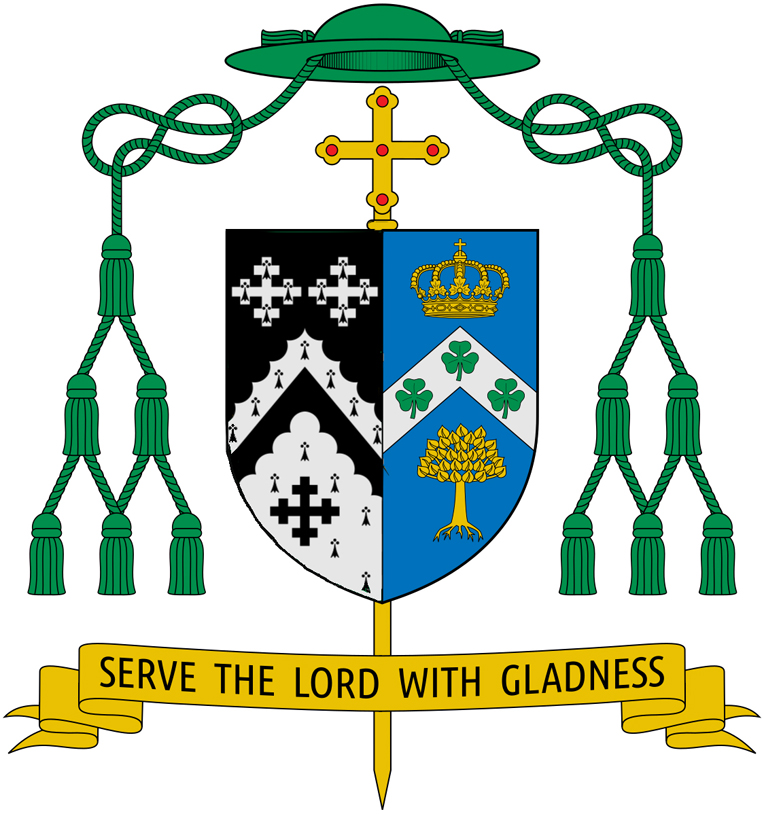
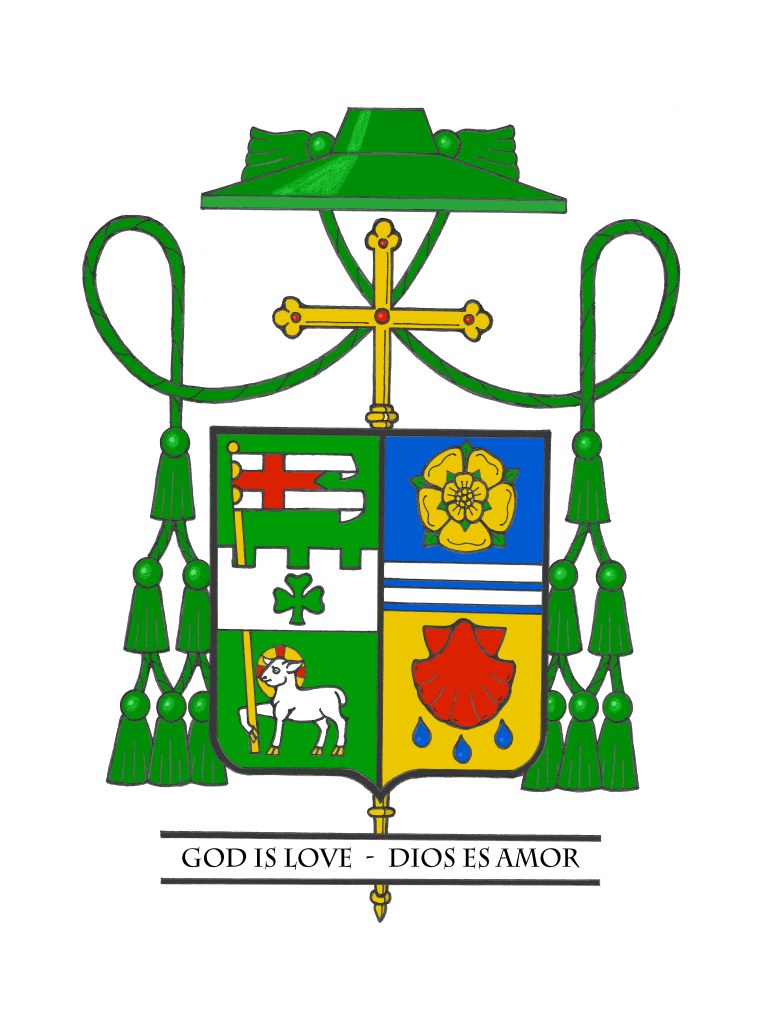
On July 1, 2020 the Most Rev. Kevin Sweeney (50) a priest of the Diocese of Brooklyn since 1997 will be ordained a bishop and installed as the 8th Bishop of Paterson, New Jersey. The coat of arms he is assuming is the following:

On the left from the viewer’s perspective, is the coat of arms of the Diocese of Paterson. The main charge, the Paschal Lamb holding the banner of victory, is the symbol for St. John the Baptist, the titular of the Cathedral. It was John who said: “Behold the lamb of God, who takes away the sin of the world” (John 1:12).

The trefoil, more commonly called a shamrock is a symbol of St. Patrick. The silver (white) division line with a crenelated upper edge represents the Lord’s protection of the city (and diocese).

On the right from the viewer’s perspective is the coat of arms assumed by Bishop Sweeney upon being named a bishop. It is joined (impaled) on the same shield with those of the diocese to indicate that Bishop Sweeney possesses jurisdiction over the diocese and that he is symbolically “married” to it. This manner of combining two coats of arms on the same shield is the method of marshaling that has been used for centuries by two armigerous people who get married.

The two main colors of the coat of arms are blue and gold (yellow) borrowing from the coat of arms of St. John Paul II whose life and pontificate greatly influenced the vocation and ministry of Bishop Sweeney. The main charge on the lower gold (yellow) field is a red escallop shell. This is a symbol of St. James, the titular of the Cathedral-Basilica in Brooklyn, and is borrowed from the coat of arms of the Diocese of Brooklyn where Bishop Sweeney was born and raised, educated and ordained a priest prior to becoming a bishop. There are three blue drops of water falling below the shell which make the shell also a symbol of St. John the Baptist, the titular of the cathedral in Paterson. In addition, this charge emphasizes the importance of Baptism as our incorporation into the Body of Christ and the call to holiness that is received by all followers of Jesus.

The upper part of the shield, is colored blue and contains two silver (white) horizontal lines as well as a golden rose. The white lines against the blue background allude to the distinctive blue and white habit worn by St. Teresa of Calcutta, the foundress of the Missionaries of Charity. This saintly woman also had a profound influence on Bishop Sweeney and he wished to commemorate her as a saint to whom he looks for inspiration in his priestly, and episcopal ministry. The golden rose is a symbol of Our Lady. The gold (yellow) rose alludes to Our Lady of Knock in particular and by this the bishop honors his Irish heritage. However, the rose also has a double symbolism in that it is an allusion to Our Lady of Guadalupe, patroness of the Americas. In connection with the appearance of Our Lady to Juan Diego a miraculous blooming of roses in December occurred so this flower, regardless of its color, is associated with Our Lady of Guadalupe.

The motto below the shield, in English and in Spanish, is, “God Is Love – Dios Es Amor”. 

The shield is also ensigned with the gold (yellow) cross placed vertically behind and extending above and below the shield. This is often mistakenly thought to be a processional cross like those used in liturgical processions. In former times archbishops, and later all bishops, had a cross mounted on a staff carried immediately in front of them on all solemn occasions. This cross was a symbol of their rank as bishop. While such an episcopal cross is no longer used practically it has been retained heraldically. In fact, there are other clerics who make use of the ecclesiastical hat with its many tassels but the one true heraldic emblem of a bishop, and the only essential one, is the episcopal cross placed behind the shield.

Above the shield is the ecclesiastical hat, called a galero which, in heraldry, replaces the martial helmet, mantling and crest. The galero is green with green cords pendant from it and twelve green tassels arranged in a pyramid shape on either side of the shield. At one time in history bishops and archbishops wore green before adopting the more Roman purple we see today. In heraldry the green hat and tassels was retained for prelates with the rank of bishop according to the Instruction of the Secretariat of State, “Ut Sive” of March, 1969.

I was pleased and privileged to design the bishop’s personal coat of arms and to marshal them to the arms of his diocese and execute the artwork. Bishop Sweeney and I first became acquainted 28 years ago when we were in the seminary. Ad Multos Annos!

Bishop Romero, Auxiliary of Rockville Centre, NY

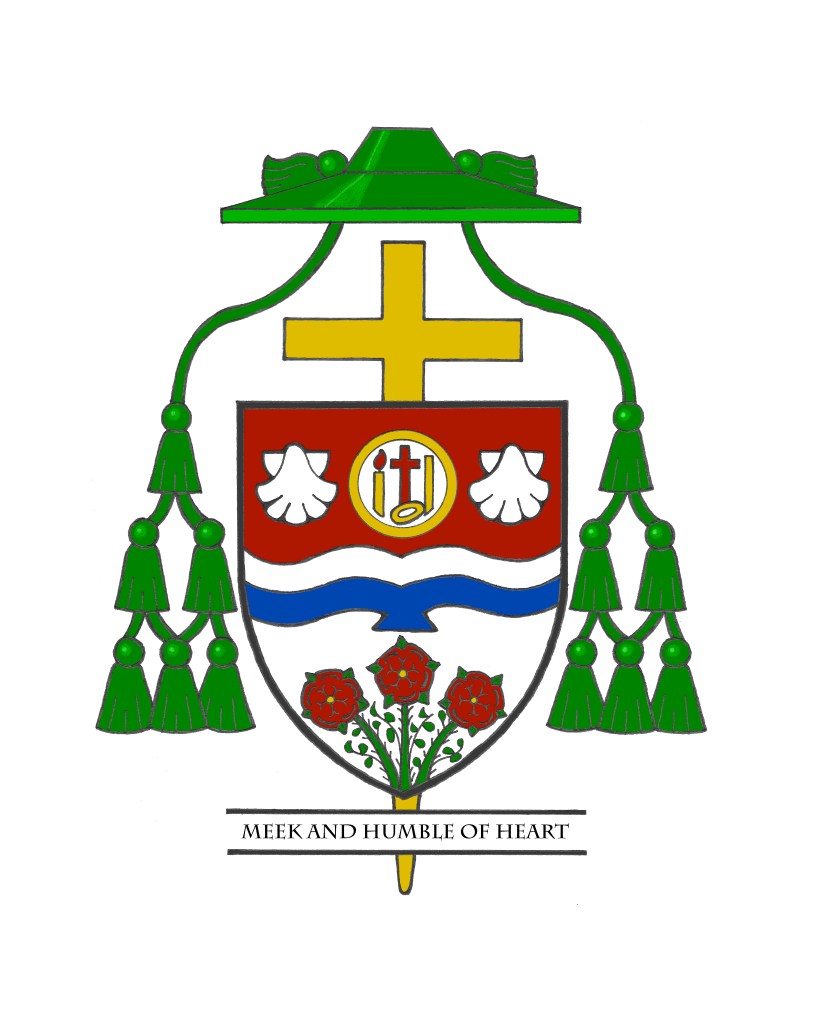
On June 29, the Solemnity of Ss. Peter & Paul, the Most Rev. Luis Miguel Romero Fernández, M.Id. (66) a native of Palencia, Spain and a member of the Idente Missionaries currently serving as a pastor in the Diocese of Rockville Centre which covers two thirds of New York’s Long Island, will be ordained the Titular Bishop of Egara and Auxiliary Bishop of Rockville Centre. The coat of arms I assisted him in designing which he will assume as a bishop are as follows:

The coat of arms assumed by Bishop Romero reflects his Religious Community, the diocese in which he serves, his previous ministry and his heritage. The colors used in this coat of arms are primarily red, white and blue, the national colors of the United States because the bishop wishes to honor the country in which he now lives and serves as both a priest and bishop. The main charge, or feature, across the middle of the shield is a bar specifically shaped to suggest an open book with the blue lower portion representing the binding and spine of the book and the white upper portion suggesting the pages. This is used to symbolize the many years the bishop spent working in a university setting as a teacher and administrator.

The lower portion of the shield depicts three red roses on their green stems. This is an allusion to the miracle of the roses in December that accompanied the apparition of Our Lady of Guadalupe to Juan Diego. As such they serve as a symbol of Our Lady, especially Our Lady of Guadalupe, patroness of the Americas and a particular devotion to the Hispanic peoples. This is for all the many years the bishop has spent in priestly ministry outside his native Spain serving Spanish-speaking people in other countries, especially in the Americas.

The upper part of the shield contains the symbol of the Community to which the bishop belongs, the Idente Missionaries. He is the first member of this community to be appointed a bishop so it was of great importance for him to include the community emblem in his own coat of arms. This is flanked by two escallop shells taken from the coat of arms of the Diocese of Rockville Centre in which he has served as a priest and pastor and which he is now called to serve in a greater capacity as a bishop.

The motto below the shield is, “Meek And Humble Of Heart” (Matthew 11:29)

The bishop specifically asked that the episcopal cross behind the shield and the galero be depicted in as simple a style as possible so they are depicted without any ornamentation. This, of course, is not reflected in the blazon because the blazon does not specify the manner of the depiction of the external ornaments. Rather, this was merely the simple manner in which the bishop requested this depiction be rendered.

New Auxiliary Bishop of Newark (part I)

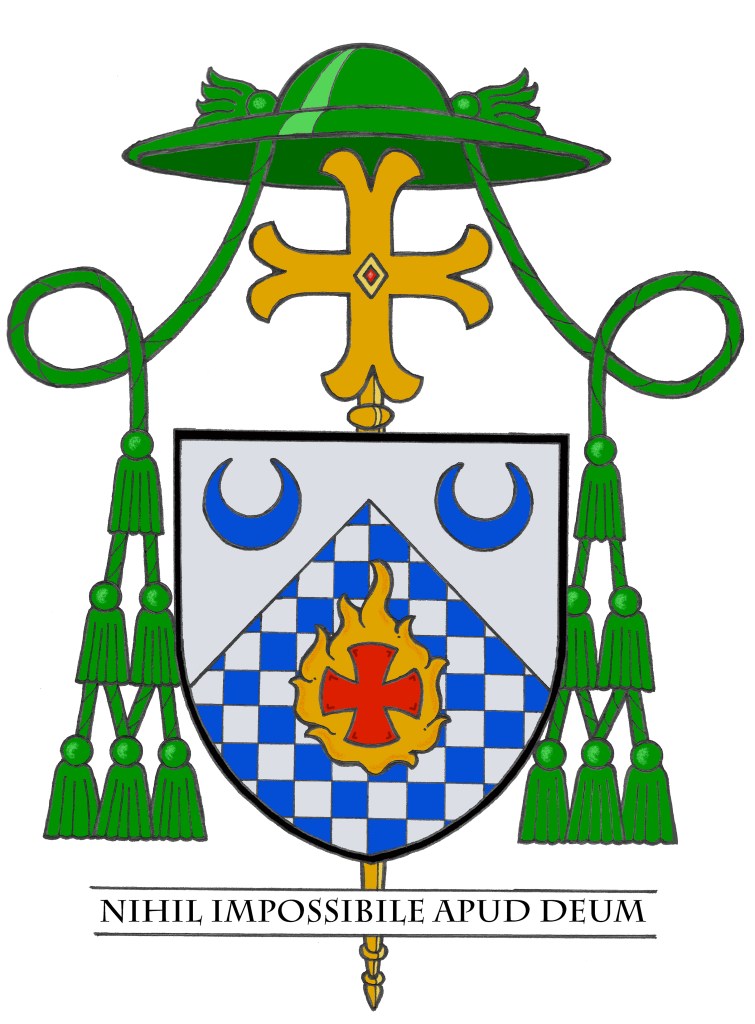
On June 30, 2020 the Most Rev. Elias Lorenzo, OSB (59) up until now the Abbot-Praeses of the American-Cassinese Congregation of Benedictine Monks and a monk of St. Mary’s Abbey in Morristown, New Jersey will be ordained as the Titular Bishop of Tabuda and Auxiliary Bishop of the archdiocese of Newark, New Jersey. The coat of arms assumed by him is the following:

Upon his election as Abbot-Praeses (i.e. President) of the American-Cassinese Congregation in 2016 I had the privilege of designing the coat of arms he would assume as an Abbot. Upon his appointment to the episcopacy Bishop Lorenzo decided, correctly in my opinion, not to change his arms in any way except to update the external ornaments from those of an Abbot to those of a Bishop. His armorial bearings reflect his family name, the community of his profession, his past ministry and his monastic patron.

The shield is divided by a line shaped like a chevron. This creates the general shape alluding to a mountain, in this case Mount Carmel, the mountain associated with the prophet Elijah from whose name the name Elias is derived. The large tongue of fire in the center of the lower portion of the shield (referred to as “in base”) combined with the mountain allude to St. Elias.

In addition, the blue and silver (white) checked pattern also has a multi-layered meaning. The American-Cassinese Congregation was founded by Benedictines from St. Michael’s Abbey in Bavaria. The motherhouse of the Congregation, St. Vincent Archabbey in Pennsylvania, makes use of the blue and silver fusils (a kind of elongated diamond pattern) from the coat of arms of Bavaria in its own coat of arms. Several other monasteries in the Congregation which are daughter houses or grand daughter houses of St. Vincent also make use of this pattern. One such abbey is St. Mary’s in Morristown, New Jersey. At this monastery Bishop Elias entered monastic life, made his profession of vows and was ordained. In his coat of arms the blue and silver (white) fusils have been turned sideways forming a grid of blue and white squares or checks. The grid pattern suggests the gridiron on which St. Lawrence was roasted alive as the means of his martyrdom. This is an allusion to the Abbot’s surname, “Lorenzo” which in Italian means “Lawrence”. The grid of blue and white squares combined with the fire represents St. Lawrence while at the same time the blue and white squares are a slightly differenced reference to the coat of arms of St. Mary’s Abbey as well as Bavaria in general as the homeland of the Congregation’s founders.

At the center of the flame there is a red rounded cross. This cross is taken from the coat of arms of Sant’Anselmo in Rome where, for seven years before his election as Abbot-President , the armiger was served as Prior of the monastic community.

Above the chevron in the upper portion of the shield (referred to as “in chief”) there are two blue crescents. The crescent has long been associated with Our Lady in particular under her title of the Immaculate Conception. That title is also the one by which Mary is the Patroness of the United States of America. In addition, crescents appear in the coat of arms of St. Mary’s Abbey and the coat of arms of the Delbarton School, the Abbey’s principal apostolate, both of with which Bishop Elias is closely associated.

The motto below the shield is taken from Luke 1:37 and is translated as, “Nothing is impossible with God”.

New Auxiliary Bishop of Newark (part II)

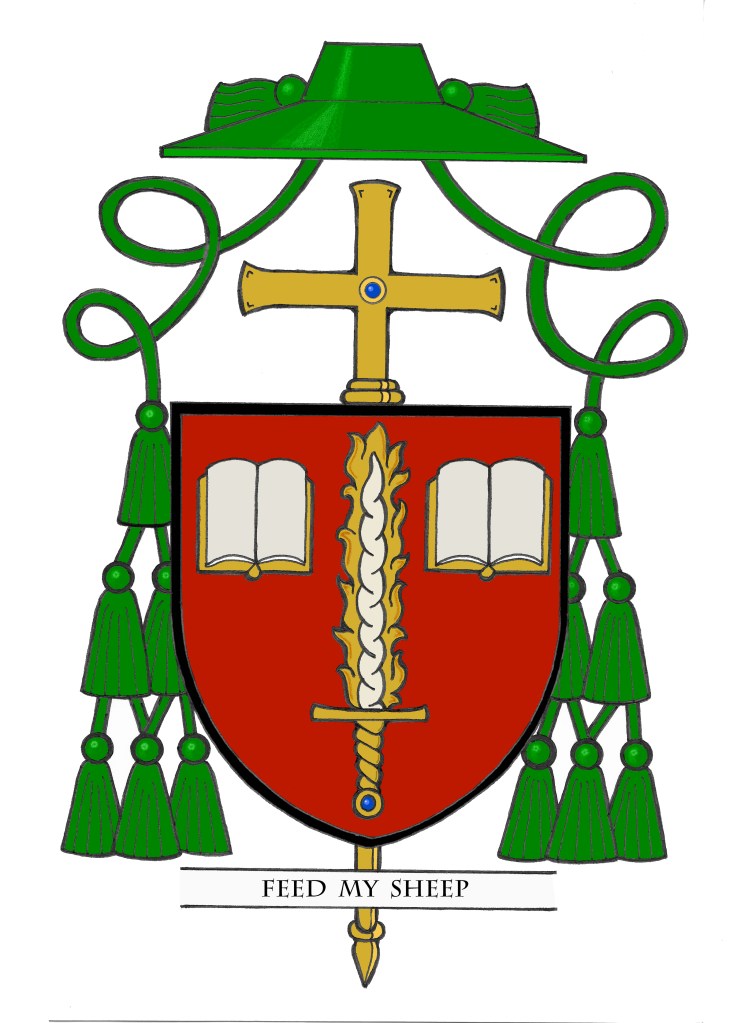
On June 30, 2020 the Most Rev. Michael Saporito (58) will be ordained as the Titular Bishop of Luperciana and Auxiliary Bishop of the archdiocese of Newark, New Jersey. The coat of arms assumed by him is the following:

Bishop Saporito worked with me to choose and assume a coat of arms reflecting his priestly life and ministry. The red background is borrowed from the coat of arms of the Archdiocese of Newark where the upper third of that shield (called a chief) is colored red. The bishop’s whole life, priesthood and, now, episcopate has been spent in the service of the Archdiocese.

The central symbol, or charge, is the flaming sword that is used as a symbol of his baptismal patron, St. Michael the Archangel. Michael, reckoned as the commander of the heavenly hosts wields the sword that symbolizes righteousness and God’s justice.

The sword, with a silver blade surrounded by golden flames and gold handle has two open books on either side. The pages of the books are blank and silver (white) while the books are bound in gold (yellow). These symbolize the Sacred Scriptures in both Testaments and are a reminder of the need for and the work of evangelization in the Church. The Bishop has devoted a part of his priestly ministry to the New Evangelization. 

The motto below the shield is “Feed My Sheep” (John 21:17)

New Auxiliary Bishop of Newark (part III)

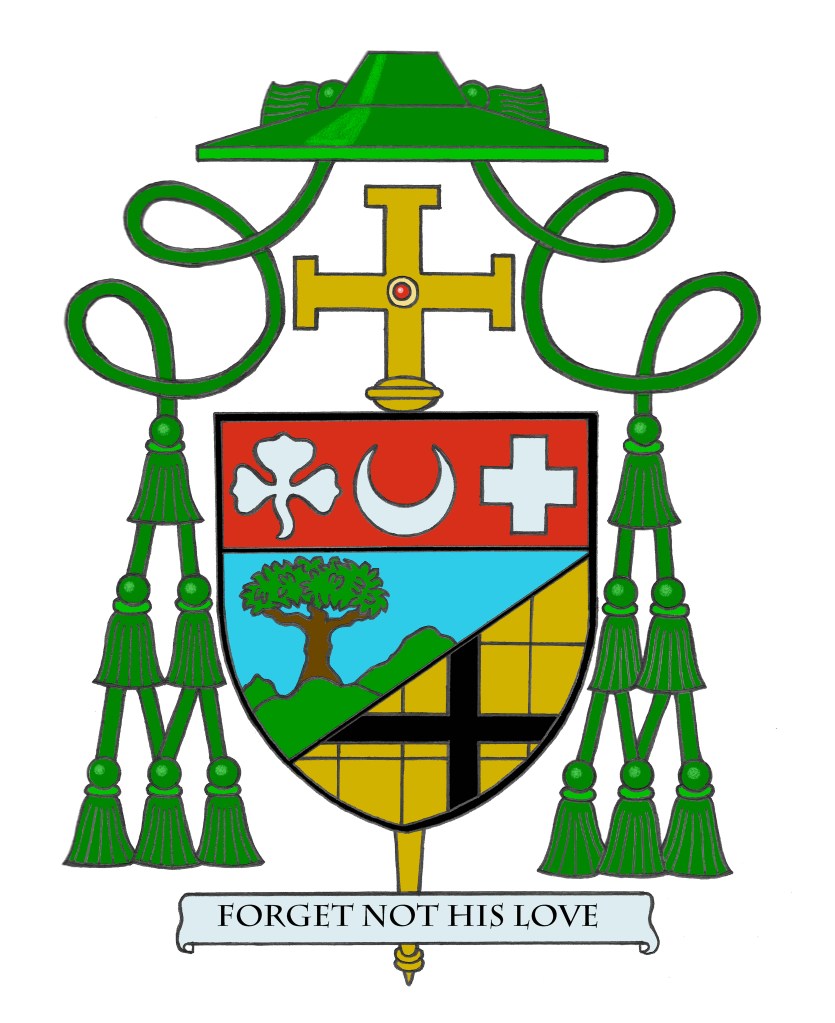
On June 30, 2020 the Most Rev. Gregory Studerus (72) will be ordained as the Titular Bishop of Tarasa in Byzacena and Auxiliary Bishop of the archdiocese of Newark, New Jersey. The coat of arms assumed by him is the following:

Shortly after his appointment Bishop Studerus contacted me and asked me to help design his coat of arms. He had some ideas based on a coat of arms in his possession reportedly belonging to his family as well as an abstract idea for representing urban ministry. The landscape was acceptable but I advised making the urban ministry symbol a bit less abstract and slightly more conventional. The chief takes off on the arms of the archdiocese with one of the trefoils being changed to a Green cross.

The main portion of the shield is divided by a diagonal line running from the viewer’s upper right to the lower left. This is called dividing the field with a bend sinister. The upper portion depicts a tree growing from a green hillside. The tree is depicted as we would find it in nature and shows three branches as an allusion to the Holy Trinity. All of this is set against a light blue sky. In heraldry blue is one of the five tinctures used. However, there is also the possibility of using what are known as “stains” in heraldry and among these are Bleu Celeste which is a decidedly lighter shade of blue than that usually used in heraldry and is frequently used to depict the sky. This symbol is borrowed from a coat of arms that was adopted by the bishop’s family. This section of the shield symbolizes Bishop Studerus’ love and concern for the environment.

The lower portion shows a black cross on a gold (yellow) background with the four quadrants of the cross being intersected with thin black lines spaced unevenly suggesting a map of city streets. This section of the shield symbolizes Bishop Studerus’ forty years of priestly ministry served in the city.

The upper third of the shield, called a “chief” takes it red color by borrowing from the coat of arms of the See of Newark which has a similar red chief with a crescent flanked by two trefoils. Here we see three symbols alluding to the cultural influences in the bishop’s life. The trefoil resembles the shamrock which is a symbol of St. Patrick and of Ireland. It is used here to allude to the Irish heritage of the bishop’s mother. The crescent in the center is symbolic of the Immaculate Conception of Mary which is the titular patron of the United States of America. The cross with four equally long bars, known as a “Greek cross”, does not in this instance symbolize anything Greek. Rather, it is the same cross found in the coat of arms and on the flag of Switzerland and it alludes to the Swiss heritage of the bishop’s father. All three are colored silver (white).

The motto below the shield is, “Forget Not His Love” (Psalm 103)

Three New Ones That Don’t Quite Hit the Mark

Recently, there have been several new bishops ordained and/or installed in the U.S. and in each case their new coats of arms are very disappointing. One of the most valuable sections of the famous book on ecclesiastical heraldry by the late (great) Bruno B. Heim entitled, Heraldry in the Catholic Church concerns the design and adoption of new coats of arms by clergy. In that section, among other pieces of advice, Heim cautions that the new armiger should seek out the advice of someone competent in heraldry and, in particular, ecclesiastical heraldry if they can. That person to be consulted may not be the one who actually does the artwork but they can advise on what is and, more importantly, isn’t appropriate in a coat of arms.

Sadly, none of these new bishops seems to have done that.

I would also add a piece of advice which I have found myself repeating so often over the years to clergy who wish to adopt a coat of arms that it has become, perhaps, the most important piece of advice I can offer. Your coat of arms is not your CV in pictures! A coat of arms is a unique mark of identification. It isn’t a pictorial mission statement, a review of every aspect of your life, a personal history in symbols, a catalogue of all your likes and dislikes or a statement on your ideas of ecclesiology and ministry.

Too many clergy, especially new bishops, don’t seem to understand this. As a result they do too much or they include things that are inappropriate. Let’s take a look.

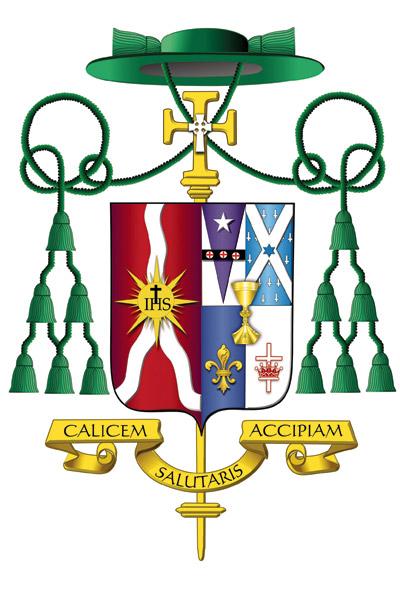
First, is the armorial bearings of Bishop Francis I. Malone (69) who was ordained and installed as the Third Bishop of Shreveport, Louisiana on January 28. The arms of the See of Shreveport are in the dexter impalement and they are not of any interest. However, the personal arms…oh boy! The chalice overall at the center is inappropriately placed and is also an almost photographic depiction of the bishop’s own personal chalice. Heraldry makes use of symbols, not portraits or photographs. An appropriate charge would be “a chalice” not a particular chalice.

The bishop has also quartered the field in such a way that he has marshaled arms that do not belong to him and appropriated them as his own. In the upper left and right of his arms he has, whole and entire, depicted the arms of the See of Philadelphia and the arms of the See of Little Rock; one because he was born there and the other because he served there as a priest. However, by including them entirely in his own arms it appears he is claiming jurisdiction over both! The better way to handle this would have been to borrow a single charge from each and incorporate them into the design of his own coat of arms rather than illicitly stealing the arms of two dioceses.

The charge on the lower left, the fleur-de-lis is fine and on the lower right the cross and crown is a logo used by his former parish which in and of itself is fine and even makes a nice heraldic charge but the overall arrangement is sloppy, and an attempt at a heraldic CV against which I warn people all the time.

Finally, the smaller Celtic cross superimposed over the episcopal cross which is an external ornament behind the shield is heraldically unsupportable. Whoever designed this coat of arms had the clear (and quite good intention) of including as many things from the bishop’s life and ministry as possible but arranged them in a way that suggests he really wasn’t that well versed in heraldic design to pull it off. Everything included in the coat of arms could have been correctly included in a more aesthetically pleasing manner if only someone who knew about heraldic design had been involved.

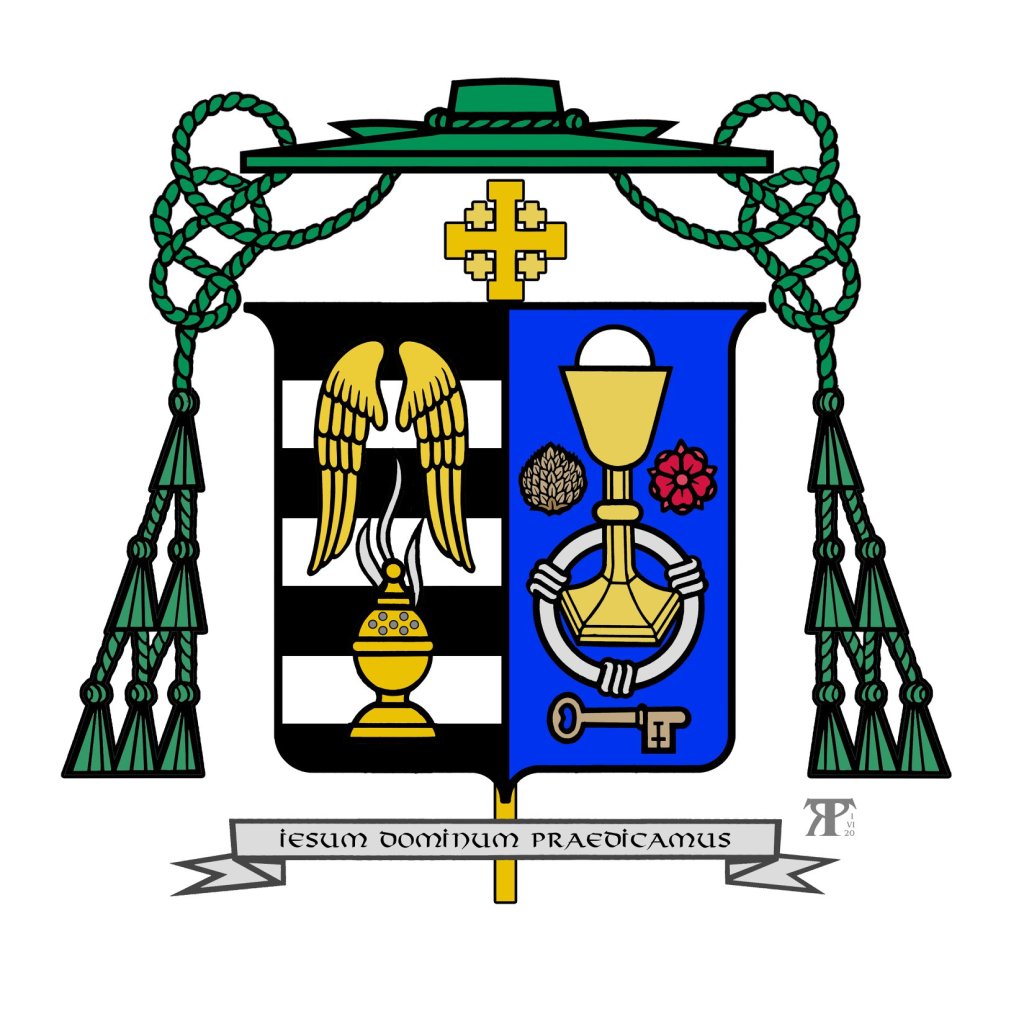
Second, is Bishop John McClory (56) a Detroit priest who was ordained and installed as the Fifth Bishop of Gary, Indiana on February 11. Again, the arms of the See are of no concern and, actually, are one of the better diocesan coat of arms in use in the USA with a nice reference to the Guardian Angels (titular patrons of the cathedral church).

This coat of arms is really rather nice. There is a good choice of the symbols to be used as charges. There are no tincture violations or indiscretions and, I would say the overall appearance of the coat of arms is aesthetically pleasing and harmonizes well with the arms of the See.

My criticism concerns the arrangement of the charges on the field which is rather like what has come to be known as the “lucky charms” style of heraldry. Namely, a bunch of charges scattered on the field and slapped onto a shield and called heraldry. In addition, trying to “personalize” the episcopal cross which is an external ornament which indicates the rank of the bearer and not a charge on the field which communicate the identity of the bearer is a mistake. It is in the form of a Jerusalem cross to indicate membership in the Equestrian Order of the Holy Sepulchre. This is not the way to depict such membership. Either a charge on the field would have been appropriate, or placing the Jerusalem cross near but outside the shield is also acceptable. In addition, the actual insignia of the Order can be depicted suspended below the shield by a black ribbon or, as a bishop, he could have placed the shield on the Jerusalem cross. But, shaping the episcopal cross to a personal preference is not an option.

Nevertheless, this is the best of the three.

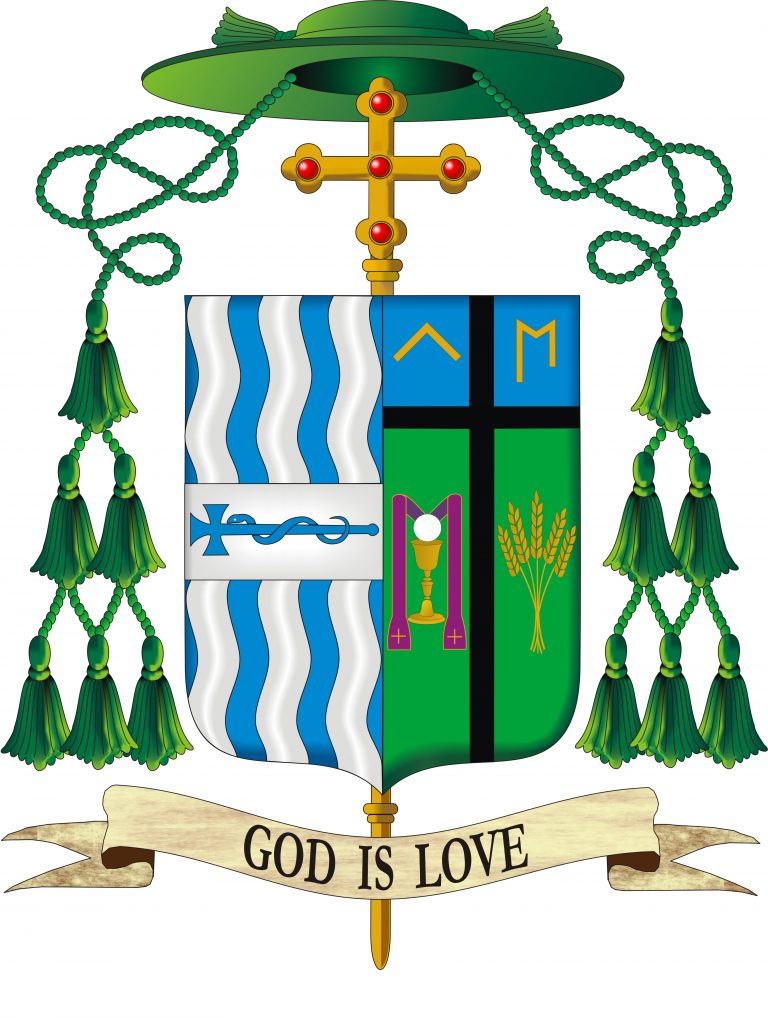
Finally, we have the armorial bearings of Bishop Donald DeGrood (54) a priest of St. Paul-Minneapolis who is being ordained a bishop and installed as the Ninth Bishop of Sioux Falls, South Dakota today, in fact, even as I write this post.

Ugh!

For the third time I take no issue with the arms of the See and also think it is one of the better designed diocesan coats of arms in the USA.

As for the personal arms he has, once again, tried to do too much. The tincture combinations are unfortunate and, actually, rather sad looking. The purple priest’s stole on a green field violates the so-called tincture “rule” which dictates that a metal on a metal and a color on another color should be avoided. The sheaf of wheat looks rather anemic (but, in fairness, that may simply be an issue involving this particular depiction of the arms). The charge of the gold letter “M” in the upper right is borrowed from the arms of St. John Paul II. There’s nothing wrong with that, per se. Many warn against using letters as charges but it is well known that John Paul II argued with Bruno Heim for maintaining the “M” in his arms which he has used as a bishop and cardinal. Certainly, that charge became widely known as John Paul’s coat of arms was used extensively during his historic 27-year-long pontificate.

However, in the official version of John Paul’s arms, painted by Bruno Heim himself, the letter “M” was depicted, correctly, as filling the whole space of the field on which it was depicted. So, the charge followed the contours of the shield shape upon which it appeared. This explains why one side of the “M” is longer than the other. However, depicting it this way, floating in the middle of the field, it is completely unnecessary, and also quite ridiculous to depict the “M” with one side shorter than the other. The “M” was not blazoned to be depicted that way, Rather, that was merely an artistic convention. There seems to be the erroneous and utterly stupid notion floating around out there that the “M” must be unevenly drawn to make it the “John Paul II M“. WRONG!

The black cross on a field that is blue and green is a bad choice of tinctures. Once again, it appears as though the new bishop consulted someone who was not very well acquainted with proper heraldic design.

These three represent a situation that is all too common in the Church in general and in the United States in particular. With all the competent assistance available, especially since the advent of the internet, it’s really rather sad that such amateurish and, in some cases, frankly ugly coats of arms continue to be created.
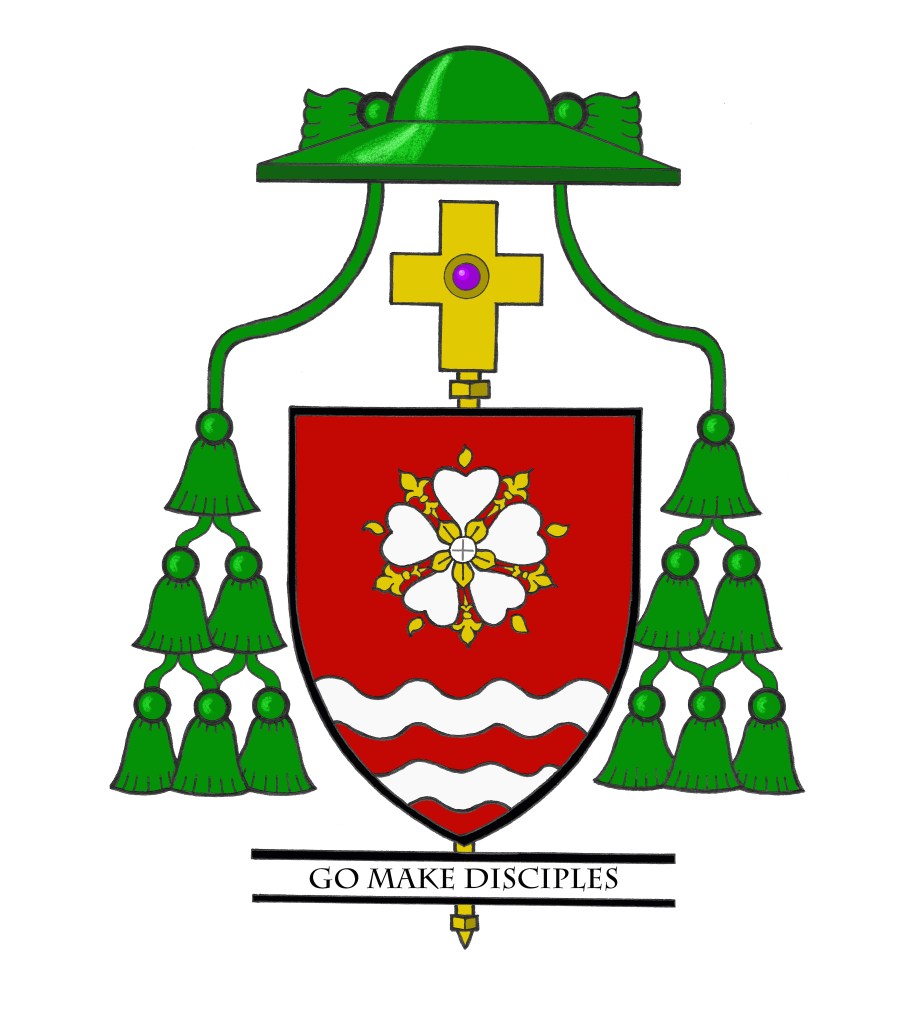
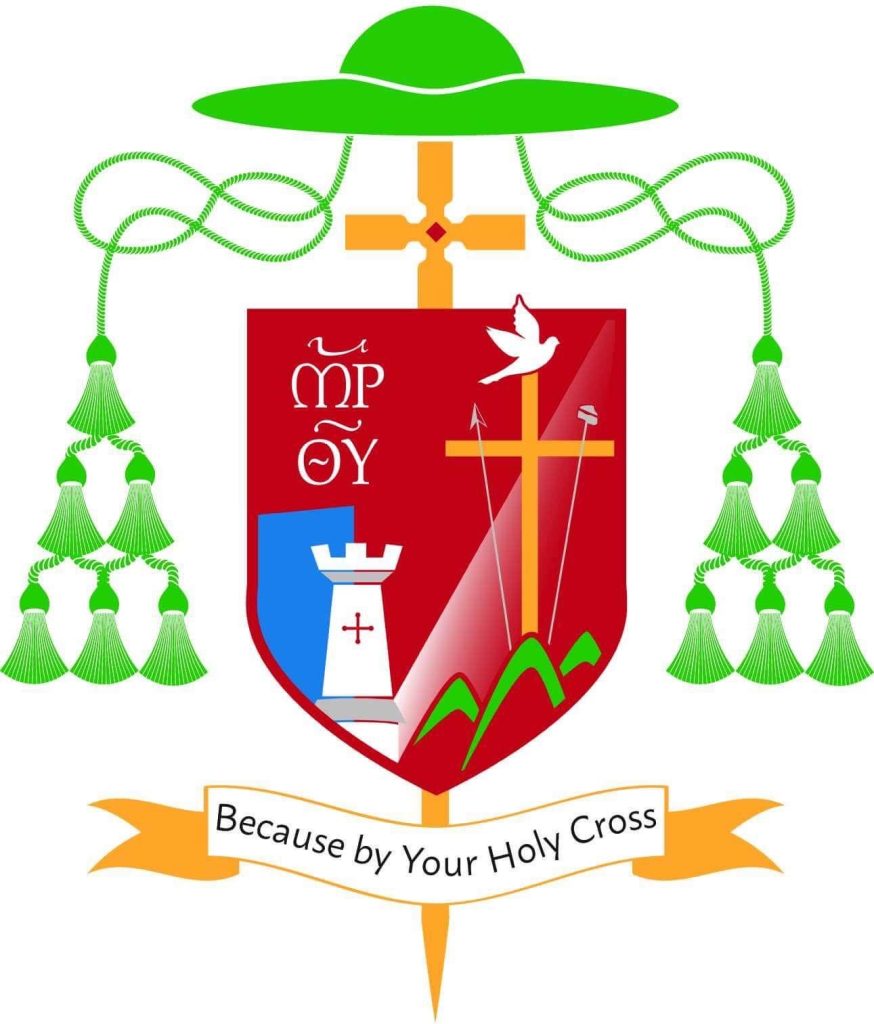
Nelson J. Perez from Cleveland to Philadelphia

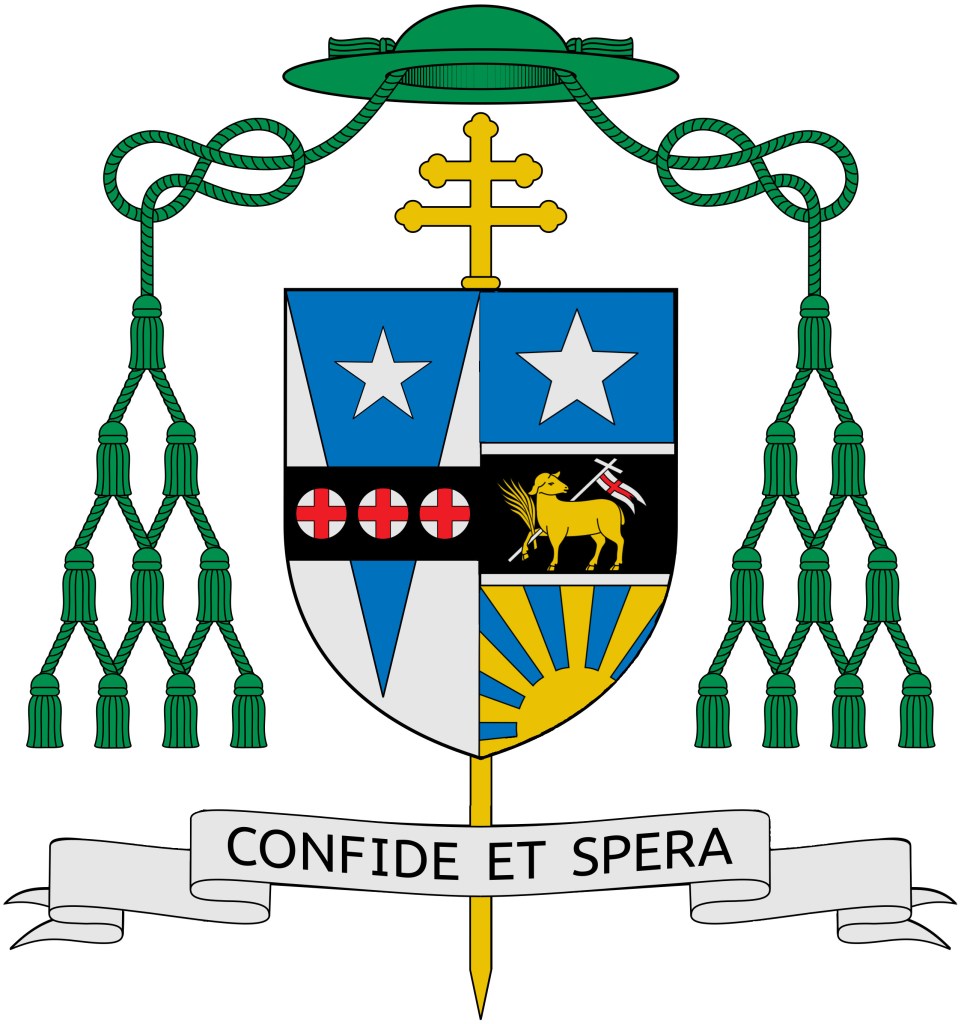
This morning the Holy See announced that the Pope has appointed 58-year-old Bishop Nelson J. Perez as the 10th Archbishop of Philadelphia succeeding Archbishop Charles Chaput, OFM, Cap. who has served as the 9th Archbishop since 2011 and who turned 75 last September. The Archbishop-elect was born in Cuba, emigrated with his family to Miami when he was a child and was raised in Northern New Jersey.

He was ordained a priest for the Archdiocese of Philadelphia in 1989. In 2012 Pope Benedict appointed him as Titular Bishop of Catrum and Auxiliary Bishop of Rockville Centre, New York. Pope Francis translated him to the Diocese of Cleveland in July, 2017.

His personal arms were assumed at the time he was ordained a bishop on Long Island. The reflect his Cuban heritage (the sun), his home diocese of Philadelphia (the star) and his vision of priestly and episcopal ministry (the lamb).

Philadelphia hasn’t had a priest of their own diocese serve as archbishop there since Archbishop Prendergast (1911-1918) so this is a momentous appointment for the archdiocese to have, if not a native son, a priest from their own presbyterate as their new shepherd. That’s relatively rare in the U.S. these days. I grew up in the Diocese of Rockville Centre and I still have many friends and some family there. I know the people there appreciated Archbishop-elect Nelson’s personality, style and his ministry with them.

Ad Multos Annos!

Archbishop of Tours

On January 5 Msgr. Vincent Jordy (58) from Perpignan, France, a priest and Auxiliary Bishop of Strasbourg and from 2011-2019 Bishop of Saint Claude will be installed as the 66th Archbishop of Tours.

Unlike so many of his confreres in the French episcopate he actually bears a coat of arms:

Of course as an archbishop, the cross will now be a patriarchal cross with two horizontal bars. The fact that he doesn’t use a galero is his personal choice. As has been mentioned on this blog before, the galero is not an essential part of a bishop’s coat of arms and may be omitted if desired. The one and only distinguishing external ornament essential for a bishop’s coat of arms is the episcopal or archiepiscopal cross placed behind the shield.

Bishop Austin Vetter of Helena

On Wednesday, November 20, the Most Rev. Austin Vetter (52), a priest of the Diocese of Bismarck, North Dakota, was ordained a bishop and installed as the 12th Bishop of Helena, Montana. He was formerly a Spiritual Director at the Pontifical North American College in Rome, the seminary which he himself attended. Like so many other American bishops coming from that source he decided to have his coat of arms designed and emblazoned by an amateur heraldist, a man with another profession, who has begun to work extensively in the field of ecclesiastical heraldry due to his many contacts in Rome. The results are usually somewhat disappointing – not bad; not incorrect; not poorly rendered – but just drab, unimaginative and a ceaseless repetition of the same things over and over again plugged into a basic template making all of them appear, essentially, the same.

From the program prepared for the Ordination we read the following description prepared by the person who designed the coat of arms: “Bishop Vetter’s personal coat of arms blends images representing his origins: the crescent moon is for the Blessed Mother, the Immaculate Conception, patroness of the United States, the Diocese of Bismarck, and the Pontifical North American College (Bishop Vetter’s alma mater where he also later served on faculty); the sheaves of wheat which combine the concept of the Eucharistic symbol and the principle product of the farm where Bishop Vetter grew up; a “wavy barrulet,” the water representing “the spring of water welling up to eternal life” (John 4:14) and the Missouri River which begins in Montana and flows through Bismarck, North Dakota; and a “gemel in chevronwise,” one of them recalling the rafter holding the roof of the church which is set upon the foundation of the apostles with Christ Jesus as the cornerstone (meaning protection) and the second representing the Rocky Mountains of Montana.

The color blue (Azure) symbolizes the separation from the worldly values and the ascent of the soul toward God, therefore the run of the Celestial Virtues which raise themselves from the things of the earth toward the sk y. It als o represents the Blessed Mother and the “Big Sky” of Montana. The silver (Argent) of the crescent symbolizes the transparency and the purity of the Virgin Mary. The garb, sheaves of wheat, is in gold (Or), the first among the noble metals, then the symbol of the first of the Virtues , the Faith which enables us to believe in the Eucharistic Host, fruit of wheat, real body of Christ.”

Yeah…blah.

The second paragraph which goes on and on about the symbolism of the colors betrays an error that many amateur heraldist make. Namely, assuming that there are definite meanings assigned to different colors in heraldry. There aren’t. Perhaps, the armiger has chosen to assign meanings to certain colors for himself personally but if that is the case the explanation should stipulate that, as in, “The bishop feels that the color blue means XYZ to him because…” Otherwise, it’s simply made up out of whole cloth.

Another interesting thing in the explanation which goes to my point about the repetition in this person’s designs is the explanation of the use of the “gemel”. In heraldry the word gemel means “twin”. It is a term taken from Scottish heraldry primarily and does not describe a particular charge or object. Rather, it is an adjective that describes certain ordinaries or subordinaries as being depicted twinned, or in a pair. So, it’s not an object, a gemel “chevron wise” (i.e. arranged in the shape of a chevron). Instead, it should be blazoned “Two chevronels gemel”, that is, two thinner chevrons paired.

What is also interesting is this explanation of the coat of arms of a bishop this same artist did several years ago, “The chevron is an heraldic device, best described as an inverted “V”; it signifies the rafter, which holds the roof of the church, and symbolizes the concept of protection.” Does that sound familiar? Perhaps it is supposed that every bishop must have a chevron of some kind in his coat of arms as a symbol of a church? Are there no other symbols of a church, or of the Church, or of protection?

This bishop’s last name – Vetter – comes from the German for “cousin” and yet there was no attempt to try and symbolize that. His first name, Austin, is derived from the name Augustine and yet none of the symbols associated with that saint were used. Why do I point this out? Because a coat of arms is first and foremost a mark of personal identification. As I have written here numerous times, it is not a CV in pictures! It’s not supposed to be about where you are from, where you lived, where you went to school, etc. It is, instead, supposed to identify you, personally. So, using charges that in some way alluded to his name or family name, while far from a necessity in any coat of arms, might have proven a better starting point and certainly would have made for a mark of identity that was more personal.

Instead, there is another cookie-cutter coat of arms. And yet the question persists of “Why are so many bishops’ coats of arms so poorly done?” It is, I believe, because too many bishops are content to copy what they have seen before for the sake of “getting it done” instead of consulting with someone who is well versed in heraldic science as well as someone who can provide real heraldic art instead of something using a computer generated template. This coat of arms, like others is not, as I wrote above, bad, incorrect or poorly rendered. But, it is rather disappointing.

Bishop Mackinlay of Sandhurst

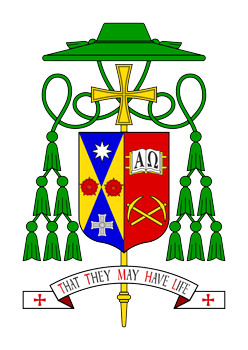
On October 16 the Most Rev. Shane Mackinlay (54), a priest of the diocese of Ballarat, was ordained a bishop and installed as the Eighth Bishop of Sandhurst, Australia.

His coat of arms is blazoned: Gules, two pickaxes in saltire, blades upwards Or; in chief an open book Argent bound Or with the Greek letter Α on the dexter page and the Greek letter Ω on the sinister page both Sable; impaling Per saltire or and azure on the former in fess two roses gules, in chief an estoile (eight-pointed star) and in base a representation of the Paderborn Cross argent.

The crossed pickaxes are the tools of goldmining, which was integral to the founding of both Ballarat and Bendigo. The bible comes from the arms of Catholic Theological College and reflects its motto, Tolle lege, the admonition that prompted St Augustine to take up and read the bible, which led to his baptism. In the arms of the see the gold of the field represents the goldfields, which are located within the diocese. The blue and the roses represent the Virgin Mary, Mother of God, who, under the title Our Lady of Good Counsel, is Patroness of the Diocese. The Paderborn Cross at the base is an ancient Christian symbol discovered in an eighth-century grave beneath the Cathedral at Paderborn, Germany, which was the home city of Dr Henry Backhaus, the pioneer priest of the Bendigo Goldfields.

The diocesan arms were designed by myself and Bishop Shane’s personal arms were designed by Richard d’Apice AM KCSG and myself and both are illustrated by Sandy Turnbull.

Remembering Bishop John Snyder RIP

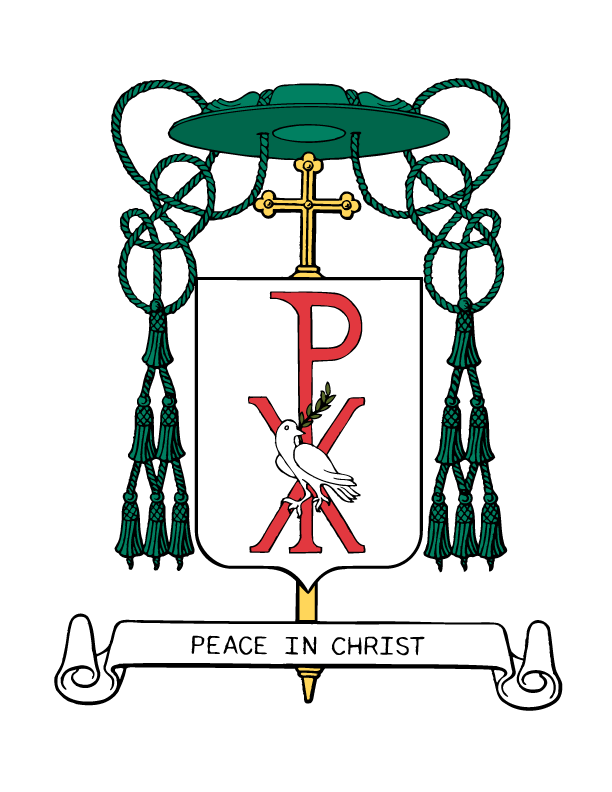
On September 27, 2019 the Most Rev. John J. Snyder (93) a priest of Brooklyn and for 21 years the IX Bishop of St. Augustine, Florida passed away. He was buried on October 1.

The coat of arms (below) which he assumed in 1972 at the time he was ordained Titular Bishop of Forum Popilii and Auxiliary Bishop of Brooklyn and which, after 2000, he once again used very simply illustrates the motto he chose for himself, “Peace in Christ”.

May he rest in peace.

9/11 Remembered

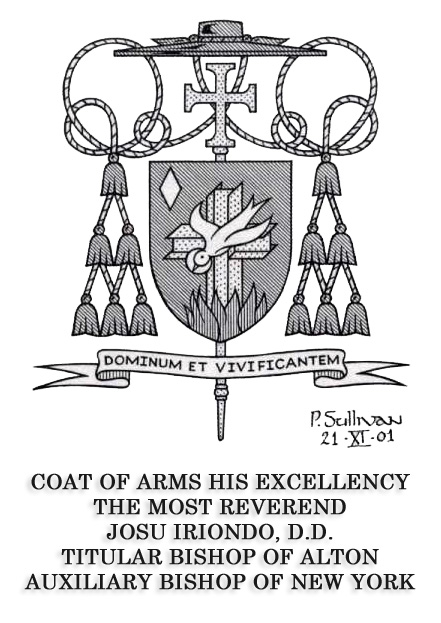
The Most Reverend Josu Iriondo, (80) formerly a Canon Regular of the Most Holy Savior of the Lateran, later incarnated as a priest of the Archdiocese of New York and retired Auxiliary Bishop of New York was appointed to be a bishop on October 30, 2001 and ordained the Titular Bishop of Alton and Auxiliary of NY on December 12, 2001 while the city was still reeling from the horrible terrorist attacks of 9/11. In his assumed coat of arms Bishop Iriondo decided to commemorate those horrible events and the faith that helped many cope with them by incorporating an image from Ground Zero into his coat of arms. There was a cross made of the remnant I-beams of one of the fallen towers that rescue workers erected over the site. That cross of steel I-beams was used as the image of the cross making up the principal charge of the bishop’s coat of arms.

artwork by Deacon Paul Sullivan

Another Ordinary Australian

On August 27 Monsignor Carl Reid, PA, (68) a Canadian who converted to Catholicism in 2012, was installed as the second Ordinary of the Personal Ordinariate of Our Lady of the Southern Cross in Australia. His personal arms were granted by the Canadian Heraldic Authority and are impaled with the arms of the Ordinariate. Richard d’Apice (in consultation with myself) assisted the Canadian heralds with the design of the personal arms. Mr. d’Apice and I designed the arms of the Ordinariate as well.

The unusual use of the crozier has been a precedent set among the Personal Ordinariates after their establishment by Pope Benedict XVI. It derives from the use of the crozier to denote Ordinary Jurisdiction while at the same time leaves off the sudarium (veil) attached to the crozier in abbatial arms which has become a symbol proper to abbots. Msgr. Reid exercises full Ordinary Jurisdiction and makes use of the pontificalia while celebrating the Sacraments like a bishop but does not possess the episcopal office. NOTE: The Personal Ordinary for the UK does not make use of a coat of arms and the Personal Ordinary for N. America is a bishop.

The artwork is by the talented Australian, Sandy Turnbull.

Bishop Brennan Translated to Wheeling-Charleston

On Wednesday, August 21, the feast of St. Pius X, the Most Rev. Mark E. Brennan (72) until recently Auxiliary Bishop of Baltimore and Titular Bishop of Rusibisir, was installed as the 9th Bishop of Wheeling-Charleston, West Virginia. He succeeds the scandal ridden Bishop Michael Bransfield.

His coat of arms (above) is clearly a redesign of the coat of arms he assumed at the time he became a bishop. Normally, I am very critical of the practice of a bishop changing his coat of arms when transferring to a different assignment. A coat of arms is not “changeable” as it is a mark of personal identification.

However, Bishop Brennan’s originally assumed arms (below) were rather busy and it would have been difficult to impale them well with the diocesan coat of arms. Of course, it is well worth pointing out that while impalement, symbolizing that the bishop is “married” to his diocese, is the norm for diocesan bishops in the United States but it is not mandatory by any means. I would hazard a guess that when Bishop Brennan assumed his coat of arms he did not think that he would ever be called upon to serve as a diocesan bishop and thought his episcopal ministry would be lived out as an Auxiliary of Baltimore. That’s not an unusual assumption when you consider he was already 69 years old when he was appointed a bishop and the mandatory age at which bishops must submit a resignation is 75!

Nevertheless, his personal coat of arms has been redesigned to better harmonize and more easily be impaled with the coat of arms of the See of Wheeling-Charleston. In my opinion, my misgivings about redesigning arms aside, I think it is an improvement over the original coat of arms. The change of the motto, also not an absolutely necessary part of a coat of arms although erroneously thought to be so by many, is less problematic.

Archbishop Wilson of Southwark (with an update)

On July 25, 2019 the Most Rev. John Wilson (51), a priest and auxiliary bishop of Westminster was installed as the 11th Metropolitan Archbishop of Southwark. London is a unique city in that it contains two different ARCHdioceses, as well as also containing part of the territory of two dioceses. Everything south of the river Thames is in the Archdiocese of Southwark.

The archbishop employs the archdiocesan arms pictured below. They follow the more ancient custom in Britain of ensigning the shield with a bishop’s mitre rather than the more continental galero.

Most Rev. Robert F. Christian, O.P. – RIP

The Most Rev. Robert Christian, a Dominican friar, who has been the Auxiliary Bishop of the Archdiocese of San Francisco passed away on July 11, 2019 at age 70.

His coat of arms was assumed by him at the time of his episcopal ordination.

Umm…no. Sorry, but “beige” isn’t a heraldic color and, no, you may not just simply make up new rules and use whatever color you wish in heraldry. The science of heraldry limits the tinctures to be used and beige isn’t one of them. The Dominican cross and the usual Franciscan conformities (the arms of Christ and St. Francis crossed with each other) made for a nice combination of symbols for his Religious Community and the Archdiocese.

May he rest in peace.