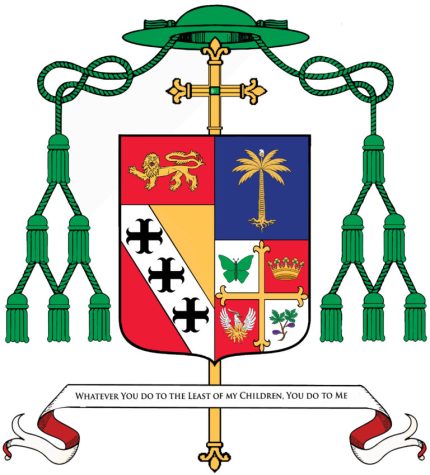
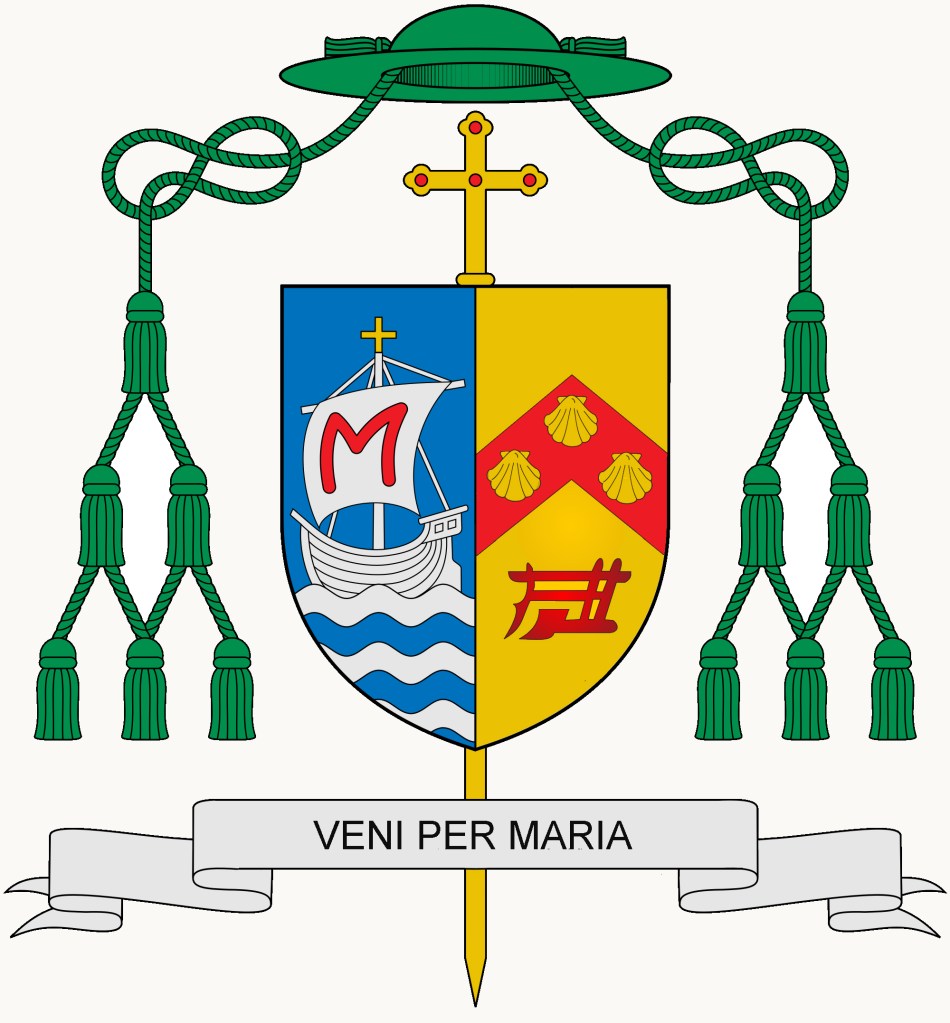
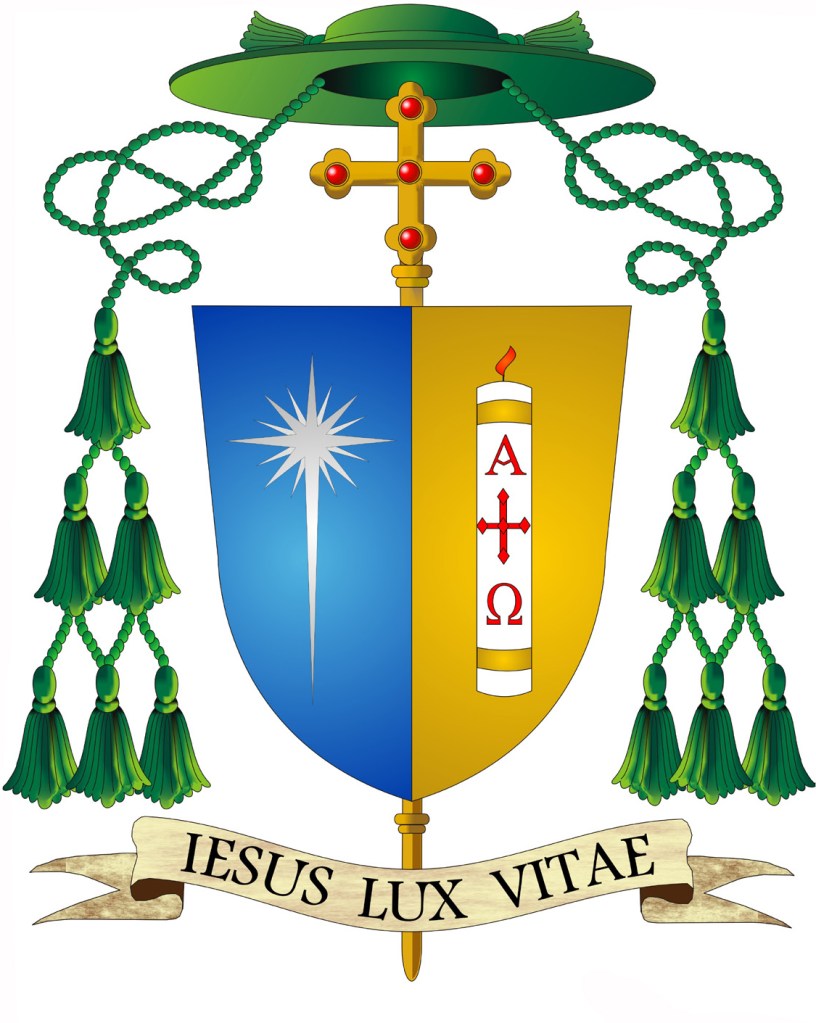
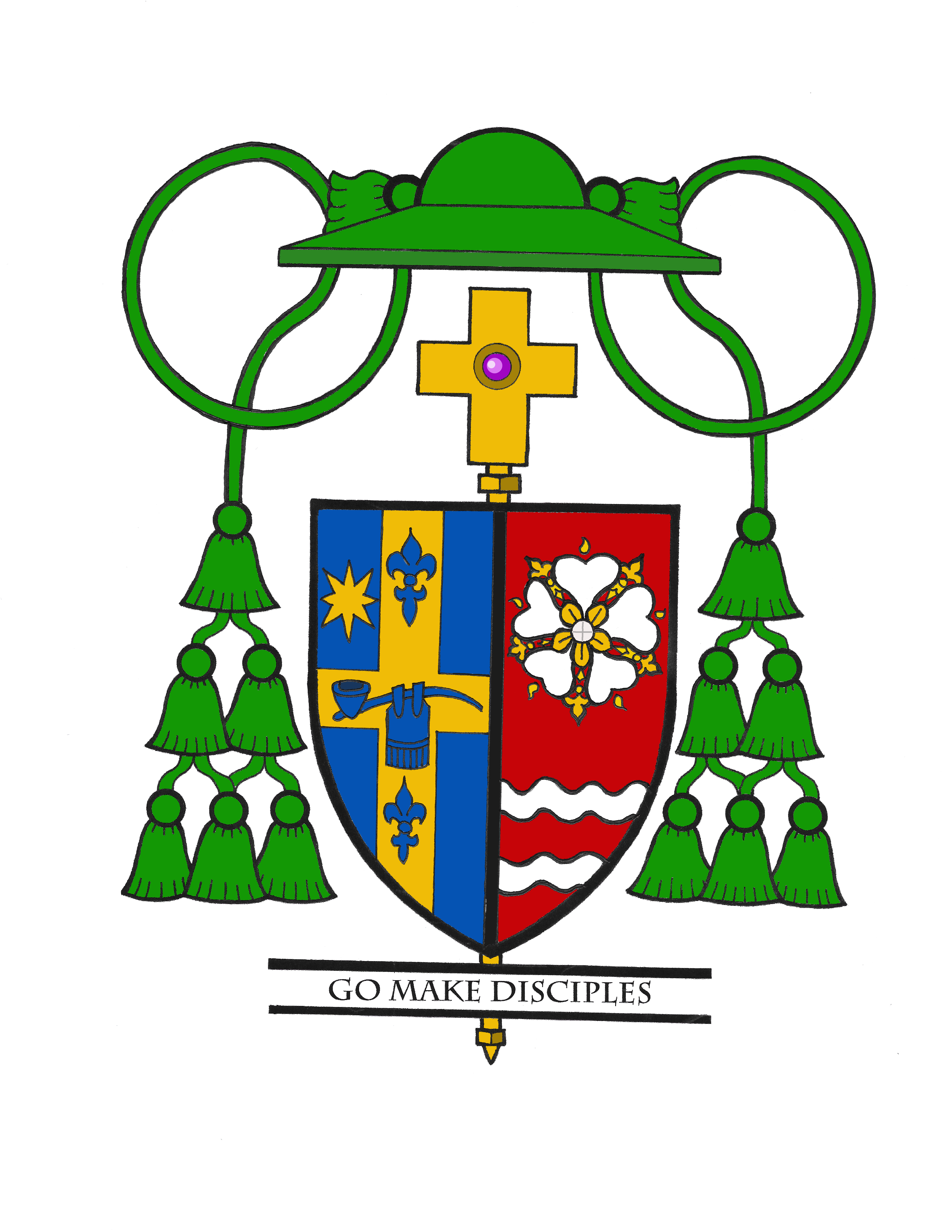
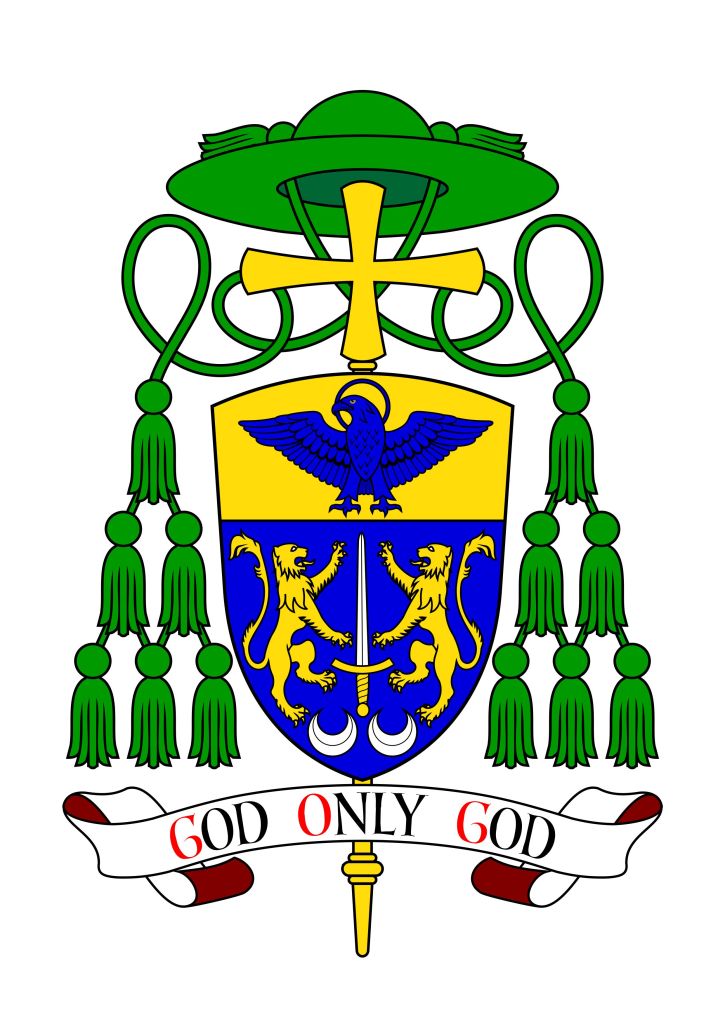
On March 1 two new auxiliary bishops were ordained for the Archdiocese of New York. They are the Most Rev. John Samuel Bonnici (57), Titular Bishop of Arindela and the Most Rev. Joseph Armando Espaillat (45), Titular Bishop of Tagarbala. Their armorial bearings, rendered by Sig. Renato Poletti, are as follows:
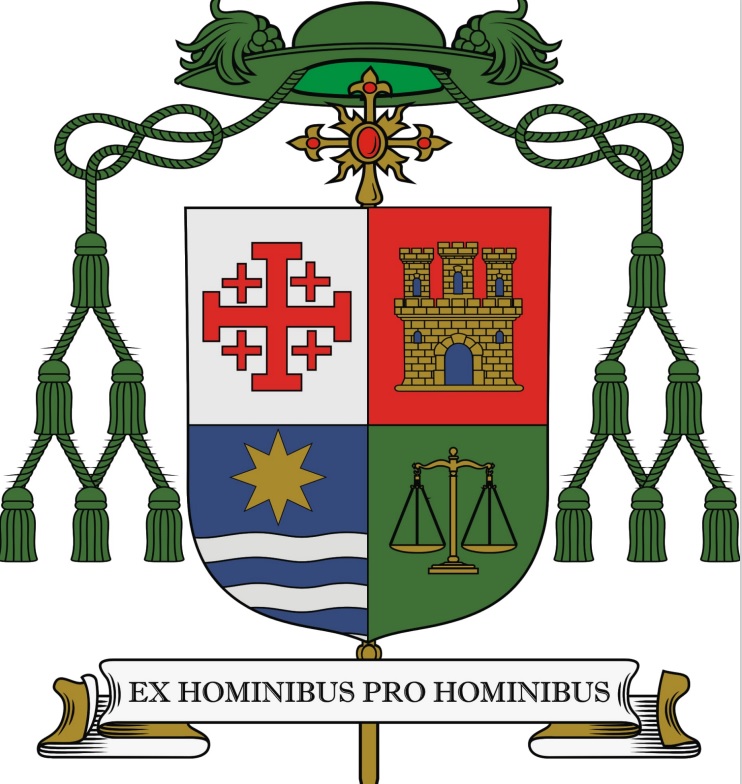
Francisco César García Magán (59) a priest of Toledo, Spain was ordained as the Titular Bishop of Scebatiana and Auxiliary of Toledo on January 15.
The design of his arms is a bit amateurish and cliched; four quarters each with a symbol. The problem with that is that while it might seem an attractive idea from the point of view of design, affording four chances to include different symbols, the idea of quartered arms implies four separate coats of arms that have been marshaled together on the same shield by the method of quartering.
It is, as I said, an amateur’s mistake to think that a newly assumed coat of arms may start out being a shield divided into four quarters each bearing something different. Having said that the new bishop’s arms are aesthetically pleasant and the symbols used are, at least, appropriate.
In the first quarter the Jerusalem cross is used not to symbolize the Equestrian Order of the Holy Sepulcher. That cross, used by that order, is not exclusive to it. Here it represents the Passion of the Lord. The second quarter alludes to the Spanish territory of Castile. The third quarter is symbolic of Our Lady (star of the sea) and the fourth quarter alludes to justice and to Canon Law, the academic color for which is green.
On January 9 the Most Rev. Juan Antonio Aznárez Cobo (61), a priest of Pamplona y Tudela and an Auxiliary Bishop there since 2012, was installed as the Archbishop of Spain, Military.
His coat of arms, which is a little bit crowded but overall not too bad, is the following:
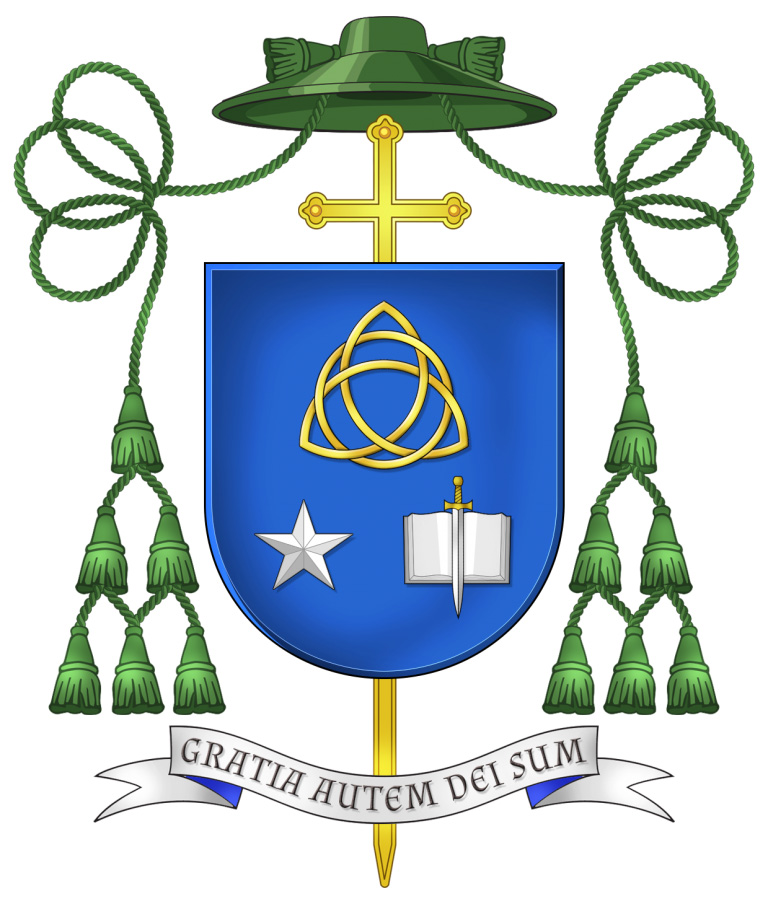
The Most Rev. Joel Maria dos Santos (55) a priest of the archdiocese of Belo Horizonte, Brazil, was ordained Titular Bishop of Thenae and Auxiliary Bishop of Belo Horizonte on December 18, 2021.
His coat of arms is rather nice. It’s clear with a simple, if not a bit haphazard arrangement of the charges. The principal symbol represents the Holy Trinity while the star is for Our Lady and the sword and book a reference to St. Paul. The color scheme is good and the tinctures and metals are a good combination while not going nuts with multiple tinctures.
On December 8 the Most Rev. Daniel Joseph Meagher (60), a priest of the Archdiocese of Sydney, Australia was ordained a bishop with the Titular See of Pocofeltus and assigned to serve as Auxiliary Bishop of Sydney. The arms he assumed, of which I was pleased to act as a consultant on the design, are the following:
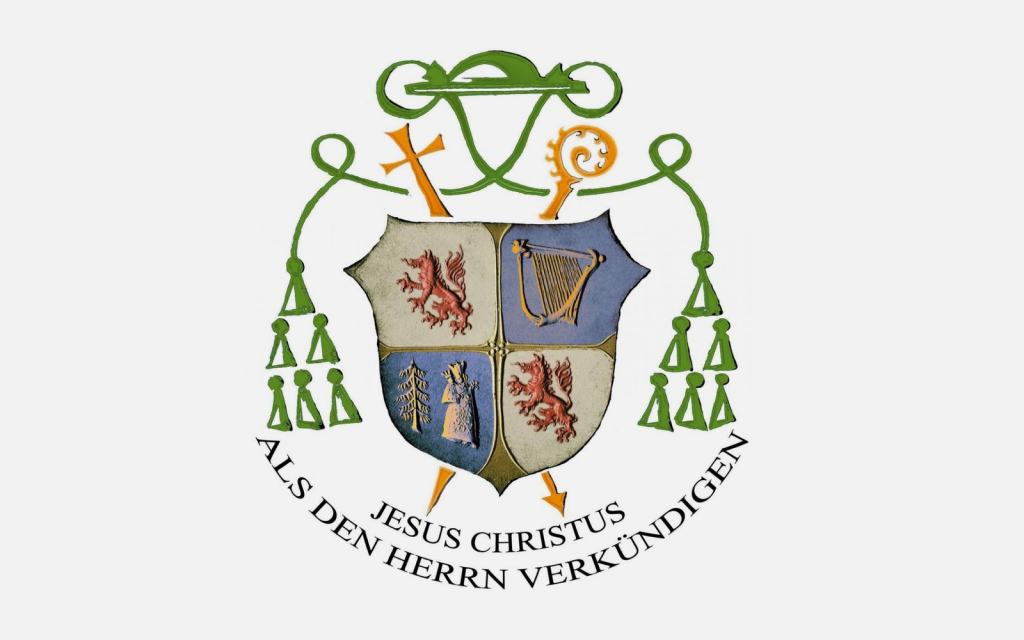
On November 8 the Most Rev. Wilhelm Schraml (86) Bishop-Emeritus of Passau passed from this life. His interesting and handsome coat of arms quartering the arms of the see with his personal arms is below. It is interesting that it incorrectly includes the crozier in the achievement.
On October 17 Pope Francis ordained his long-serving Master of Pontifical Ceremonies, Guido Marini (56) as Bishop of Tortona at a liturgy in St. Peter’s Basilica. Bishop Marini, a priest of Genoa who served as Papal MC since 2007, will be installed in his cathedral church on November 7.
The armorial bearings he has assumed were prepared by Marco Foppoli.
Today, September 29, Pope Francis appointed the Most Rev. Robert Brennan, 59, Bishop of Columbus, OH since 2019 to become the 8th Bishop of Brooklyn in its 168 year history. He succeeds Bishop Nicholas DiMarzio, 77, who served there since 2003.
Bishop Brennan is a NY native and was a priest, official and Auxiliary Bishop in the neighboring diocese to Brooklyn, Rockville Centre until he went to Ohio three years ago. He also studied in the Brooklyn Diocese when he attended St. John’s University in Jamaica, Queens.
The arms he assumed in 2012 when he became a bishop impale nicely with those of the See of Brooklyn:
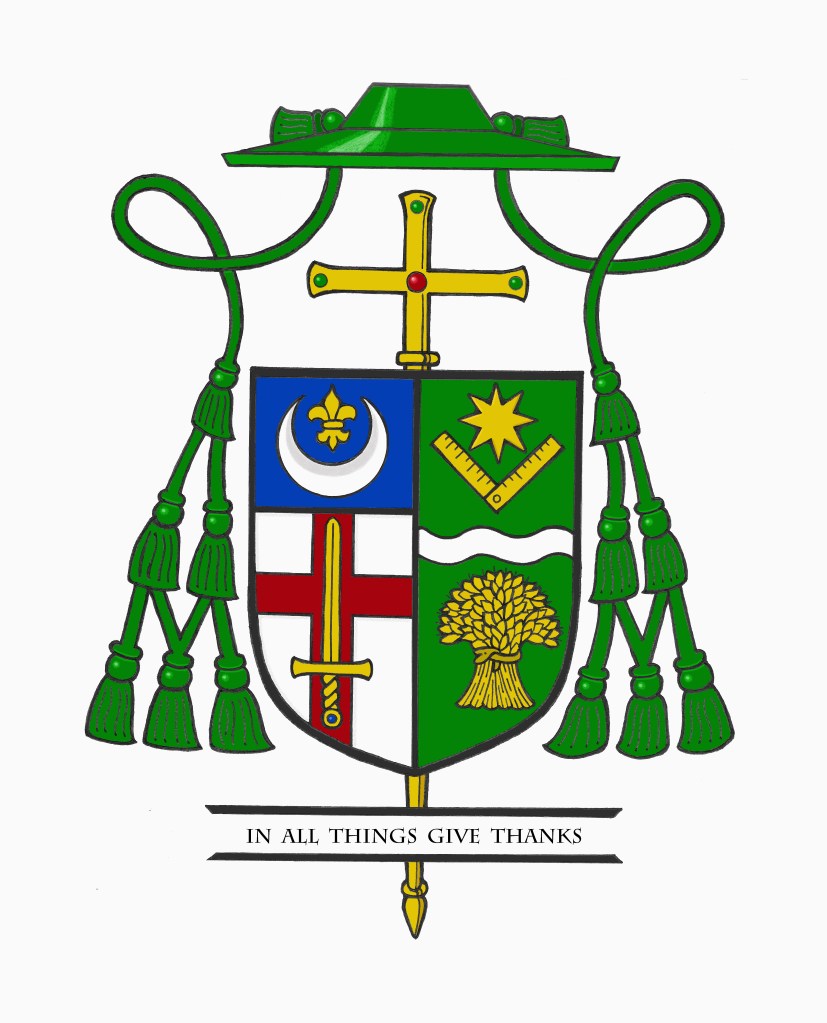
On September 30th the Rev. John C. Iffert (53) a priest of the Diocese of Belleville, Illinois will be ordained a bishop and installed as the 11th Bishop of Covington, Kentucky.
The armorial bearings that he will be assuming upon entering his episcopal ministry are:
It is customary in North America for a bishop to marshal his personal coat of arms to those of his jurisdiction, in this case the See of Covington. The method most often used is impalement whereby the two separate coats of arms are depicted side by side on the same shield. This method is most often used heraldically to depict the arms of two married people who are armigerous. In employing this method in the coat of arms of a diocesan bishop it illustrated that the bishop is “married” to his diocese. The arms of the See of Covington were commissioned by William T. Mulloy, 6th bishop of Covington, following the 1953 elevation of the cathedral to a minor basilica. The gold (yellow) sword over the red cross on a silver (white) field is the symbol of Saint Paul, the Patron of the Diocese of Covington. On a chief (upper third of the shield) the gold fleur-de-lis and silver crescent are symbols of the Blessed Virgin Mary who is the titular patroness of the Cathedral of the Assumption.
The right-hand side of the shield depicts the personal coat of arms now assumed by bishop Iffert. The field (background) is green a color used to symbolize hope in the liturgy and which also hearkens to the bishop’s farming ancestors, the color green being associated with the fertile land. Across the center of this field a wavy barrulet ( a line thinner than a bar or fess) represents the the rivers that flow near Belleville, IL (the Mississippi) and Covington, KY (the Ohio). These river cities are the places where Bishop Iffert has exercised his priestly and now episcopal ministry. In the upper portion there is a gold carpenter’s square and an eight-pointed star. These are symbols of St. Joseph and Our Lady. The star also appears in the coat of arms of Pope Francis so combined here they allude to the idea that Bishop Iffert was appointed by Pope Francis during the Year of St. Joseph.
The gold garb of wheat in the lower part of the shield has multiple meaning. At harvest time wheat is brought in and gathered in sheaves or garbs. Harvest time is the time of year when we celebrate Thanksgiving and in the year Bishop Iffert was born his birthday happened to be Thanksgiving Day. In addition, the wheat alludes to what is used to confect the Eucharist, a word that means “thanksgiving”. The area of Illinois from which the bishop comes is often called “Little Egypt”. In addition, the garb of wheat is often used in heraldry to represent agriculture in general so it alludes to the bishop’s already mentioned farming ancestors. So, in the single charge of a sheaf of wheat we can allude to the Thanksgiving holiday, the act of giving thanks which is the central action of the Eucharist as the center of our Catholic lives and the matter of the Eucharist itself, the “gift of finest wheat”.
The motto below the shield is, “In All Things Give Thanks”, taken from 1 Thessalonians 5:18.
The shield is also ensigned with those external ornaments that indicate the bearer is a bishop. The gold (yellow) cross is placed vertically behind and extending above and below the shield. This is often erroneously thought to be a processional cross like those used in liturgical processions. However, in former times archbishops had a cross mounted on a staff carried immediately in front of them while in procession or on solemn occasions. This cross was a symbol of their rank as archbishop. Later, archbishops – and eventually all bishops – began to incorporate this symbol of rank into their coats of arms. A processional cross in Catholic usage is a crucifix and has a corpus on it while the episcopal cross very specifically does not. While such an episcopal cross is no longer used practically it has been retained heraldically. In fact, there are other clerics who make use of the ecclesiastical hat with its many tassels but the one true heraldic emblem of a bishop, and the only essential one, is the episcopal cross placed behind the shield.
Above the shield is the ecclesiastical hat, called a galero which, in heraldry, replaces the martial helmet, mantling and crest. “The hat with six pendant tassels (green, purple or black) on each side is universally considered in heraldry as the sign of prelacy. It, therefore, pertains to all who are actually prelates.” (Heim, Bruno B., Heraldry in the Catholic Church 1978, page 114) The galero is green with green cords pendant from it and twelve green tassels arranged in a pyramid shape on either side of the shield. At one time in history bishops and archbishops wore green before adopting the more Roman purple we see today. In heraldry the green hat and tassels was retained for prelates with the rank of bishop according to the Instruction of the Secretariat of State, “Ut Sive” of March, 1969.
It was both my privilege and my pleasure to assist in the design and execution of the bishop’s coat of arms.
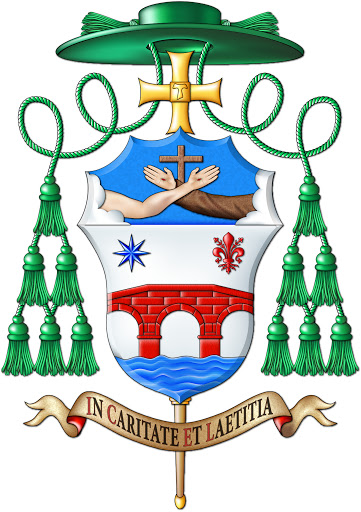
On August 9 the Most Rev. Giovanni Roncari, OFM. Cap. (71) Bishop of Pitigliano-Sovano-Obrbetello Italy was additionally installed as the Bishop of Grosetto, Italy. Henceforth, Grosseto is united to Pitigliano-Sovana-Orbetello in persona episcopi. His coat of arms, designed by Giuseppe Quattrociocchiis below:
The chief (upper third of the shield) contains the traditional symbol of all the various types of Franciscans, namely the crossed arms of Christ and Francis with a cross. The bridge recalls the place where the bishop hails from (San Piero a Ponti) and the star is for Our Lady. The inclusion of the Florentine fleur-de-lis is to recall the city of Florence where the bishop exercised a great deal of his priestly ministry.
The coat of arms is well done, despite the asymmetry of the star and fleur-de-lis. That bothers some people but can also work very well depending on the overall design and I think it does so here.
My only criticism is the inclusion of the small Tau Cross at the center of the episcopal cross standing behind the shield. As I have frequently written about on this blog I am of the opinion that the external ornaments in a heraldic achievement, which indicate rank, not identity, should not be seen as open to personalization. But, in the grand scheme of things that is a minor criticism at best. I particularly like the shape of the shield chosen as I think it works very well with what is depicted upon it.
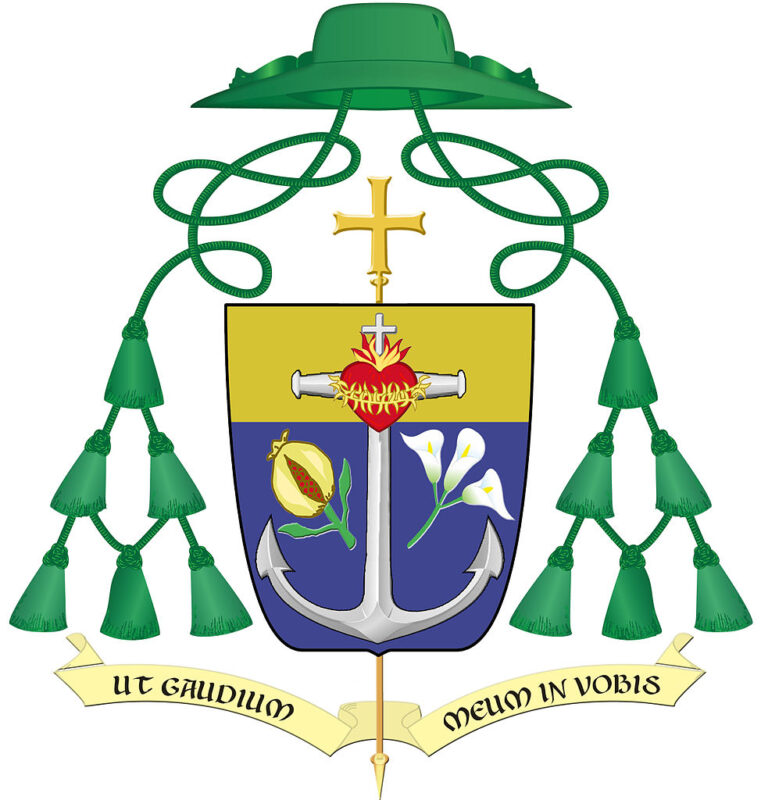
On July 31 Bishop José Rico Pavés, a bishop since 2012, was installed as the Bishop of Asidonia-Jerez (Jerez de la Frontera) Spain. His coat of arms is:
Generally speaking I think this is a nice coat of arms. The charges are clear and easy to discern and would be even if viewing the coat of arms greatly reduced, as on printed matter. The green portions of the lilies and the pomegranate don’t really break the tincture rule of no color on a color despite their being on a blue field because they are secondary additions to the primary charges (the blossoms of the lily and the fruit of the pomegranate themselves). Such little things can easily be tolerated.
The only real criticism I have is the notion of the anchor extending up onto the chief from the field. Charges, especially the principal charges like this one, aren’t supposed to overlap portions of the shield, especially in this instance where the shield is divided by having a chief. The chief itself is an ordinary and, as such, is considered to be placed over the upper portion of the blue field. Even if the anchor is blazoned as “overall” that doesn’t justify having it extend up to overlap the chief. In addition, it does actually violate the tincture rule of no metal on a metal since the whole body of the anchor is silver and it extends to a gold chief. Again, another good reason to have the anchor remain below the chief. Without counterchanging, it doesn’t really work so it comes off as a poor design decision.
I wonder why there is even a chief at all? Having the Sacred Heart on the anchor could have been enough justification to leave it red (on a silver anchor), or it could have been depicted all in gold and then the entire arms could have simply had a blue field.
Nevertheless, despite this one item, the rest of the coat of arms is, in my opinion, very nice.
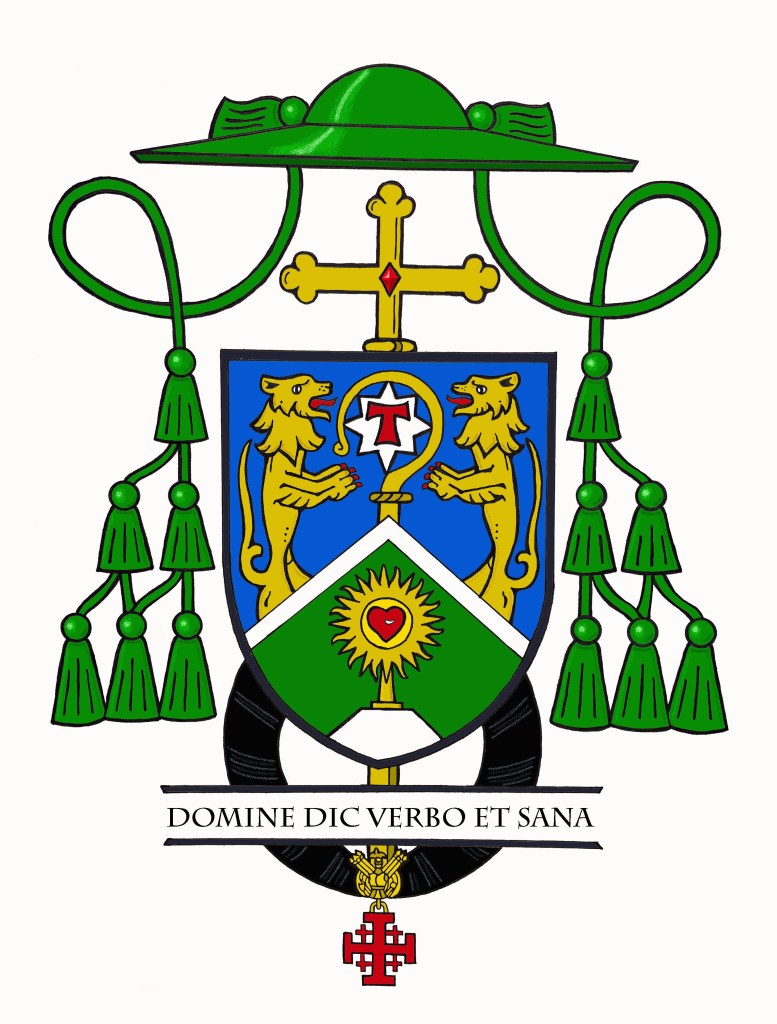
On Friday, July 16 the Most Rev. Gregory Gordon (60), a priest of the Diocese of Las Vagas, Nevada will be ordained as the Titular Bishop of Nova Petra and the first Auxiliary Bishop of Las Vegas. The armorial bearings he is assuming are:
The shield is divided with a chevron as an allusion to the paternal family name and also as one for the state of Nevada (which partly includes the Sierra Nevada range). It is snow-covered as a nod to the name “nevada”. The mountain also represents Mt. Carmel because the bishop is being ordained on the feats of Our Lady of Mount Carmel.
The upper portion contains charges borrowed from the arms of his patron saint, Gregory the Great with a further allusion to Gregory’s seminal work on the office of bishop, the Liber Regulae Pastoralis. The star in the crook of the crozier is a symbol for Our Lady and the Tau cross a reference to St. Francis of Assisi and the Franciscan missionaries who pioneered the work of the Church in Nevada.
The lower portion displays a charge referring to a Eucharistic miracle in which the Host in a monstrance was turned to flesh in Lanciano, near the part of Italy from which the bishop’s maternal family come. It also refers to the Eucharist at the heart of priestly and episcopal ministry. Furthermore, it alludes to the Sacred heart of Jesus. It rests on a base suggesting a rock (the rock of St. Peter) as well as an allusion to the name of the titular see, Nova Petra.
The motto is taken from the Communion Rite of the liturgy and is also a reference to the Centurion’s acclamation in Matthew 8:8. Suspended below the shield is the insignia of the Equestrian Order of the Holy Sepulchre of Jerusalem, of which the bishop is a Knight Commander. In addition, all bishops in the Order are accorded the rank of Knight Commander with star.
I was privileged to assist the bishop with creating the design of his coat of arms and also emblazoned them.
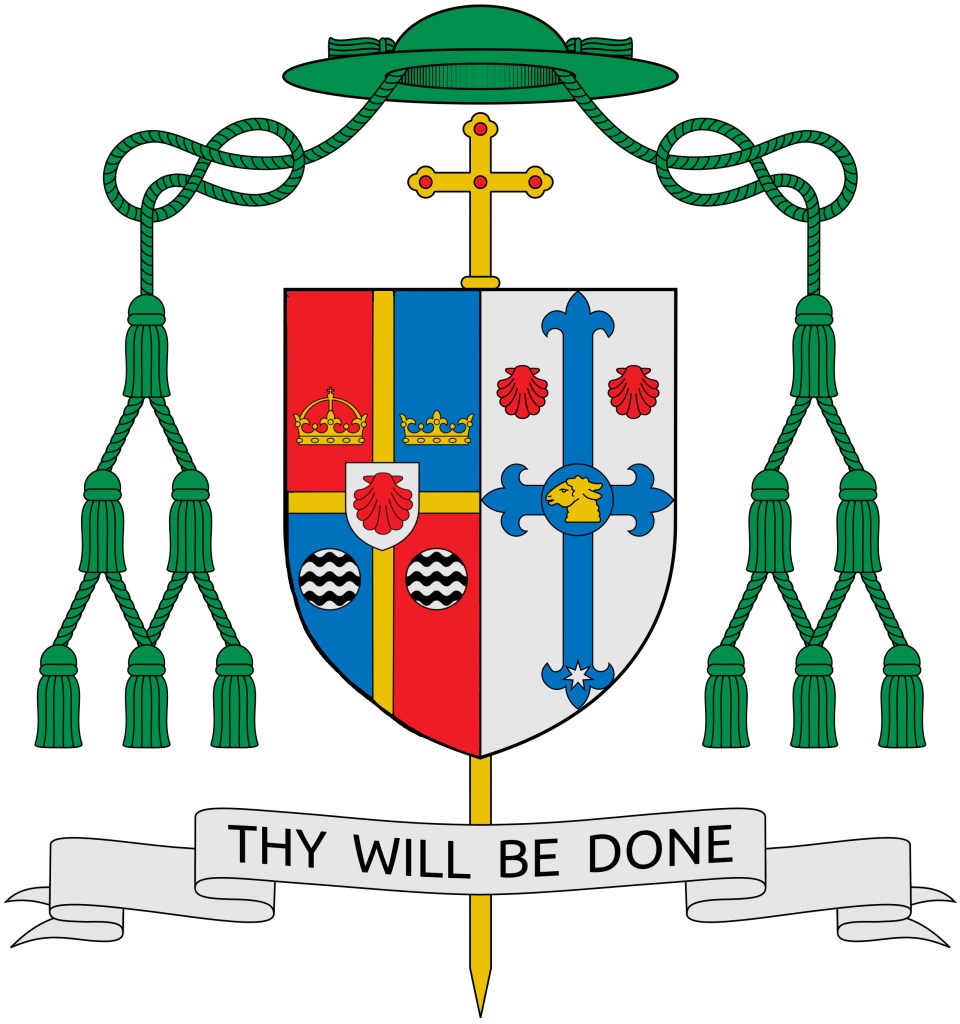
On July 13 the Most Rev. William Koenig (64) a priest of the Diocese of Rockville Centre, NY will be ordained a bishop and installed as the 10th Bishop of Wilmington, Delaware. The coat of arms he has chosen to assume is illustrated below impaled with those of the See of Wilmington.
The arms of the See are based on those of the Lords De La Warr one of whom, Thomas West, was Governor of Virginia and for whom the state and river are named. The crosses allude to the arms of the Lords Baltimore, proprietors of Maryland because the diocese covers all of Delaware and the eastern Shore portions of Maryland. The gold lion borrows from the arms of Bl. Pius IX who erected the See.
While the new bishop’s name would lend itself easily to symbols of St. William the Abbot and a royal crown (the name Koenig means “king”) he has, somewhat disappointingly, decided to use arms that allude to various aspects of his priestly career. These are the typical “CV arms” against which I am always warning. American bishops are fixated on their coats of arms “telling the story” of their lives rather than simply doing what coats of arms are supposed to do: identify.
These arms aren’t horrible. They are merely disappointing. They could have been SO much better.
On July 2 the Most Rev. Italo Dell’Oro, CRS (68) will be ordained titular bishop of Sucarda and Auxiliary Bishop of Galveston-Houston, Texas. The armorial bearings he is assuming are:
This is not my favorite design but it is not terrible either. The division line embattled and everything in chief look fine. I’m not fond of the kind of “landscape heraldry” depicted in base. Nevertheless, that type of heraldic design appeals to many and there are no errors in this design. What I dislike about it is simply a matter of taste which is purely subjective.
On June 29 the Most Rev. James Golka (54) a priest of the Diocese of Grand Island, Nebraska, will be ordained a bishop and installed as the third Bishop of Colorado Springs, Colorado. The coat of arms he is assuming is:
The green field with the gold and silver wavy barrulets represent the bishop’s home state of Nebraska and the Wood and Platte rivers. The pelican in its piety in chief is a symbol of the Eucharist and the sword, in base, a symbol of St. Michael, stands for the ministry of deliverance and healing. The star in base is a symbol of Our Lady. The cathedral in Grand Island is dedicated to the Nativity of mary. It is where the bishop received his Sacraments of Initation, was ordained a priest and served as Rector since 2016. The motto is taken from 1 Corinthians chapter 4 verse 1.
I have no desire to comment on the arms of the See of Colorado Springs. They are well established. The bishop’s personal arms have a good rationale for why the particular charges were chosen. It is a relatively simple design and clear and doesn’t violate any of the usual heraldic conventions. It’s not terribly exciting or impressive in my opinion but that is a very subjective assessment. Overall, I’d say, a nice coat of arms.
On May 20 the Most Rev. Daniel Felton (66), a priest of the diocese of Green Bay, Wisconsin will be ordained a bishop and installed as the XI Bishop of Duluth, Minnesota. The coat of arms he is assuming, impaled with the coat of arms of the diocese is:
On April 17, 2021 the Most Rev. Jerome Feudjio (65) a priest of the Diocese of St. Thomas, American Virgin Islands was ordained a bishop and installed as the sixth Bishop of St. Thomas. The bishop is a native of Cameroon. The armorial bearings he has assumed are:
These are placed here for your information with no further comment. (I’m feeling charitable today)