Category Archives: Bishops

Bishop Forbes of Roseau

On July 25, the Feast of St. James the Apostle, the Most Rev. Kendrick J. Forbes (48), a priest of the Archdiocese of Nassau, Bahamas was ordained a bishop and installed as the tenth Bishop of Roseau, Dominica in the Antilles (West Indies).

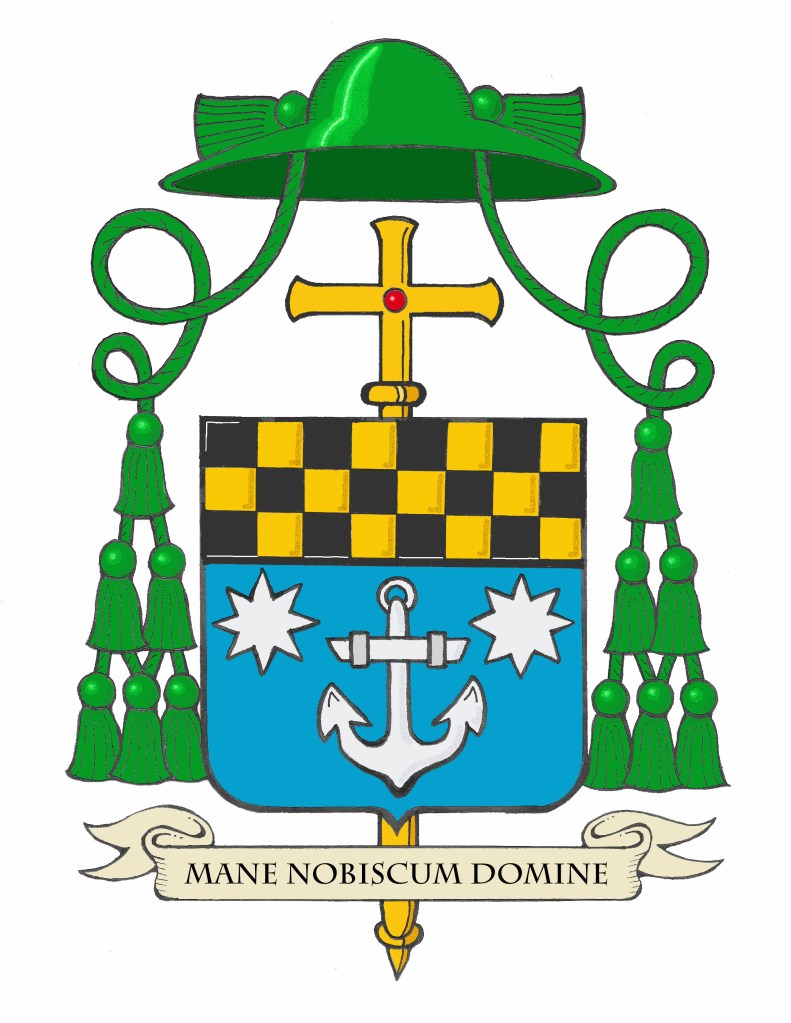
Upon his ordination to the episcopacy he has assumed the following coat of arms:

The personal coat of arms assumed by Bishop Forbes combines symbols that are meaningful to him reflecting his, origins, his spiritual life and priestly ministry. At present, the Bishop has elected to assume a personal coat of arms only. In the Catholic Church it is often customary for a diocesan bishop to combine his personal coat of arms side by side on the same shield with the coat of arms of his diocese in a form of marshaling called “impaling”. It represents his marriage to the diocese and his jurisdiction over it. However, this custom is far from a universal one and, at present, the Diocese of Roseau does not employ a unique coat of arms as a diocesan corporate symbol. 

The main part of the shield shows a light blue field on which there is a silver (white) anchor. On either side of the anchor are two eight-pointed stars. For centuries, the anchor has been a symbol of hope used in art, in the liturgy and in heraldry. The eight-pointed star is borrowed from the coat of arms of Pope Francis who named Bishop Forbes to the episcopate. There are two for balance and symmetry. The upper third of the shield is called a “chief” in heraldry and it depicts the black and gold (yellow) checkered pattern borrowed from the coat of arms of the Archdiocese of Nassau where Bishop Forbes was ordained and served as a priest before becoming a bishop.

The motto below the shield is,“Mane Nobiscum Domine” taken from Luke 24:29 meaning “Stay with us Lord.” 

It was both my privilege and my pleasure to design and to emblazon the bishop’s coat of arms for him.

Burlington’s Own Bishop McDermott

The Most Rev. John J. McDermott (61), a priest of the Diocese of Burlington, Vermont who recently served—twice—as diocesan administrator in the interim times between bishops, was ordained a bishop and installed as the XI Bishop of Burlington on July 15th.

His assumed armorial bearings are understated and impale well with the rather nice coat of arms of the diocese.

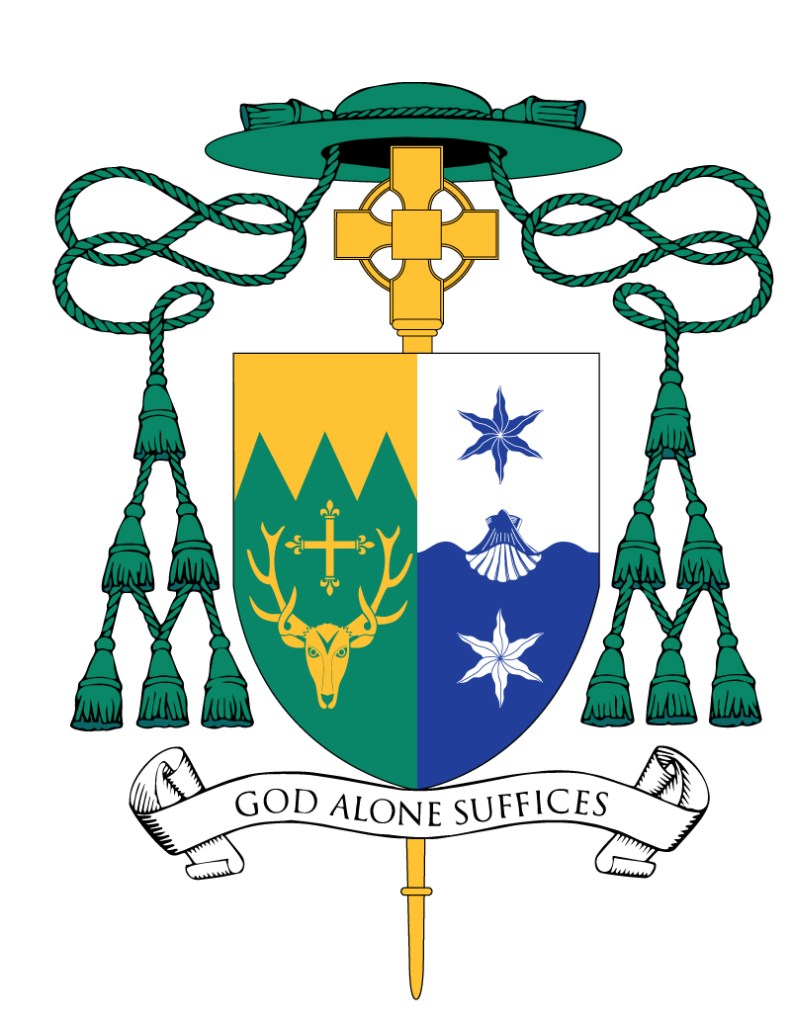
According to information provided by the Diocese: “the Bishop’s personal coat of arms is divided horizontally by a wavy line (per fess wavy)into two sections painted respectively white and blue (argent and azure). Following high school, Bishop McDermott attended the United States Coast Guard Academy in New London, Connecticut, and this allusion to the sea refers to those days as they were important to his discernment to become a priest, as well as to the waters of Lake Champlain. 

Two six-pointed wavy stars (estoilles) appear, one in the “sky” to refer to Our Lady,the Star of the Sea, and the other in the “sea” itself. A six-pointed star is a traditional symbol not only of Our Lady but also of Saint Joseph, as a descendant of the royal house of King David. Its position here depicts the holiness of Saint Joseph as a reflection of that of his Immaculate spouse. 

Between the stars is a scallop shell, a traditional attribute of Saint John the Baptist, the Bishop’s baptismal patron saint. The shell is divided along the same wavy line as the shield, as if it were being dipped into the water at the moment of conferring Baptism. The shell and the stars are all painted counterchanged, that is, blue where the field is white, and white where the field is blue.

A pleasant coat of arms which kept things nice and simple, that is to say, clear.

Caddy to Cairns (UPDATED!)

The Rev. Joseph Caddy (64) a priest of the Archdiocese of Melbourne in Australia will be ordained a bishop on August 15 and installed as the 10th Bishop of Cairns, Australia.

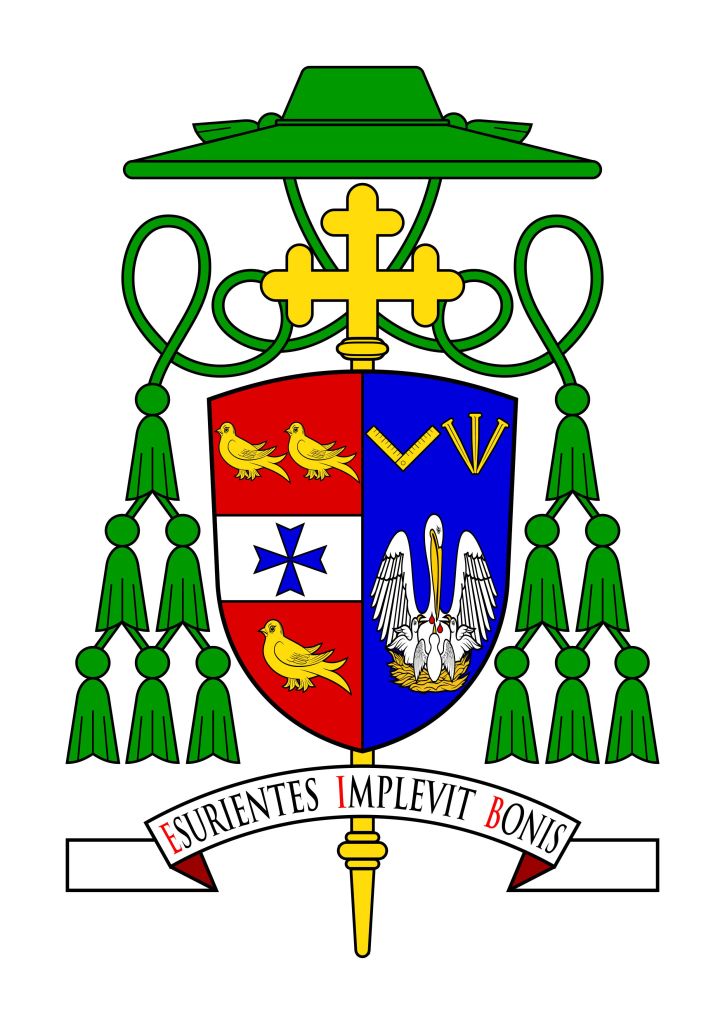
His armorial achievement, to be assumed upon episcopal ordination, is as follows:

The existing arms of the diocese occupy the dexter impalement. The personal arms consist of the pelican in its piety. This is borrowed from the coat of arms of Corpus Christi College which was the seminary attended by the armiger. Its eucharistic imagery is also reflected in the motto which translates to, “He fills the hungry with good things”. The carpenter’s square in chief is a reference to his Baptismal patron, Joseph and because his father, grandfather, and one brother are/were all carpenters.

The three Passion nails meeting in base allude to the coat of arms traditionally used by the English Caddy family which depict three piles engrailed meeting in base. The square and the nails, then, are a reference to his given and family names.

I was happy to act as a consultant on the design of the bishop’s personal arms in conjunction with Mr. Richard d’Apice, AM, KCSG. The artwork was very nicely done by Mr. Sandy Turnbull of Australia. Both are members of the Australian Heraldry Society.

UPDATE: Thanks to a comment from a regular reader asking about the diocesan arms we made a change. His question prompted me to refer back to my collaborators. In turn, the Diocese of Cairns was contacted and I, myself, delved into the pretty good small library of my own which I have amassed over the last thirty years. It turns out that our original depiction showed an fimbriation that really shouldn’t have been there! So, it was back to the drawing board for Mr. Turnbull who promptly made the correction. The end result is the corrected , and I think improved, coat of arms for Bishop Caddy, well in time for his ordination & installation.

And all thanks to a reader of this blog!

Some Recent Installations/Ordinations in the U.S.

During the last month there have been some vacant Sees filled in the United States. The Most Reverend Christopher Coyne (65) succeeded to the See of Hartford on May 1 becoming its fourteenth bishop (and sixth archbishop). A very fine achievement depicted in the style of the late Deacon Paul Sullivan…except I think it is ill-conceived to place a green cross on a blue field. Yes, there is the slightest fimbriation on the cross to protect against violation of the so-called tincture “rule”. Nevertheless, the overall appearance is odd…and the fimbriation, such as it is, is entirely too narrow to the point of being almost invisible!

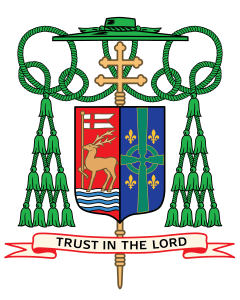
The Most Rev. James Ruggieri (56) was ordained a bishop and installed as the fourteenth Bishop of Portland Maine on May 7.

According to the diocesan website, “The personal arms of Bishop Ruggieri are divided horizontally (per fess). The upper half is painted white (argent) and bears an anchor painted blue (azure). It recalls the birthplace and home of the Bishop in the Diocese of Providence, Rhode Island. That state’s flag and seal comprise a gold anchor and a scroll with the motto “Hope.”

The anchor is an ancient symbol of the theological virtue of hope, deriving from the words of the Letter to the Hebrews: “We have this hope as a sure and steadfast anchor of the soul …” (Hebrews 6:19). In this depiction, the stock of the anchor is positioned on the shank to resemble a Passion Cross, an equally ancient symbol of the theological virtue of faith. As Pope Benedict XVI pointed out, “Hope, in fact, is a key word in Biblical faith—so much so that in several passages the words faith and hope seem interchangeable. Thus, the Letter to the Hebrews closely links the “fullness of faith” (10:22) to “the confession of our hope without wavering” (10:23).

In the lower half of the shield is a depiction of the five loaves and two fish that the Lord Jesus multiplied to feed five thousand men and their families. The only pre-resurrection miracle that is recounted in all four Gospels (Mt 14:13-21; Mk 6:32-44; Lk 9:10b-17; Jn 6:1-15), it holds a special place in the story of the public ministry of Jesus and points to the institution of the Eucharist at the Last Supper. The Feeding of the Five Thousand also highlights the cooperation of the apostles – whose successor the bishop is – with the Lord, both in the ministry of charity, and as celebrants and guardians of the Holy Eucharist and the other sacraments.”

The episcopal cross is depicted incorrectly, but more about that to follow.

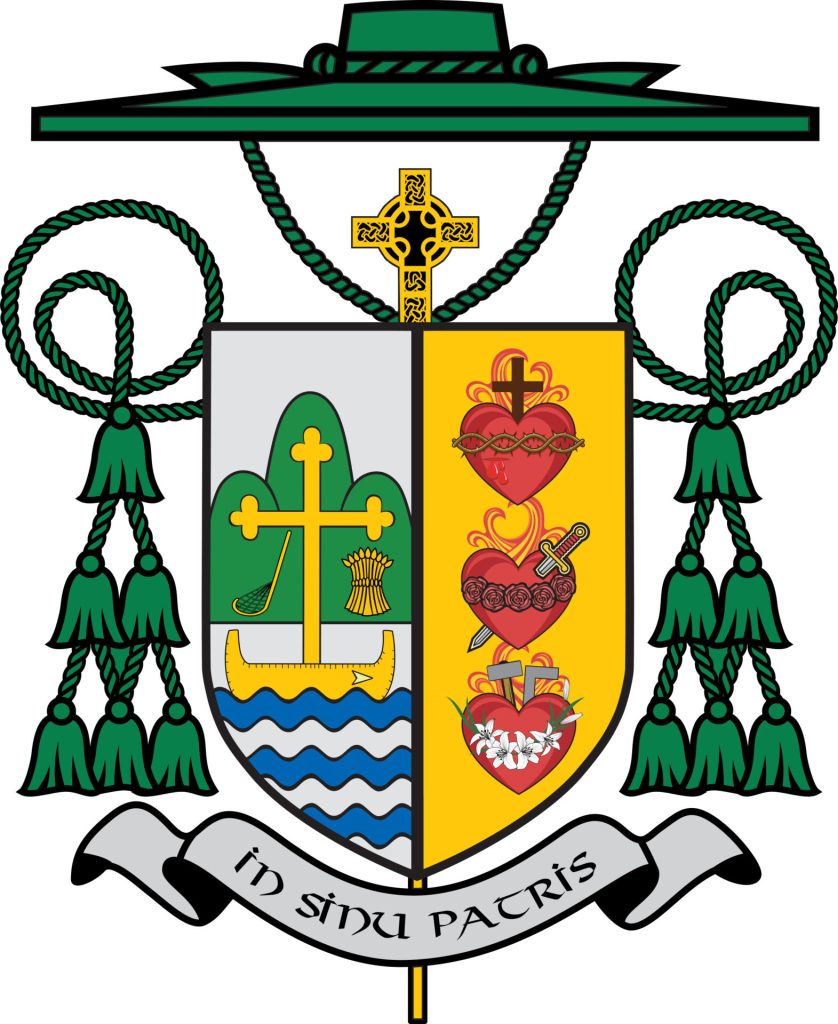
The Most Rev. William Battersby (64), Auxiliary Bishop of Detroit, was installed on May 20 as the eleventh Bishop of La Crosse, Wisconsin.

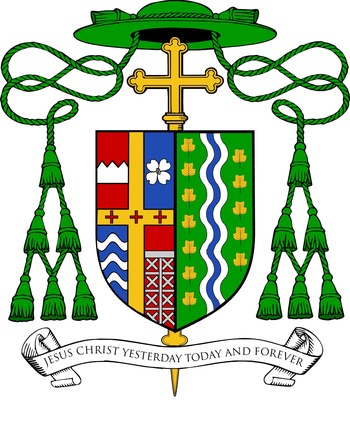
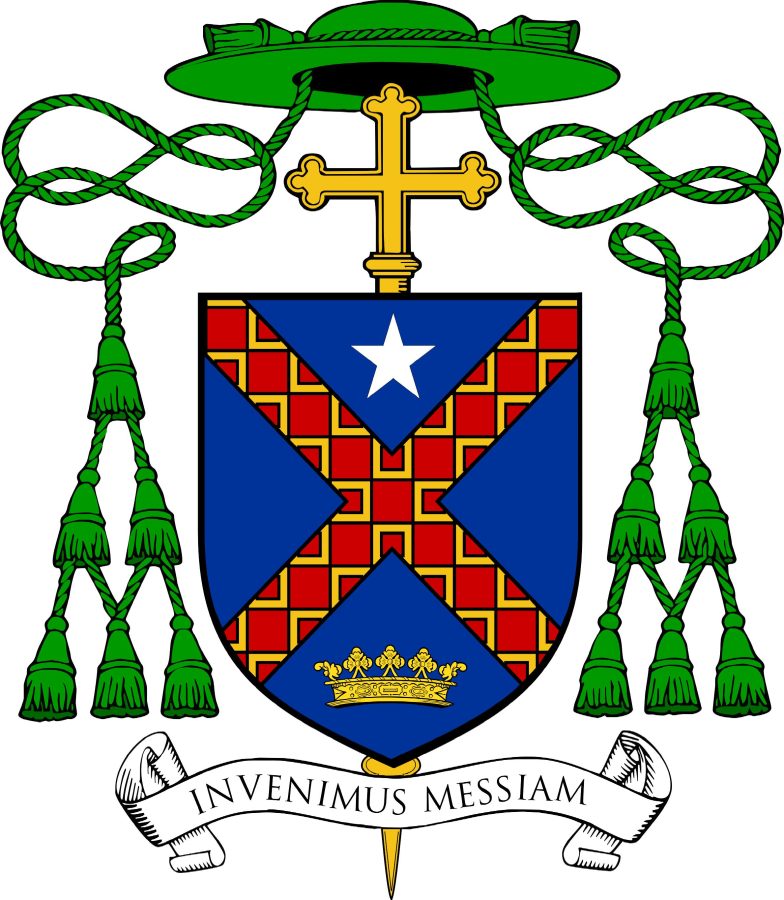
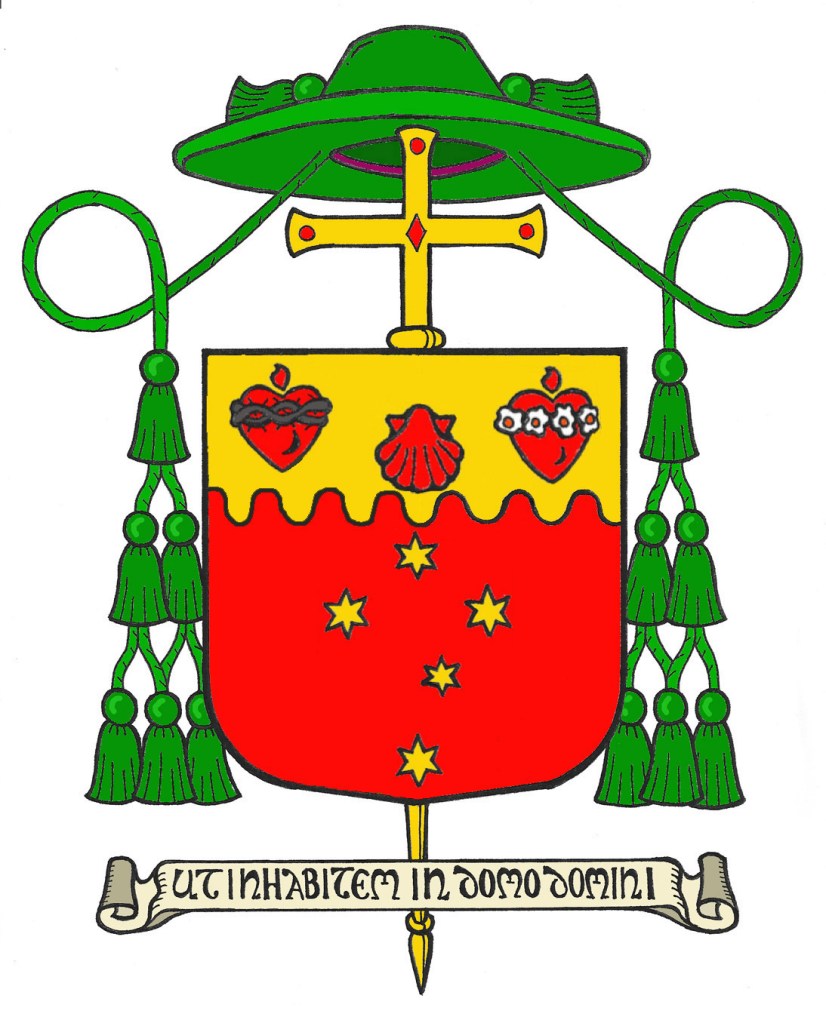
His coat of arms, while very simple, seems a bit overly given to the devotional. The explanation from the diocesan website says, “For the personal coat of arms of Bishop Battersby…at the top of the shield is a Celtic processional cross meant to honor Bishop Battersby’s Irish heritage. It is shaped like a traditional cross but with a ring, representing the sun, around the intersection of the stem and arms. The whole cross is decorated with ornate Gaelic patterns.

Bishop Battersby’s Coat of Arms includes the three Sacred Hearts. The hearts represent the Holy Family and symbolize the unending and boundless love for us. The wounded heart signifies his devotion to the Sacred Heart of Jesus. It also pays tribute to Sacred Heart Major Seminary where he prepared for the priesthood and at which he served as vice-rector and dean of seminarian formation at the time he was called to the episcopacy.

The second heart, the Immaculate Heart of Mary, signifies the trust and confidence that Bishop Battersby has in the Blessed Mother’s intercession and protection. The sword symbolizes the sorrows of Mary, the flames represent her burning love for Jesus and us, her children and the roses represent her purity. 

Bishop Battersby’s devotion to St. Joseph is represented in the third of the Sacred Hearts, the Chaste Heart of Joseph, inflamed with love and adorned with the white lily of purity, a symbol of his faith and steadiness.”

Again, I’ll say something about the episcopal cross below.

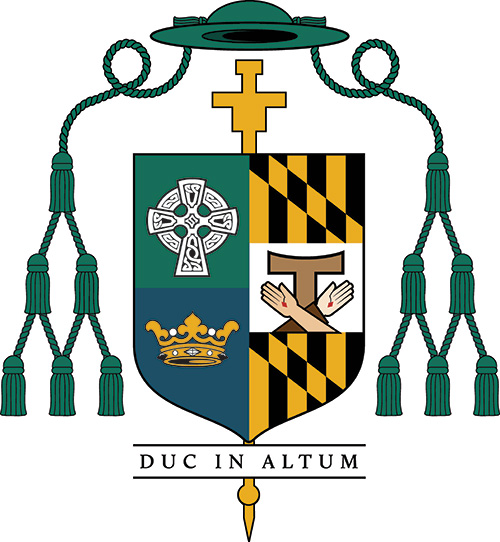
May 29 saw the ordination and installation of the Most Rev. Michael Martin, OFMConv (62) as the fifth Bishop of Charlotte, North Carolina.

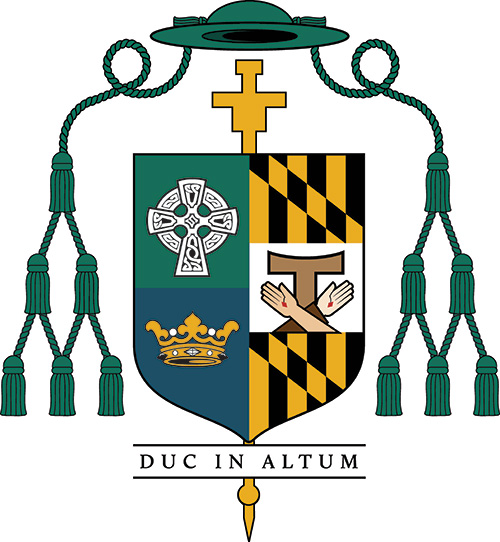
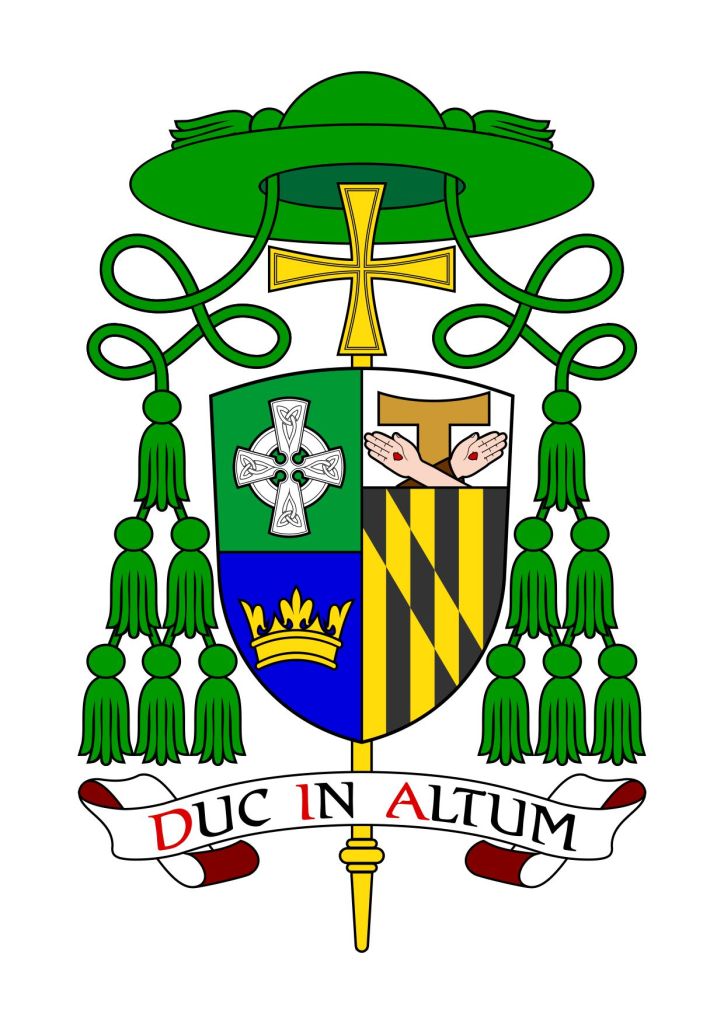
The diocesan website describes his personal arms, “To the viewer’s right is the Franciscan coat of arms. Featuring the traditional Franciscan Tau cross with two arms crossing one another, it is rich in symbolism. The two arms, one Christ’s and the other St. Francis of Assisi’s, both bear the stigmata. They symbolize God’s love and Francis’s loving response to the Word made incarnate, Taberski explained. It is an image found throughout the ministries, friaries, missions and sites served by the Franciscan order.

On the right side of the shield, the top (known as the “chief”) and the bottom (the “base”) feature references to George Calvert and his son Cecil Calvert – the first and second barons of Baltimore. The Calverts were among the first Catholics to arrive in colonial America. They established the then Province of Maryland as a safe place for English Catholics to emigrate to since they were no longer able to freely practice their faith at home. In the coat of arms, the use of six vertical stripes – alternately gold and black, with the diagonal stripe in color – recalls Bishop Martin’s hometown of Baltimore.”

A nice simple design but perhaps the arms of Calvert would have looked better depicted once in the main part of the field with the Franciscan symbols occupying a chief? And again there is an incorrect episcopal cross!

So, my criticism of that, which I have often written about in this blog, is that, firstly, it is NOT a “processional” cross!! It is an episcopal cross—a heraldic symbol—which indicates the coat of arms belongs to a bishop. It is, in fact THE heraldic symbol indicating episcopal arms. The galero, while traditional, is not necessary, nor is a green galero with 12 tassels exclusive to the arms of bishops. But the inclusion of the episcopal cross is truly the sign—and the only essential one—to indicate that the achievement depicts the coat of arms of a bishop.

As an external ornament it is NOT subject to personalization. An armiger has a great deal of choice regarding what is depicted on the shield. However, the external ornaments are not subject to his whim, nor may they be used to convey further personal significance or symbolism. Rather, their purpose is to indicate rank in the overall achievement. The blazon may not specifiy a certain type, shape, color, ornamentation, or embellishment to the galero, or the episcopal cross. Each and every artist is free to depict the episcopal cross as he pleases.

This idea of extending the personal symbolism to the external ornaments is occurring more and more of late…as more and more people with very little background in, or knowledge of heraldry are being asked to design episcopal coats of arms. It is amateurish and a grossly mistaken thing to do.
New Coadjutor of Camden, New Jersey

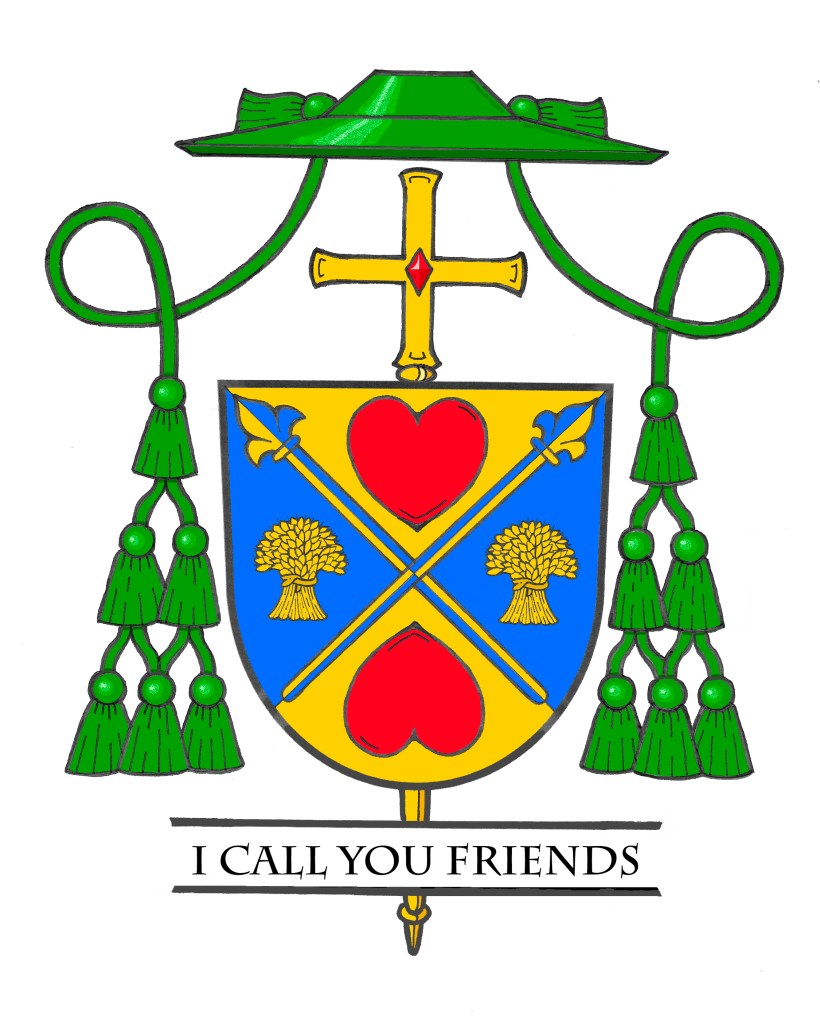
On May 21 Pope Francis appointed the Most Rev. Joseph Williams (50) a priest and bishop from the Archdiocese of St. Paul-Minneapolis to be the Coadjutor Bishop of Camden, NJ. Bishop Williams has been serving as Titular Bishop of Idassa and Auxiliary of St. Paul-Minneapolis since 2022. He will assist the current Bishop of Camden, Dennis Sullivan (74) whose resignation from the See of Camden, submitted in 2020 when he turned 75, will be accepted on his 80th birthday, March 17, 2025. At that time, as Coadjutor, Bishop Williams will automatically succeed to the See. There are no longer Coadjutor Bishops without the right of succession appointed in the Church as there had been at one time.

The Bishop’s coat of arms (below) will make for an interesting achievement when eventually impaled with those of the Diocese of Camden.

The arms of the See of Camden are composed of a black field on which are placed three silver elephants’ heads, which are arms derived from the arms of Charles Pratt, First Earl of Camden and Lord Chancellor of England, and for whom the See City is named. Three gold crosses accompany the elephants’ heads, in honor of the Blessed Trinity and for difference in order to make the shield peculiar to the Diocese of Camden. Above the elephant heads and crosses is a silver crescent to honor the Blessed Virgin Mary in her title of the Immaculate Conception, titular of the Cathedral Church in Camden.

Bishop Bersabal, Auxiliary of Sacramento

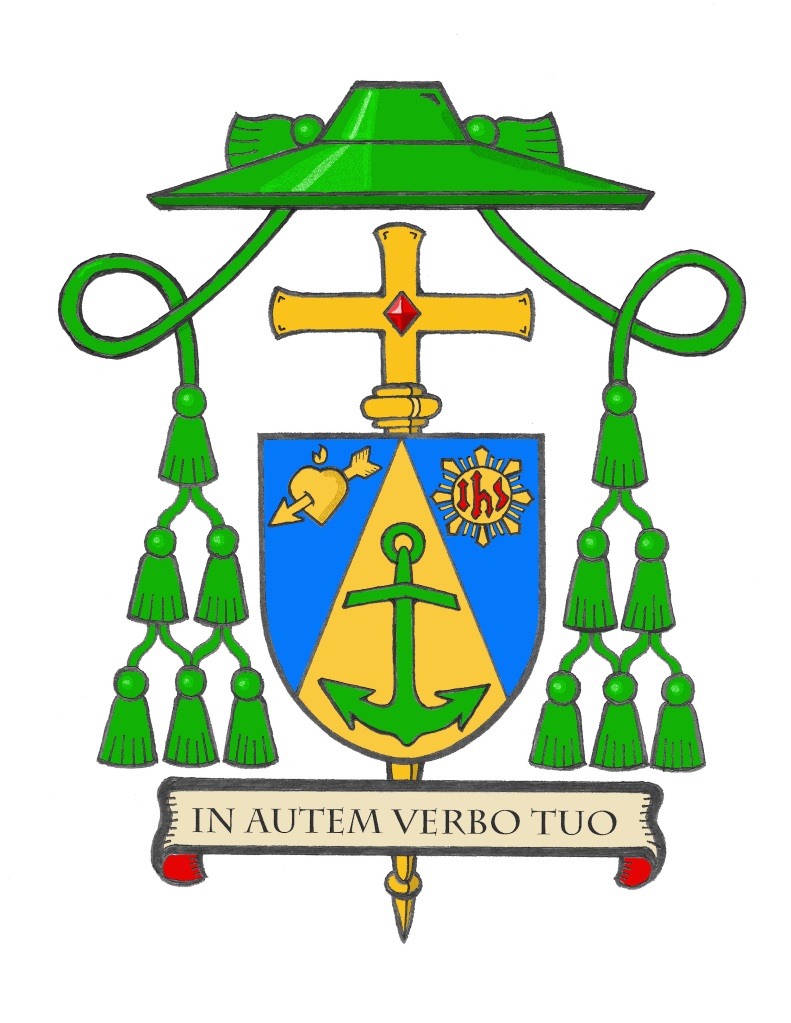
Father Reynaldo Bersabal (59) who was originally a priest of the Diocese of Cagayan de Oro in his native Philippines and who later incardinated as a priest of the Diocese of Sacramento in California has been named the Titular Bishop of Balecium and Auxiliary Bishop of Sacramento. His episcopal ordination will take place on May 31.

The main part of the shield shows a similar background to the coat of arms of the Diocese of Sacramento with the colors reversed. The field is blue with a large gold (yellow) triangular shape called a “pile”. In this case it is a pile reversed issuant in base. On this pile is a green anchor which is a symbol of the theological virtue of Hope. The anchor has long been a symbol associated with hope and green is the liturgical color used in Ordinary Time because it is also a symbol of hope and growth.

At the top of the shield to the left is a symbol for St. Teresa of Avila, to whom the bishop has a great devotion. The saint herself described her heart as having been pierced by God’s love with a spear, or arrow that was aflame. On the right is a  gold (yellow) sun on which appears the three letters “IHS” in red. This sunburst charged with the monogram is used as a symbol for three things. It is a depiction of the Holy Name of Jesus using the first three letters of His name in Greek. This is borrowed from the coat of arms of Pope Francis who appointed the bishop. The shape of the sunburst is borrowed from the flag and coat of arms of the Philippines where it is seen prominently. So, it is a symbol of his native place. It also has the appearance of the monstrance containing the Sacred Host and so it is thirdly symbolic of the Eucharist since he has been appointed a bishop during the national Eucharistic revival. As a symbol of the Blessed Sacrament it is also another allusion to the Diocese of Sacramento.

The motto below the shield is, “In Autem Verbo Tuo” from Luke 5:5.

I was pleased to be able to assist the bishop with the creation of his coat of arms.

A Philly Trifecta

On Friday, March 7 the Most Revs. Keith J. Chylinski (52), Christopher R. Cooke (50) and Efren V. Esmilla (61), all three priests of the Archdiocese of Philadelphia, were ordained bishops in the Church and appointed as Titular Bishop of Gunela, Titular Bishop of Malliana, and Titular Bishop of Ottana respectively, as well as Auxiliary Bishops of Philadelphia. Bishop Chylinski was fortunate to receive the Titular See of Gunela which had belonged most recently to Christophe Cardinal Pierre, the Apostolic Nuncio to the United States who was present at the liturgy of ordination. That’s rather unusual. He, of course, relinquished his episcopal titular see when he was created a Cardinal-Deacon.

The coats of arms of the three new Auxiliaries are:

There are two curious things about Bishop Chylinski’s coat of arms. The blazon and explanation say that the crosses are, “…crosses pattée, sometimes referred to as Maltese crosses…”

Indeed those depicted are Maltese crosses but that is definitely not the same thing as crosses pattée. Those are two different charges. The blazon should called them crosses of Malta. Pattée crosses have straight edges on them. In addition, it depicts and explains that the episcopal cross (which is incorrectly described as a “processional” cross, which it is not) has a blue gem at the center to honor Our Lady and also an escallop shell on the node to allude to St. James. Those two additions are heraldically unsupportable. The external ornaments indicate the rank of a bearer and are not subject to personalization in this manner. They are depicted generally in a conventionally accepted form and individual artists are free to depict them in their own style.

The blazon, which is not only an official description of a coat of arms but, truly, where the design of the coat of arms “lives” (as opposed to any one artistic rendering), may not stipulate the appearance and depiction of any of the external ornaments. It may indicate that they are part of the achievement but not how they are to be depicted. In ecclesiastical heraldry the Church regulates the use of the external ornaments. The blazon of the arms must be limited to the charges on the shield.

Bishop Barbosa

On Saturday, February 3, the Most Rev. Christiano Barbosa (47) a priest of the Archdiocese of Boston, was ordained as the Titular Bishop of Membressa and Auxiliary Bishop of Boston by His Eminence Sean Cardinal O’Malley, OFM Cap.

The anchor is a fitting charge and placing it overall is also fine heraldically but having it right up against the rather unnecessary “diminished” bordure when they are both gold is heraldically questionable and artistically awkward. The use of the constellation of the Southern Cross as a symbol for Brazil is also a bit odd since it’s usually associated with Australia or New Zealand owing to its inclusion on the flag of those nations.

Other than that the rest of the achievement is fine.

Bishop Dorsonville RIP

The Most Rev. Mario Dorsonville (63) a native of Bogotá, Colombia who incardinated as a priest of the Archdiocese of Washington, DC in 1999, and who also served as Auxiliary bishop of that same archdiocese from 2015-2023 before being appointed as the 5th Bishop of Houma-Thibodaux on February 1, 2023, sadly passed away on January 19, 2024. His funeral will take place on February 1 exactly one year after the announcement of his appointment as bishop of the diocese. May he rest in peace.

Worth Repeating

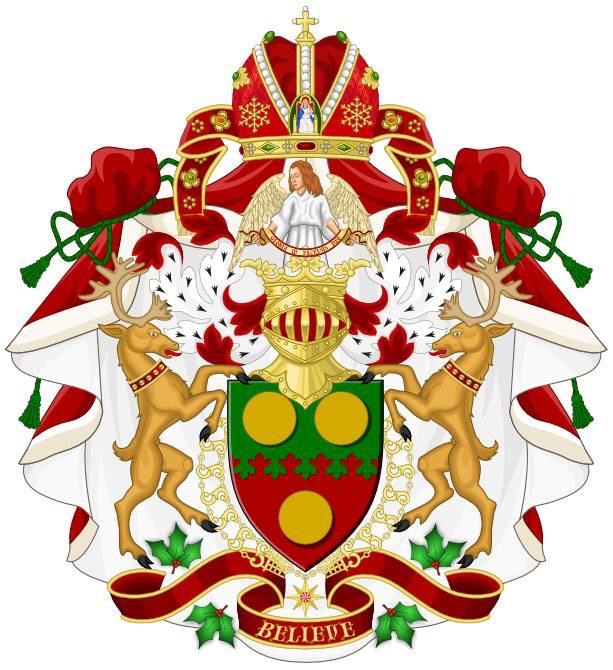
Last year I shared this idea as we approached the Christmas season. I thought I was worth seeing again.

At this festive time of year it is a bit of fun to wonder if there is a bishop in the Church who can claim to have jurisdiction over the North Pole and, thus, be Santa Claus’ pastor. I think such a claim might be made by the Territorial Prelature of Tromsø which is in the northernmost part of Norway. A portion of the territory of the prelature is above the arctic circle.

The Prelature is currently served by an Administrator

Bishop Strickland

The Most Rev. Joseph E. Strickland (65), originally a priest of Dallas, Texas, later incarnated to Tyler, Texas and since 2012 Bishop of Tyler was removed from that office on November 11, 2023 by the Roman Pontiff.

Back in 2012 when he was appointed as Fourth Bishop of Tyler I had the happy task of designing his coat of arms. Now that he has ceased to be the Bishop of Tyler his coat of arms will be modified to reflect that reality. He remains a bishop in the Church and, as such, retains the use of his armorial bearings. His coat of arms at the time of his ordination and installation was:

Now that he has been removed as Ordinary of Tyler, his armorial bearings will appear as this:

Bishop Maekawa, OP

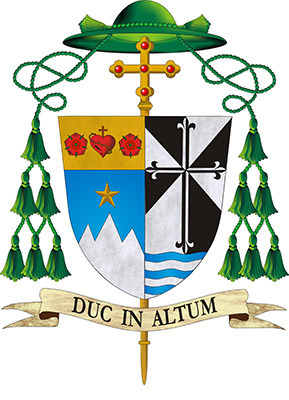
On October 12, the Most Rev. Stephen Maekawa, OP (55) a priest of the Order of Preachers (i.e. the Dominicans) living and working in Alaska was ordained a bishop and installed as the 10th Bishop of Fairbanks, Alaska.

His coat of arms is:

According to the diocesan website:

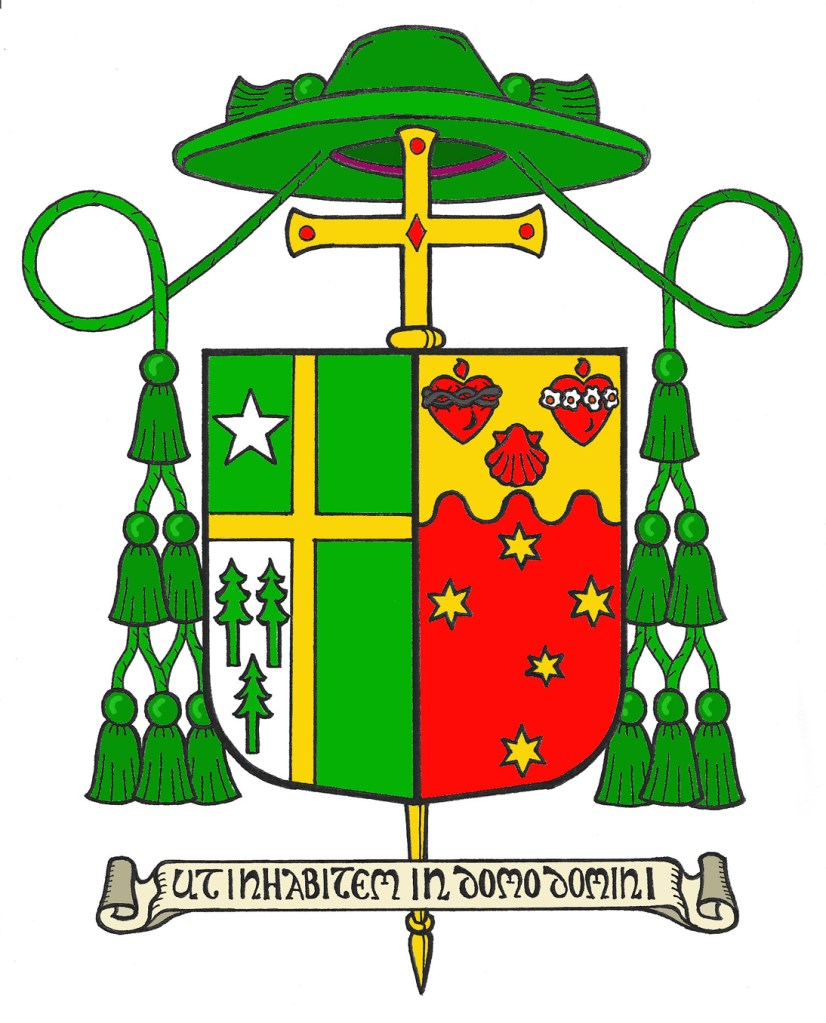
In the right side of the shield (to the observer’s left), we find represented the coat of arms of the Diocese of Fairbanks. At the base, the North Star is suspended on a blue field over the mountains of Alaska, which appear in white. In the upper section, between two red roses on a field of gold, is the Sacred Heart of Jesus, titular symbol of the Cathedral of the diocese. The roses, representing St. Therese of Lisieux, patroness of the Alaska Missions, recall her promise, “After my death I will let fall a shower of roses.

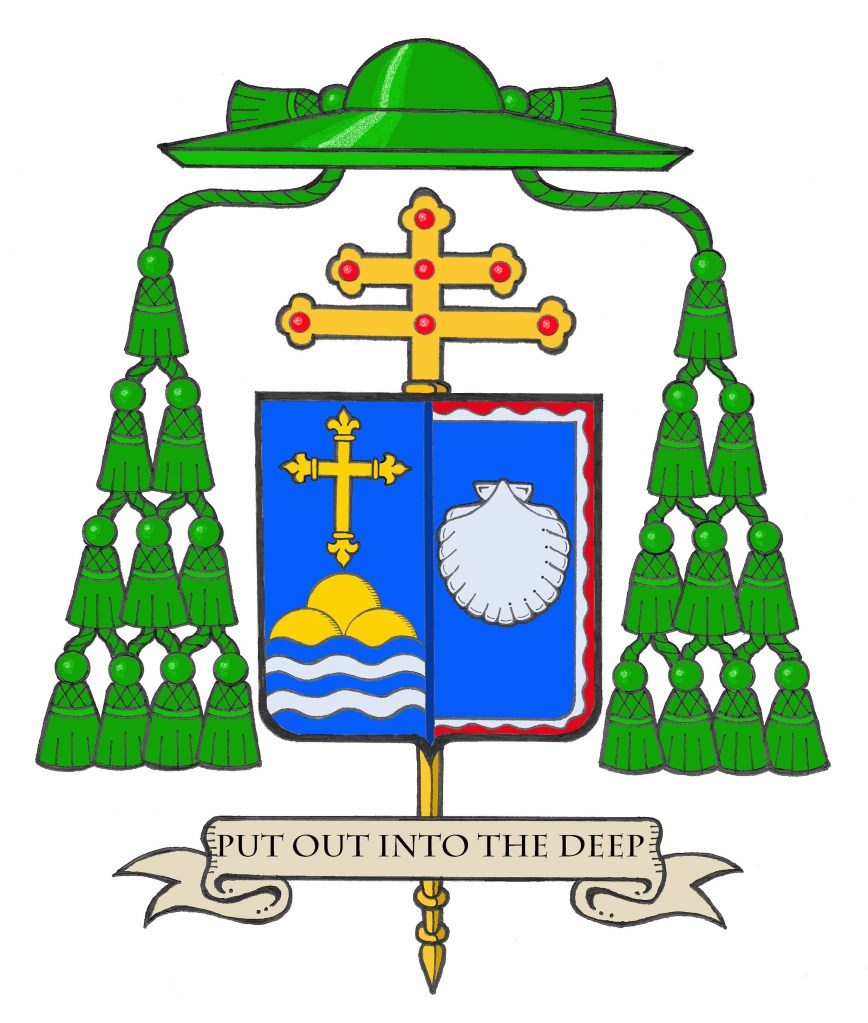
In the left side of the shield (to the observer’s right) is the personal coat of arms of Bishop Maekawa. The black and white cross is the from the coat of arms of the Order of Preachers founded by St. Dominic in 1216. The waves represent the waters of baptism and the family name Maekawa which means “before the river.” The episcopal motto “Duc in Altum” is Jesus’ command to the Apostle Peter, “Put out into the Deep” which reminds us to trust in the Lord Jesus believing that all creation belongs to God: “The earth is the Lord’s and all it holds, the world and those who dwell in it.” (Ps 24:1)

I think, unsurprisingly, the bishop has chosen a simple coat of arms reflecting his Religious community. It harmonizes well with the diocesan arms with which it is impaled. A nice design that doesn’t try to do too much–perhaps the single biggest error made by most new American bishops.

The L.A. “Quad”

On September 26, in an unprecedented liturgy, the Archdiocese of Los Angeles received four new Auxiliary Bishops at the same time. While it is unusual for any diocese to receive so many new bishops at once it seems almost fitting for the U.S.’s largest archdiocese of well over 4 million Catholics to receive the needed assistance in episcopal ministry in order to serve the people of southern California adequately. Bishops Albert Bahhuth (66), Matthew Elshoff, OFM. Cap.(68), Brian Nunes (58) and Slawomir Szkredka (49) were all ordained to the episcopate by the Most Rev. José Gomez, Archbishop of Los Angeles.

Their armorial bearings were all designed by James-Charles Noonan. As he usually does he makes a great deal about the shape of the episcopal cross in each achievement as well as the “significance” of the shape and color of the gemstone in each one. None of that is heraldically supportable. It may be his favorite idea but, as I have written about extensively in the past, the external ornaments in a coat of arms are not personalized not do they contain unique and special symbols particular to the armiger. That would require they be blazoned as such and would then have to be copied by any artist rendering the coat of arms. Only the charges on the shield are unique to the armiger.

Even there, Mr. Noonan has placed his own stamp on these four coats of arms. Acknowledging the unusual nature of four bishops being ordained at once he has included a similar chief in all four coats of arms as a means of tying them all together by the use of this similar charge. The idea in and of itself has some merit. The occasion was unique; something unique to mark it is a nice idea.

However, the coats of arms of auxiliary bishops do not contain charges that represent the jurisdiction in which they will serve as auxiliary bishop. A heraldic representation of possessing jurisdiction over a diocese belongs to the Ordinary of the diocese alone. In addition, a reference to the diocese (by borrowing a charge from the diocesan coat of arms) is quite common in heraldry. But, that isn’t what has occurred here. Instead of each coat of arms borrowing some charge from the arms of Los Angeles the four new bishop’s arms all bear an almost identical chief–an ordinary charge–in a manner not unlike those used to signify membership in a Religious Order or an Order of Chivalry.

Don’t misunderstand me: my criticism is not of the idea of heraldically marking the unusual circumstance of four bishops being ordained all at the same time. Rather, it is of the use of a near-identical charge, and one that sort of implies a kind of jurisdiction, that I am criticizing. It’s a clever devise. But, perhaps a bit “too clever” for its own good. In addition, one has to consider that all four of these bishops may not–indeed very likely will not–remain as auxiliaries of Los Angeles permanently. Once one of them is translated to another diocese the whole unifying symbolism uniting all four coats of arms begins to fall apart. Perhaps the use of a single similar charge employed differently in each of the coats of arms would have been a better solution?

The design of each of the rest of the four coats of arms is quite correct and very nice. As usual, Mr. Noonan’s regular collaborator in producing the artwork has shown herself capable of creating very fine work.

The following are the coats of arms of Bishops Bahhuth, Elshoff, Nunes and Szkredka:

Two for San Diego

On September 28 of this year the Most Rev. Michael Pham (56), a priest of the Diocese of San Diego, CA will be ordained a bishop and will serve as Titular Bishop of Cercina and Auxiliary Bishop of San Diego. On the same day, the Most Rev. Felipe Pulido (53), a priest of the Diocese of Yakima, WA will be ordained the Titular Bishop of Buffada and also serve as Auxiliary Bishop of San Diego.

I was happy to assist both of these new bishops with the creation of their respective coats of arms. The armorial bearings of Bishop Pham are:

The shield is divided horizontally to depict a silver (white) sky above a blue wavy ocean. The ocean is criss-crossed by diagonal lines in order to create a pattern suggestive of a fisherman’s net. This has more than one meaning. First, it represents that after 1975 while still living in Vietnam the bishop’s father became a fisherman to provide for his family. In addition, the net indicates not only the task of an apostle (or a successor to an apostle) of being a “fisher of men” but it also alludes to the New Evangelization where we are exhorted to put out into the deep (Duc in Altum). This symbolizes both the bishop’s priestly and episcopal ministry. 

In the upper part of the shield the main charge is a boat on the waves under full sail. The boat also alludes to the work of a fisherman. In addition, a boat, in heraldry, is often used as a symbol of the Church itself, often referred to as the barque of Peter, who was a fisherman himself. On the sail of the boat in the center is a red beehive surrounded by two green palm branches. The beehive is a symbol of St. John Chrysostom, the bishop’s baptismal patron saint. Chrysostom was the archbishop of Constantinople and renowned for his inspiring preaching. So, he was known as a “honey-tongued” preacher, hence the beehive as his symbol. The palm branches are an ancient symbol of martyrdom. The bishop’s family comes from the first diocese in the north of Vietnam where his ancestors were among the first martyrs for the faith in that part of the world.

On either side of the boat are eight red tongues of fire which also have more than one meaning. First, they are symbols of the Holy Spirit which, the Sacred Scriptures remind us, descended on the Apostles as tongues of fire at Pentecost. This was the beginning of their ministry to go out into the world to preach the Gospel so it is another symbol of Evangelization. Throughout his priestly ministry the bishop has worked with various groups of different ethnic and cultural backgrounds. Many flames represent a diversity of communities. Bishop Pham strengthened the cultural communities found in the diocese and shared them with the larger Catholic community. He has served as Episcopal Vicar of the Office of Ethnic & Intercultural Communities. Six years ago, he launched the first-ever Pentecost Mass for All Peoples, which has come to attract more than 2,000 faithful annually. So, symbols of the Holy Spirit were seen to appropriately reflect this ministry. It also reflects how, on Pentecost, when the Holy Spirit descended, people from many different and various places, languages and cultures heard the Apostles speaking in their own languages. The red of the boat, the beehive and the tongues of fire is a further allusion to the blood of the martyrs.

The motto below the shield is, “Hiệp Nhất trong Chúa Kitô” which means “One in Christ” or “United in Christ” in Vietnamese. This motto reflects the work the bishop has done throughout his priesthood to help various communities and to work towards the unity of diverse cultures and groups within the People of God.

The armorial bearings of Bishop Pulido are:

The shield is divided into four quarters with wavy horizontal lines from top to bottom. In the first and fourth quarters the lines alternate blue and silver (white) while in the other two quarters they alternate red and gold (yellow).

The blue and white lines represent the Blessed Virgin Mary. In addition, they suggest water which also alludes to Jesus washing the feet of His disciples. In addition, they can be seen as referring to the waters of Baptism. The red and gold (yellow) lines represent the Holy Spirit and fire. In addition, the colors can be seen as referring to the Blood (as well as water) that poured from the side of the Lord at His crucifixion. They are also seen as referring to bread (gold/yellow) and wine (red) as a reference to the Eucharist. In this way these lines also refer back to the foot washing because Jesus was showing His disciples the kind of self-sacrificing service they were called to which was about to be played out in His sacrifice on the cross and would be experienced for them in the future whenever they came together to share the Eucharist.

At the center of the shield is a silver (white) roundel called a plate. On this plate is a simple symbolic representation of the Mandatum (washing of the feet). The outer edge of this roundel, or plate is a line composed of small humps. Such a line is called “invected” in heraldry. It is borrowed from the coat of arms of the Diocese of Yakima, WA where Bishop Pulido served as a priest before being named a bishop.

The motto below the shield is, “Building Communio” which is what the bishop sees as the purpose and goal of his episcopal ministry.

Bishop Lohse of Kalamazoo

On July 25, the Feast of St. James, Rev. Mons. Edward M. Lohse (61) a priest of the Diocese of Erie, PA since 1989 (and a man who was two years ahead of me at St. Vincent Seminary) is being ordained and installed as the Fifth Bishop of Kalamazoo, Michigan.

The cross in chief is from the attributed arms of St. Edward the Confessor. The division line wavy is from the arms of the See of Erie and it represents the lakeshore where Erie lies. On the fess are symbols of the Jesuit Order and the Benedictine Order both of which profoundly influenced the bishop’s formation and spirituality. The base uses the blue and silver fusils from the arms of Wittelsbach and, by extension, of Bavaria to symbolize his family and faith, both of which have their origins in Bavaria.

The arms are simple, clear and contrast nicely with the somewhat unfortunate arms of the See of Kalamazoo. I think a better composition of the arms would have been to place the Bavarian fusils in chief with the wavy division line beneath them and then have blue field with the cross throughout and the two symbols of the orders in the first and fourth quarters. That’s merely an opinion, mind you, and in matters of taste there can be no real dispute. However, the pattern of fusils in bend looks better at the top of the shield where the eye is first naturally drawn. A solid chief with a patterned base makes a weak composition, in my opinion, because it looks top-heavy.

In addition, the essentially silver (white) backgrounds of both of the roundels placed on a silver fess looks washed out and weak. They would have contrasted better being on a blue field and “popped” a bit more. Also, the cross and lettering on the medal of St. Benedict should be black, rather than blue. I suppose the same could be asserted for the letters on the Jesuit symbol as well.

Overall, it is still a good design and Bishop Lohse certainly has a coat of arms that is better than many other US bishops. That’s not saying much, however, given the appallingly bad heraldry employed by most US bishops. Nevertheless, I think this is a decent coat of arms. My criticism is intended to convey only that it could have been a little better without changing any of the symbolism, but just arranging it better.

Bishop Henning of Providence

In 2018, the Most Rev. Richard Henning, a native and a priest of Long Island’s Diocese of Rockville Centre, NY (and a high school classmate of mine) became Auxiliary Bishop of that diocese. I was pleased and honored to assist him with the design of his personal coat of arms to be adopted upon ordination to the episcopate.

Last year, the Holy Father appointed him to be the Coadjutor Bishop of Providence, Rhode Island, just across Long Island Sound from his former diocese. A coadjutor bishop is appointed to share in the authority of the diocesan bishop in running the diocese and has the right of automatic succession to the See when the previous bishop dies or retires. (NOTE: there used to be such a thing as coadjutor without the right of succession, but such appointments are no longer made). Bishop Henning succeeded to the See of Providence on the first of May of this year upon the retirement of Bishop Thomas Tobin becoming the IX Bishop of Providence. So his armorial bearings have been altered to impale his personal arms with those of the See:

The arms of the Diocese of Providence are composed of a blue field on which are placed three silver (white) crosses with arms that appear to terminate in anchors. These crosses, heraldically known as “moline crosses,” are used to suggest an anchor. By employing the symbol of the State of Rhode Island this signifies that the Diocese of Providence encompasses all of the state it was established to serve. The crosses, three in number to signify The Trinity, are rendered in the traditional colors of water, blue and silver (white), because of the importance that water plays in the life of “The Ocean State.” These colors are also the traditional colors for the representation of the Blessed Virgin Mary, who, in her title of Our Lady of Providence, is Patroness of the Diocese and of the See City.

Bishop Henning’s personal coat of arms is composed of a design depicted in red (Gules), white (Argent) and blue (Azure) which are the national colors of the United States.

Both the blue background and the single escallop shell allude to the sea as evoking the Bishop’s own background and the shell is also borrowed from the coat of arms of the See of Rockville Centre, the diocese in which he was born and raised and which he served as a priest and auxiliary bishop. The shell image also recalls the Bishop’s heritage in the Diocese of Brooklyn, dedicated to its patron, St. James. The episcopal ordination of Bishop Henning took place on the eve of the Feast of St. James. In concert with the Bishop’s motto, the shell is a traditional symbol of baptism and pilgrimage. It is in the depths of these waters that Christians find their salvation in Jesus Christ.

The white wavy line surrounding the blue field is similarly taken from the arms of Rockville Centre and it alludes to the diocese’s location on Long Island, NY. Furthermore, it indicates the sea as the place where the barque of St. Peter, an image used to evoke the Church, is located.

The blue background also evokes the Bishop’s devotion to the Blessed Virgin Mary and his years of service as a Professor and Rector at the Seminary of the Immaculate Conception in Huntington, NY. The red wavy portion of the border evokes the Bishop’s devotion to the Most Sacred Heart of Jesus and his former service as the Director of the Sacred Heart Institute for the Ongoing Formation of the Catholic Clergy.

This situation was one of those times that chance presented a challenge. The bishop wanted to impale his arms with those of the See as is customary in N. America. In addition, he had no good reason to change the diocesan arms and no desire–correctly–to change his personal arms. Impaling them side-by-side presented an aesthetic challenge because they both employ blue fields. In addition, it is customary not to continue a bordure all the way around the field when the arms are impaled. Rather, there is a kind of dimidiation employed whereby the bordure is discontinued along the impalement line. In order to make the division between the two coats of arms more visible, and slightly less confusing a division line of very light blue (blue celeste, if you will) was employed for aesthetic reasons. This is really more of an artistic style choice rather than a heraldic one. Once again, it was my pleasure to assist him with this project.

Bishop Senior of Harrisburg

The Most Rev. Timothy C. Senior (63) a priest of Philadelphia who has served as Auxiliary Bishop there since 2009 was installed as the 12th Bishop of Harrisburg, Pennsylvania. His arms, assumed in 2009, are now impaled with those of his See. The black and white bordure in his personal arms are an interesting allusion to his love of playing the piano.

Bishop Edward Cullen of Allentown: RIP

The Most Rev. Edward Cullen, a priest of Philadelphia who served as Auxiliary Bishop there from 1994-1997 and who went on to become the Third Bishop of Allentown, PA from 1997-2009, passed away on May 9, 2023 at age 90. RIP.

The coat of arms he assumed upon becoming a bishop in 1994 is simple enough. Because so many bishops want to include as much symbolism as they can he decided against symmetry by having the garb and the star next to each other. The problem is that symmetry is an important aspect of heraldic art. It might have been better to place the star in the center between two garbs. Even though that increases the number of charges it provides for a more symmetrical look and avoids the appearance of a bunch of charges merely splayed across a shield. The garb may only represent one thing but having two of them would still have looked better.

Some might say, “But then it is as if they represent two separate things.” Only if you are being tiresomely literal. Solely for the sake of symmetry and a better composition and appearance, two garbs with a star between them would have been a better choice.

It is unfortunate that the personal arms and the diocesan arms both had fields Gules. But, sometimes that kind of thing happens. It would not have been a good idea to change the field in the personal arms to something else. Occasionally, the luck of the draw created some unfortunate combinations when marshaling arms together. That’s just the way it is. In such situations a bishop could consider not impaling his arms with those of the See or the artist could get creative with the depiction of the coat of arms by doing something like employing a division line of a color other than merely black to separate the two impalements.

Overall he had a nice coat of arms but with a little bit of help it could have been even better.