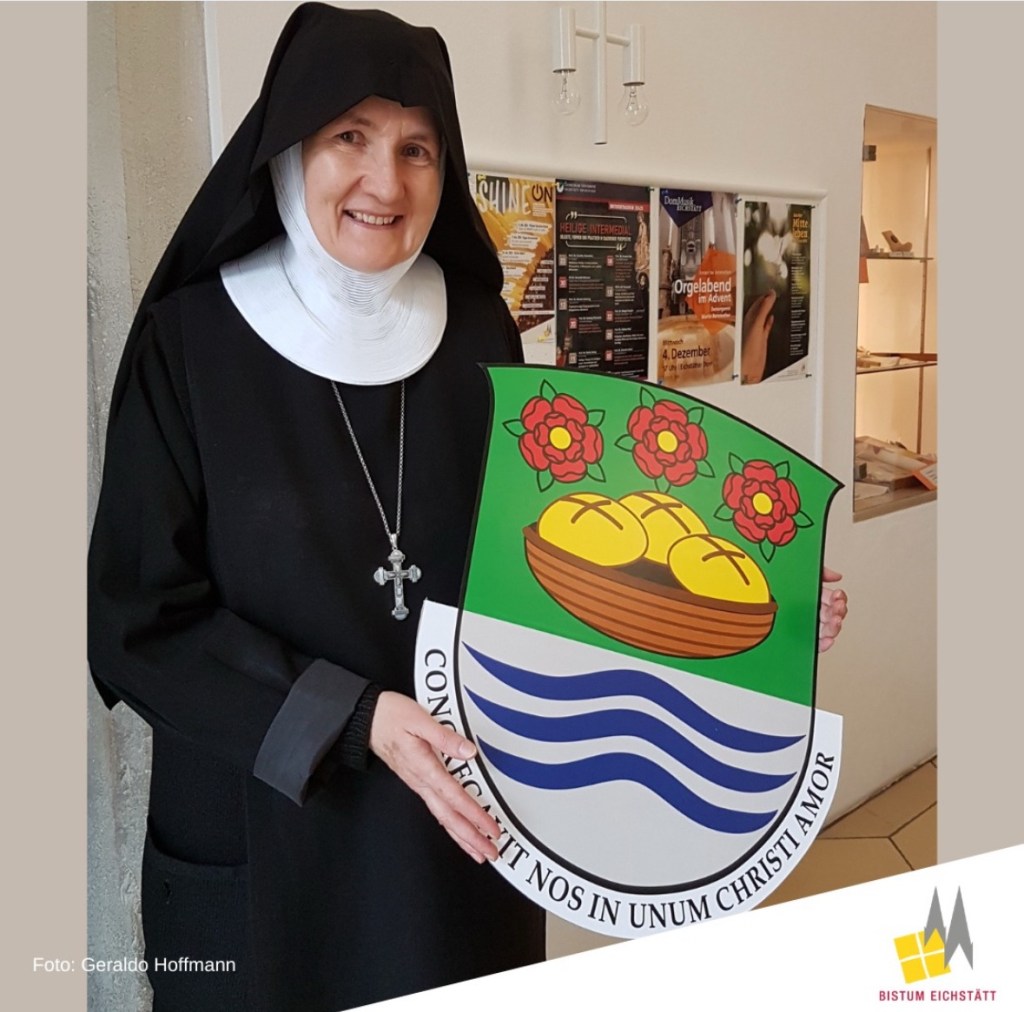
The Benedictine nuns of St. Walburga Abbey, Eichstätt elected Mother Elizabeth Hartwig, OSB as their abbess on October 28 of last year. On November 30 she received the abbatial blessing from the Rt. Rev. Barnabas Bögle, OSB, Abbot of Ettal.
Her assumed coat of arms depicts, in chief, the bread and roses that are symbols of her patroness, St. Elizabeth of Thuringia. In base the three wavy lines represent rivers from three places of importance in her life: the Elbe in Torgau where she grew up; the Saale in Jena where she studied; the Altmühl in Eichstätt where she became a nun. The motto says “We are bound together by the love of Christ”.
The coat of arms was designed by one of the nuns of the Abbey, Sister Caritas Dirr.
On September 14, the Feast of the Exaltation of the Holy Cross, the Benedictine Abbots from all over the world meeting in Congress at Sant’Anselmo in Rome elected the Most Rev. Jeremias Schröder, OSB (59) as the 11th Abbot-Primate of the Order.
Abbot Jeremias was elected the Archabbot of St. Ottilien in Germany from 2000. At that time the office of Præses (President) of the Congregation of St. Ottilien was ex officio joined to that of Archabbot. In 2012 it was decided to separate the two offices. Archabbot Jeremias resigned as Archabbot of the Archabbey and then continued as President of the Congregation of St. Ottilien until 2024. He succeeds Abbot-Primate Gregory Polan (74) who is an American and monk of Conception Abbey in Missouri.
The Abbot-Primate does not have juridical authority over the Order but serves as the titular head of the worldwide Benedictine Confederation of monks and nuns.
Using the armorial bearings he assumed as Archabbot, Abbot-Primate Jeremias would be entitled to impale his personal coat of arms with that used by the Order of St. Benedict.
Retired Archabbot of Saint Vincent Archabbey, Latrobe, Pennsylvania, Douglas R. Nowicki, O.S.B., (79), died Tuesday, July 23, in Allegheny General Hospital, Pittsburgh, following a brief illness. The eleventh Archabbot of Saint Vincent, he served from 1991 until he reached the retirement age of 75 in May of 2020, when he retired. He was the second longest-serving Archabbot in the 178-year history of Saint Vincent. With more than 150 monks, St. Vincent was the first Benedictine monastery in the United States, and is one of the largest monasteries in the world. He will be buried on July 29, 2024.
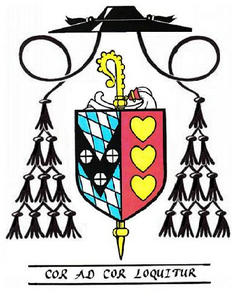
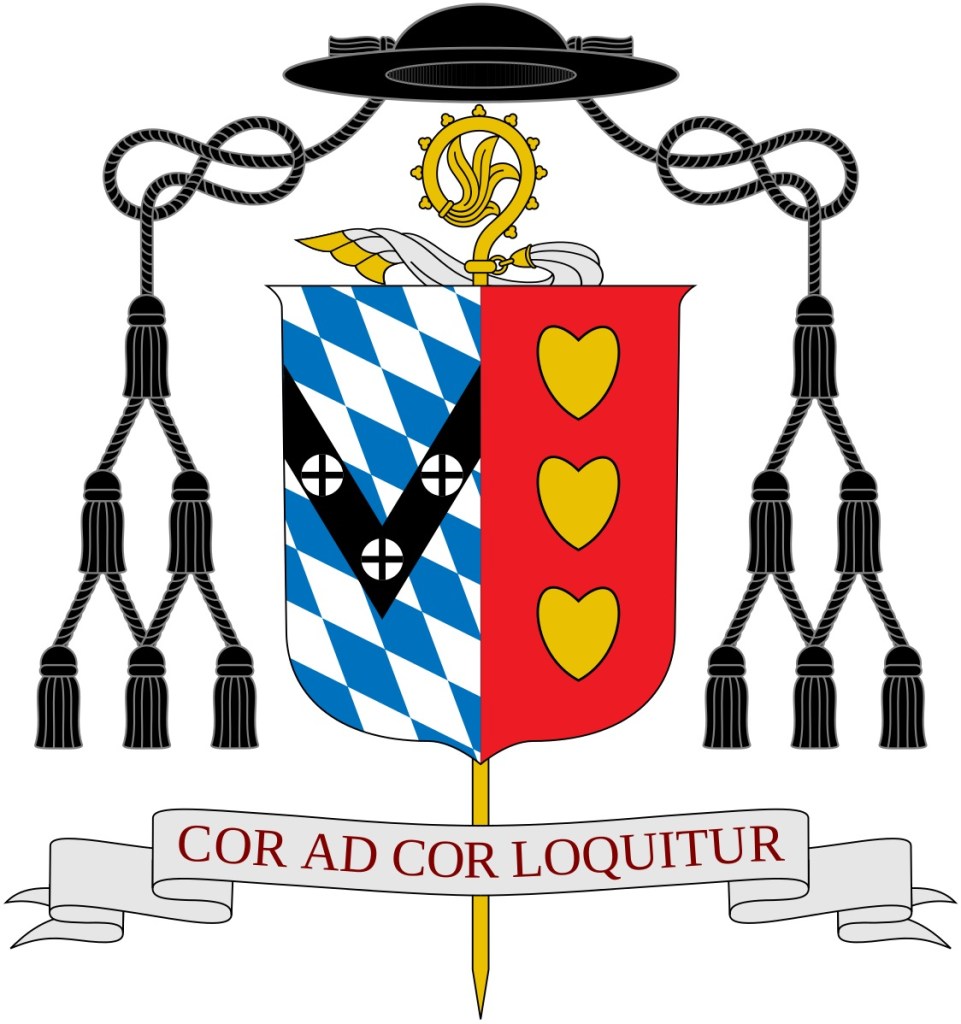
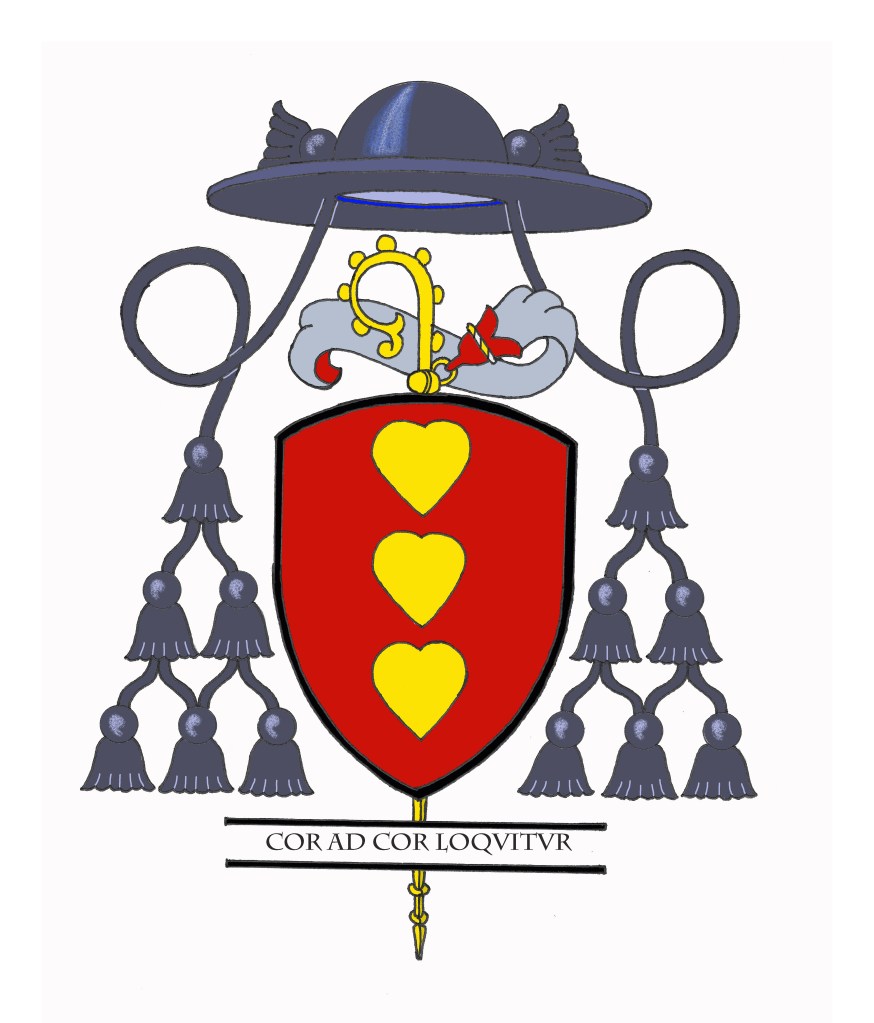
When he was elected in 1991 I was still a member of the monastic Community in Latrobe. My mentor—the late Géza Grosschmid, Ph.D.—and I were given the job of devising a coat of arms for the new Archabbot. Ultimately, Archabbot Douglas rejected the design Dr. Grosschmid suggested and went with a modified version of it devised by me. Essentially, it illustrated the motto, taken from St. John Henry Newman, “Cor Ad Cor Loquitur” which means “Heart Speaks To Heart”.
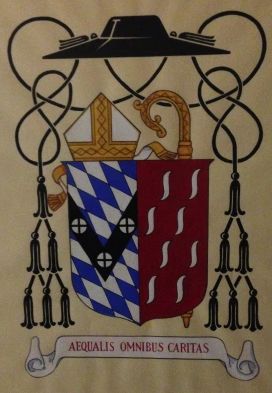
Above we see my original drawing of the coat of arms without the motto added. The dexter impalement depicts the coat of arms adopted by St. Vincent Archabbey in the early 20th Century under the abbatial term of the Rt. Rev. Alfred Koch, OSB, the 5th Archabbot of St. Vincent. It depicts the blue and silver elongated diamond-shaped fusils taken from the arms of the Royal House of Wittelsbach, the Kings of Bavaria. This alluded to the origin of the founding monk and first Archabbot of St. Vincent, Boniface Wimmer, OSB who was from St. Michael’s Abbey in Bavaria, as well as to the patronage and financial assistance given to the fledgling community through the Ludwigs-Missionverein, an organization established by King Ludwig I of Bavaria to support missionary efforts in the new world.
The black horizontal fess with three plates (white roundels) seen on the arms of William Penn is reshaped as an inverted chevron to form the letter “V” for Vincent and the three plates are charged with three crosses. The arms of the Archabbey are impaled—joined on the same shield—with the Archabbot’s personal arms. This marshaling of two separate coats of arms on the same shield employs the same method used for the coat of arms of two armigerous people who are married. It indicates the “marriage” of the armiger with the place of his jurisdiction with the arms of the jurisdiction occupying the place of the groom and the personal arms occupying the place of the bride.
The Archabbot’s personal arms, as I said, illustrate the motto.
I had also presented Archabbot Douglas with the option of displaying his arms ensigned by a galero with twenty tassels rather than merely twelve. In a manner similar to that of an archbishop using twenty tassels to a bishop’s twelve tassels, I proposed that as an Archabbot he also make use of this distinctive galero indicating his rank. Archabbots don’t actually have any greater jurisdiction or privileges over other Abbots (the one exception being that he may occupy a senior place in the procession whenever attending a gathering of several Abbots). In addition, none of the other previous ten Archabbots of St. Vincent made use of such a galero so, ultimately, he decided to honor that precedent and rejected the idea.
Although his two immediate predecessors had armorial achievements that did not display the usual veiled abbatial crozier Archabbot Douglas agreed with my suggestion he do so. When St. Paul VI reformed many things concerning the dress and externals of the hierarchy in 1969 one of his decisions included removing the mitre and crozier from the coats of arms of Cardinals, Archbishops and Bishops. They were seen as superfluous since episcopal coats of arms make use of the episcopal cross as the sign of the armiger holding the rank of (arch)bishop. However, it was not the intention to remove the use of the veiled crozier—a peculiarly abbatial heraldic symbol—from the coats of arms of Abbots. The veil became a symbol of abbatial croziers in a time before Abbots would have worn pontifical gloves when pontificating. The veil served the useful function of protecting the shaft of the crozier from dirt and oils from the hand. Later, even after pontifical gloves were used by Abbots, the veil, or sudarium, remained attached to the crozier to distinguish such a heraldic emblem from that of a bishop. Despite the reforms of St. Paul VI which referred to the coats of arms specifically of Cardinals, Archbishops and Bishops, the veiled crozier remains to this day as the heraldic emblem of Abbots and Abbesses.
As I said, Archabbot Douglas was happy to follow my advice in this regard. I noted on one of my subsequent visits to the Archabbey that the display of archabbatial coats of arms in the Archabbot’s outer office included a new rendering of Archabbot Douglas’ coat of arms with the veiled crozier omitted. It could be that there was simply an effort to have his coat of arms artistically conform to the pattern followed by his two immediate predecessors. One also is moved to wonder, however, if the person responsible was simply acting in ignorance? It would be hoped that the move was not a deliberate one. If it were, it would constitute an action displaying the most blatant ignorance of commonly accepted heraldic practices in the Church as laid out in the excellent and scholarly work of the late Bruno B. Heim, Heraldry in the Catholic Church, as well as in several other similar publications. In other words, don’t take my word for it! It’s verifiable independently of my opinion. In fact, my collaborator on this project for Archabbot Douglas, Dr. Grosschmid, was a close friend and collaborator of Archbishop Heim who was widely accepted as the foremost expert in Catholic ecclesiastical heraldry of his day. Dr. Grosschmid concurred with my assertion that the Archabbot’s coat of arms should employ the veiled crozier which is why I felt so comfortable advising the Archabbot in that way.
Nevertheless, in this later rendering it was omitted. I note, too, that Archabbot Douglas’ successor, Archabbot Martin de Porres Bartel, OSB, the twelfth Archabbot, similarly omits the veiled crozier from his armorial achievement, no doubt advised in the same manner that was (accidentally or deliberately) ignorant of the appropriate practices. I note, too, with some satisfaction that the Wikipedia article about Archabbot Douglas correctly displays his coat of arms according to the manner in which I designed it. (below)
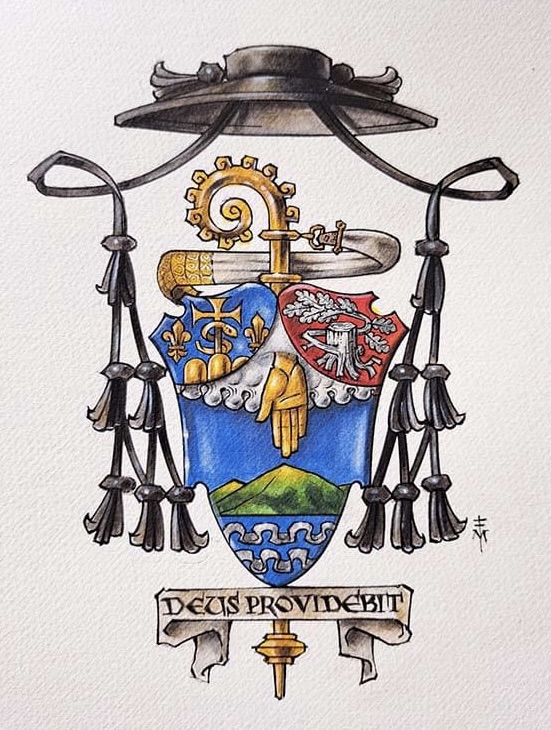
The armorial bearings of the newly elected Abbot of St. Benedetto in Monte in Norcia, Italy, the American, Rt. Rev. Benedetto Nivakoff, OSB, which were designed and executed by Marco Foppoli. In chief are the armorial bearings of the Abbey and the personal arms in base refer to the motto.
The Most Rev. Notker Wolf, OSB (83) the former Abbot-Primate of the Benedictine Confederation (2000-2016) who, before that, served as the Archabbot of St. Ottilien Archabbey in Germany from 1977-2000 passed away in Frankfurt on April 3, 2024. He had been leading a pilgrimage to Italy but felt unwell. In trying to return home he stopped off overnight in Frankfurt awaiting a morning flight to Munich but passed away during the night in his hotel room.
His arms (rendered by the late Michael McCarthy) were slightly modified after he originally assumed them (second image). In addition, the artist chose to give his galero an extra row of tassels since he was Abbot-Primate of the Order but there is no precedent for such a decision. Abbot-Primate and Archabbots usually use a galero with twelve tassels as other Abbots do. The arms reflected his love of music as well as his own Benedictine monastic life.
The Right Reverend Dom Cuthbert Brogan, OSB who first became Prior-Administrator of St. Michael’s Abbey at Farnborough in England in 1996 and was elected as its Abbot in 2006 has–at long last–finally become armigerous! Four years ago he was elected Abbot Visitor of the English-speaking Province of the Subiaco Congregation, to which his monastery belongs. At that time he finally decided to begin the process of applying for a grant of arms from HM College of Arms in London.
This is neither a quick (nor, I must admit an inexpensive) proposition. Nevertheless, those who live in countries where there is an official heraldic authority, such as the College of Arms, are subject to its jurisdiction and are not simply free to assume a coat of arms like those who live in places without a heraldic authority, like the USA for example. Here in the US an abbot may simply assume arms. In those places where there is a state-sponsored heraldic authority it may be illegal to do so, depending on the country.
Last week, Dom Cuthbert received his grant of arms and it is magnificent!
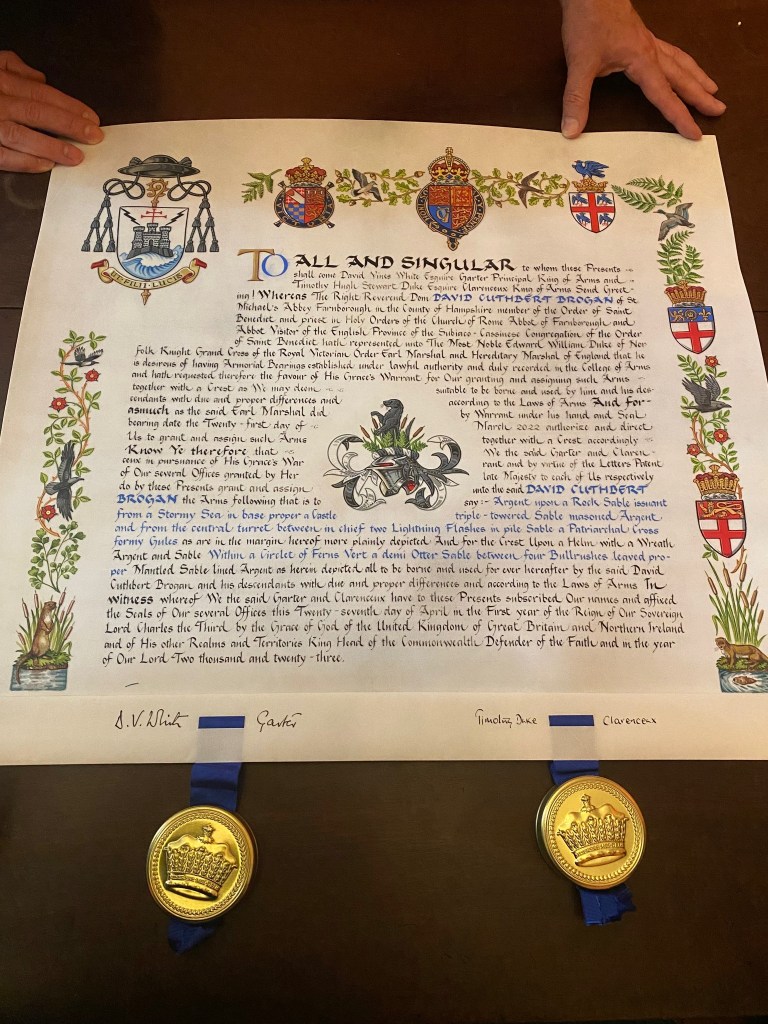
As is usually the custom (though not a necessity) a beautiful custom-made, illuminated document for the Letters Patent of the grant was produced. This one bears the royal arms at the top using the “Tudor style” crown preferred by His Majesty between the arms of the Earl marshal, the Duke of Norfolk and the College itself. The margins are decorated with the arms of office of Garter Principal King-of-Arms as well as Clarenceux King-of-Arms who also signed the Letters Patent. The margins also contain bullrushes and otters. The otters are symbolic of St. Cuthbert, the Abbot’s patron. He was born on the feast of St. Cuthbert. Otters warmed the saint’s feet with their breath when he emerged from the North Sea after a night of singing psalms. The bullrushes are for Rushmoor Borough, in which Farnborough Abbey is located. In addition, the raven is a symbol of St. Benedict, the roses are for England and the ducks are another animal alluding to St. Cuthbert.
The College of Arms is in the habit of also providing a crest even for their ecclesiastical clients despite the fact that the galero replaces helm, mantling and crest in the achievement of a cleric. Here the crest is also composed of a demi-otter and ferns and bullrushes (already explained). While it is not used in the achievement, the Abbot is free to use his crest as a stand alone symbol, or even adapt it and use it as a heraldic badge.
It is a nice touch, too, that the grant was dated March 21, 2022 which is the feast day commemorating the Death of St. Benedict.
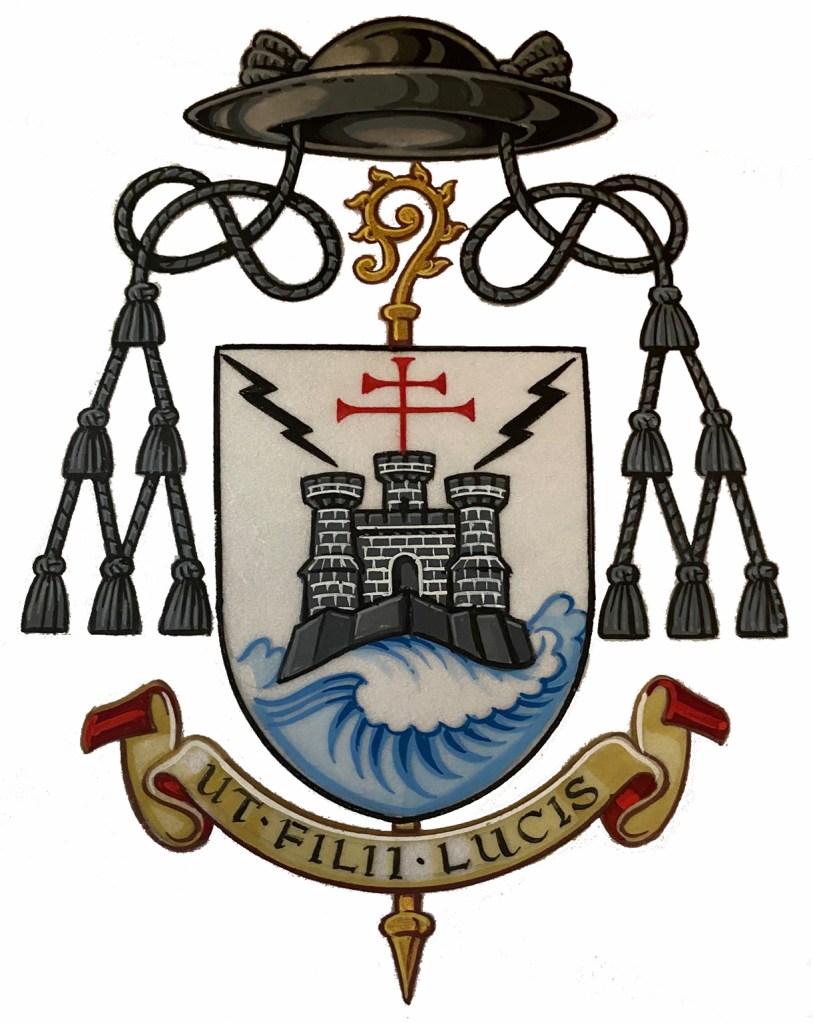
The arms themselves are explained by Abbot Cuthbert thusly: “The fortress is the monastic life – the house built on rock of the gospels. This keeps in certain values and excludes others. The island represents a number of islands – England, Lindisfarne, Mont St Michel, and Caldey – all associated with me or our monastery. The island also represented the fuga mundi – separation from the world which marks the monastic life. The patriarchal cross is from the arms of the Subiaco Cassinese Congregation. The stormy sea expresses how the monastery stands unchanging amongst the vicissitudes of church and world. The two bolts of lightning recall assaults on my monastery from two sources in the past. But the house stood firm“.
The motto below the shield translates as “The Children of Light”.
I am very pleased to say that I was one of the people encouraging Abbot Cuthbert over the years to apply for a grant of arms. It pleases me to no end that after quite a few years he did, indeed, follow my advice. I think the final result was worth the wait. The design is good; clear and simple. In addition, rather than falling prey to the temptation into which so many prelates fall by making their coat of arms a CV in pictures, this coat of arms is filled with significance while using simple imagery. The Abbot chose to symbolize concepts and events of significance to his life rather than his name, or his family name, or the many jobs and/or accomplishments or associations he has had. That’s where so many prelates fail. They insist on symbols of everything and everyone with whom they have been associated throughout theirs lives no matter how slight the association has been.
Abbot Cuthbert has avoided that pitfall and ended up with a bold, clear and very good coat of arms. His abbey also makes use of a fine coat of arms for the abbey itself (see below). Now I’ll have to start needling him to have a rendering done of his arms impaled with those of his abbey!
On March 8, 2023, the Right Rev. Antonio Fallica, OSB (63) who was appointed as the Abbot of the Territorial (Arch)Abbey of Montecassino on January 9, will be ordained to the priesthood. At the time of his appointment he was a Benedictine brother in Solemn Vows but not a cleric. It is a requirement that the holder of the office of Abbot be a cleric so he was ordained a Deacon on February 14 and is now being ordained a priest. Then he will be able to fully assume the office of Abbot. The arms (below) are those traditionally used by the (Arch)Abbey. It was also used by the last Abbot, Donato Ogliari, OSB who now serves as Abbot of St. Paul Outside-the-Walls in Rome and is currently still the Administrator of Montecassino until Abbot Antonio takes over. They are ensigned by a green galero rather than black because, although greatly reduced, the Abbey is still a Territorial Abbey (what used to be called an “Abbey Nullius”) and so its abbot uses the same galero as a bishop.
The Right Reverend Jonathan Licari, OSB who was ordained a priest of the Diocese of Duluth in 1976 and has been a monk of St. John’s Abbey in Collegeville, Minnesota since 1982 was elected as the 18th Præses or Abbot-President of the American-Cassinese Congregation on June 23, 2022 during a meeting of the General Chapter of the Congregation taking place at St. Benedict’s Abbey in Kansas. At the time of his election Abbot Jonathan did not yet possess the abbatial dignity. He received the solemn abbatial blessing the same evening as his election from the Most Rev. Elias Lorenzo, OSB who had himself served as the 17th Abbot-President of the Congregation prior to being appointed Auxiliary Bishop of Newark, NJ.
Abbot Jonathan had recently completed a term as Administrator of Mary, Mother of the Church Abbey in Richmond, Virginia and had also just been appointed by his predecessor as Abbot-President, Abbot John Klassen, OSB of St. John’s Abbey as the Administrator of St. Mary’s Abbey in Morristown, NJ (which also happens to be the monastery to which Bishop Elias belongs as a monk. Are you keeping up?)
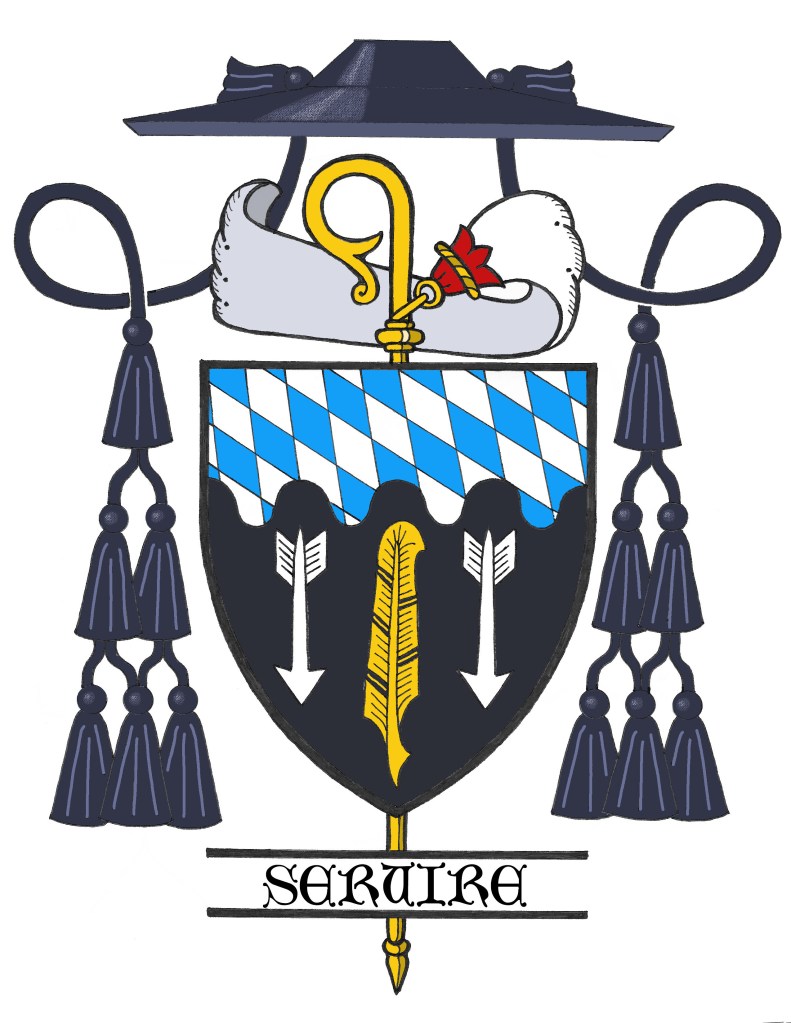
Abbot Jonathan decided to assume a coat of arms and I was very pleased and honored to assist him in the design and execution of his armorial bearings.
The blazon is: “Sable, a quill pen, point downward Or between two arrows, points downward Argent; a chief wavy, fusily in bend Azure and Argent. Shield ensigned with an abbot’s crozier Or behind the shield with the sudarium attached and an abbot’s galero Sable cords and twelve tassels disposed in three rows of one, two and three all Sable. On a scroll below the shield the motto: “Servire”.”
The field is colored black to allude to the black Benedictine habit. In addition, the area of Minnesota where he was born and raised is known as an area for mining iron ore. The black also alludes to the iron. The gold (yellow) pen in the center is a symbol of administration which is the kind of work the Abbot has been assigned to do during most of his monastic life. The two arrows are a symbol of the Biblical figure, Jonathan, his monastic patron. They allude to the story of Jonathan shooting arrows as a signal to David about whether or not he was safe in the First Book of Samuel, chapter 20.
The shield is divided by a wavy line of division. This is symbolic, once again, of the part of Minnesota where the Abbot grew up known for its many lakes. The upper third of the shield, called a “chief” depicts the familiar blue and silver (white) pattern of fusils (elongated diamond shapes) placed in a repeating pattern along diagonal lines. This is the background of the coat of arms of the Bavarian Royal House (Wittelsbach) and of the State of Bavaria in Germany today. The motherhouse of the Congregation was founded by Boniface Wimmer who was a monk of St. Michael’s Abbey in Metten and the Ludwigsmissionverein was heavily subsidized by the Bavarian Royal Family. So, the coat of arms of St. Vincent Archabbey uses this background in its own arms. In addition, the coat of arms of the Abbot’s own Community at St. John in Collegeville makes use of this background in two of the four quarters on its coat of arms. In fact, of the 18 existing independent houses of the American Cassinese Congregation there are 8 which were directly founded from St. Vincent as daughter-houses and 2 which were founded as granddaughter-houses from St. Vincent. Of those houses 5 of them make use of this Bavarian pattern and/or of its color scheme as an allusion to the Bavarian origins of the Congregation. So, the chief is used to symbolize St. Vincent and Bavaria as the origins of the American-Cassinese Congregation as well as St. John’s Abbey, the Abbot’s own community of origin. It is also an allusion to St. Mary’s Abbey where the Abbot is serving as Administrator for several years.
The motto below the shield is the single Latin word, “Servire” which means to serve.
The shield is also ensigned with those external ornaments that indicate the bearer is an abbot. The gold (yellow) crozier, no longer used in the coats of arms of bishops but retained in the arms of abbots is placed vertically behind and extending above and below the shield. Attached to the crozier is a veil or sudarium. Widely used in the Middle Ages it is rarely seen in actual use today. It dates from a time when abbots were already making use of the crozier as a sign of their authority but had not been granted the privilege of full pontificals which, prior to the reforms of the 1970s, would have included liturgical gloves. The purpose of the sudarium was originally practical; it shielded the metal of the crozier from dirt and perspiration from the hands. Later, it became merely symbolic and has been retained in heraldry to distinguish the crozier of an abbot.
Above the shield is the ecclesiastical hat, called a galero which, in heraldry, replaces the martial helmet, mantling and crest. The galero is black with black cords pendant from it and twelve black tassels arranged in a pyramid shape on either side of the shield. This is the hat assigned to a prelate with the rank of abbot according to the Instruction of the Secretariat of State of the Holy See, “Ut Sive” of 31 March, 1969 (Acta Apostolicae Sedis 61 (1969) 334-40).
On August 22 the Most Rev. Rembert (George) Weakland, OSB (95) passed away in Milwaukee. He had been a monk and Archabbot at St. Vincent Archabbey in Latrobe, Pennsylvania serving as Coadjutor Archabbot cum plena jure from 1963-1967, Abbot-Primate of the Benedictine Confederation, 1967-1977 and Archbishop of Milwaukee from 1977 until 2002. His final years were marred by scandals and revelations of misconduct.
His armorial bearings were the same as an Archabbot and Abbot-Primate as well as during his tenure as Archbishop. A very simple design using a red field and stylized tongues of fire represents the Descent of the Holy Spirit.
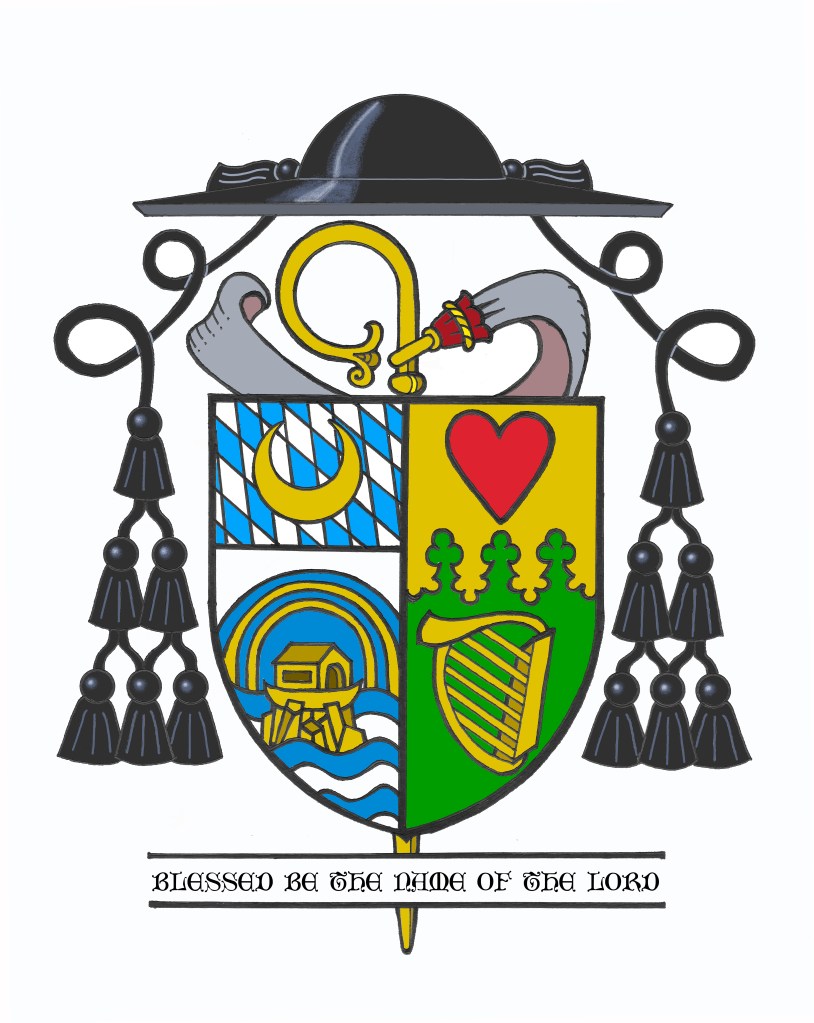
On May 12, 2022 the monks of Newark Abbey in Newark, New Jersey elected the Right Reverend Augustine Curley, OSB as the third Abbot of their community. He is still yet to receive the abbatial blessing. The arms he has assumed are shown above.
The armorial achievement, or coat of arms, of Abbot Augustine is composed of the shield with its various charges, the external ornaments of an abbot and the motto. The shield contains the coat of arms of the abbey impaled (combined side-by-side on the same shield) with the personal arms. Such impalement illustrates that the abbot is, in a sense, “married” to the community and exercises jurisdiction over it during his tenure in office.
In the armorial bearings of Newark Abbey the field is primarily silver (white) with six white and blue wavy lines representing waves below. Out of this sticks a gold (yellow) rocky formation on top of which is the ark, also gold (yellow). This is a representation of the ark and the rock upon which the ark came to rest after the great flood of Noah’s time surrounded by receding waters of the flood. Above the ark is a stylized rainbow in blue and gold (yellow) representing the the new beginning of Newark Abbey after the tumultuous period preceding its re-elevation to Abbatial status.
The chief (upper third) of the shield is a field of the blue and silver (white) elongated diamond-shaped fusils in a diagonal pattern taken from the Bavarian royal arms. Newark Abbey traces its monastic origins back through St. Mary’s Abbey which was a daughter house of St. Vincent Archabbey in Pennsylvania. St. Vincent was founded by Boniface Wimmer, a monk of St. Michael’s Abbey in Metten, Bavaria.
The personal armorial bearings which Abbot Augustine has assumed recall his Irish heritage, his patron saint and his Benedictine life. The green field with a gold (yellow) harp is a symbol of his Irish ethnic background as well as an allusion to the singing of the psalms, composed by King David, which are traditionally accompanied on the harp. This is the principal work of a Benedictine monk —the ora in “Ora et Labora”— as it were. The upper portion of the shield is divided using a line representing trefoils, more commonly known as shamrocks, a further symbol of Ireland and, in particular, the Irish rebels Abbot Augustine counts among his ancestors. Those facing upward are three in number as an oblique reference to the fact that Abbot Augustine is the third Abbot of Newark Abbey. On the upper portion of the shield is a single red heart. The heart is used as a symbol of St. Augustine, the abbot’s monastic patron saint but also represents the exhortation to “Listen…inclining the ear of one’s heart” that makes up part of the Prologue of the Holy Rule of St. Benedict.
The shield is ensigned with the black pilgrim’s hat, called a galero, used in heraldry for clerics in place of the traditional helmet, mantling and crest. The hat has black cords terminating in twelve black tassels. Behind the shield and extending above and below it is a gold (yellow) abbot’s crozier with the sudarium (veil) attached. This veil was used in former times to protect the shaft of the crozier from dirt and perspiration before the time when abbots would have worn liturgical gloves. While the veil is no longer used it remains as a heraldic emblem to distinguish the crozier of an abbot. These are the ornaments proper to a prelate with the rank of abbot according to the Instruction of the Holy See, “Ut Sive” of March 1969.
On a scroll below the shield we see Abbot Augustine’s chosen motto, “Blessed Be The Name of The Lord” which is from the Book of Job.
I was pleased and privileged to design his personal arms and marshal them to those of the Abbey.
On May 7 the Rt. Rev. Michael Brunner, OSB, elected Abbot on January 17, 2022, will receive the abbatial blessing as the fourth Abbot of the Abbey of St. Gregory the Great in Portsmouth, Rhode Island.
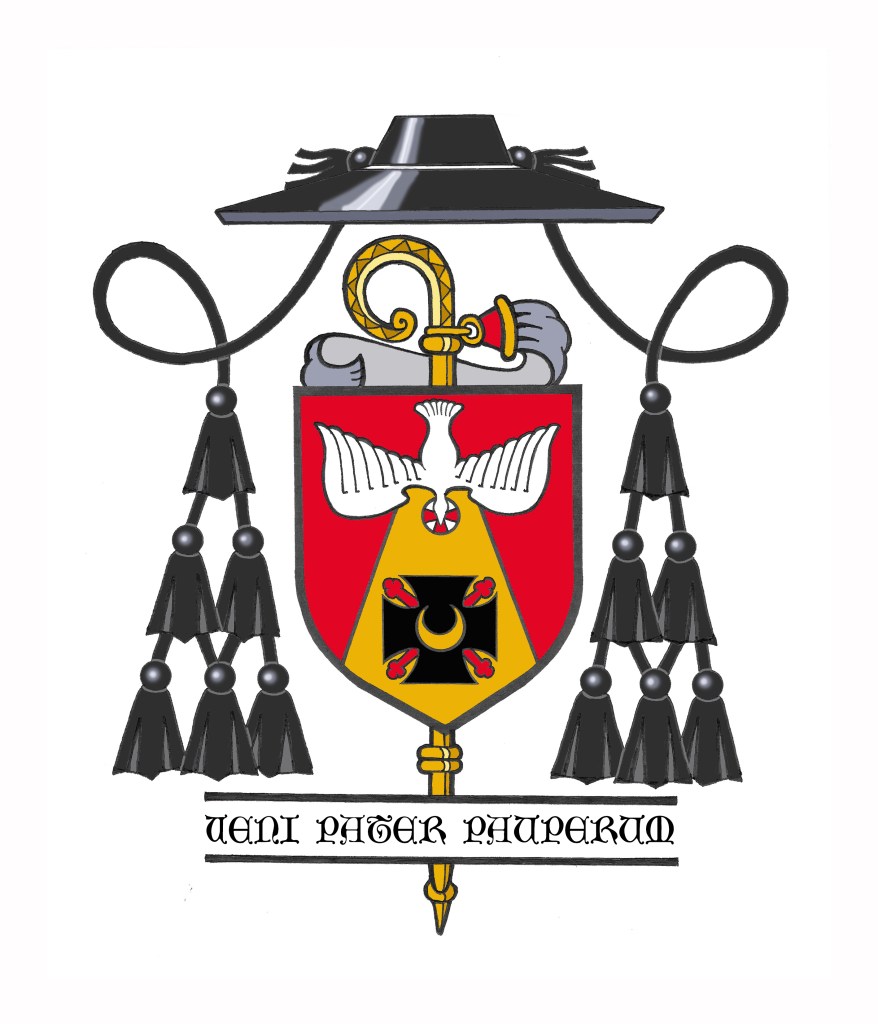
The armorial achievement, or coat of arms, of Abbot Michael is composed of the shield with its various charges, the external ornaments of an abbot and the motto. The shield contains only the personal arms assumed by Abbot Michael. While it is often customary to impale (combine side-by-side on the same shield) the personal arms with those of the abbey that is not mandatory and it is up to the personal choice of the armiger.
The coat of arms has a red field or background. This color is used liturgically in the Church on feasts connected with the Holy Spirit. Prominent in the upper portion is the descending silver (white) dove with a halo containing a red cross indicative of Divinity. This, of course, alludes to the Divine guidance and light of the Holy Spirit. The Abbot’s motto is taken from the great hymn, “Veni, Sancte Spiritus” so, the dove is a tie-in with the Abbot’s motto. The dove is also an allusion to the Abbey’s patron saint, Pope St. Gregory the Great who, in art, is often seen with the dove that symbolizes the inspiration of the Holy Spirit.
Issuing from the dove is a golden (yellow) beam of light and on this beam is a black cross pattee charged at the center with a gold (yellow) crescent. This black cross is combined with a red cross bottony turned in an “X” shape and placed behind the black cross.
The black cross pattee is a symbol of the Abbot’s Christian faith as well as his German ethnic background. The red cross turned in saltire (and X-shape) behind it is used in heraldry to symbolize St. Michael, the Abbot’s patron saint. The crescent on the cross is symbolic of Our Lady under the title of The Immaculate Conception and is there as a symbol of the Abbot’s Marian devotion.
The shield is ensigned with the black pilgrim’s hat, called a galero, used in heraldry for clerics in place of the traditional helmet, mantling and crest. The hat has black cords terminating in twelve black tassels. Behind the shield and extending above and below it is a gold (yellow) abbot’s crozier with the sudarium (veil) attached. This veil was used in former times to protect the shaft of the crozier from dirt and perspiration before the time when abbots would have worn liturgical gloves. While the veil is no longer used it remains as a heraldic emblem to distinguish the crozier of an abbot. These are the ornaments proper to a prelate with the rank of abbot according to the Instruction of the Holy See, “Ut Sive” of March 1969.
On a scroll below the shield we see Abbot Michael’s chosen motto, “Veni Pater Pauperum” which is from the Pentecost Sequence, “Veni, Sancte Spiritus”.
It was both my privilege and my pleasure to devise and depict the armorial bearings of Abbot Michael.
The armorial bearings of Mother Eustochium Lee, OSB the recently elected Abbess of the community of Pax Cordis Iesu at St. Cecilia Abbey, Ryde, Isle of Wight in the UK. She receives the abbatial blessing today.
The armorial bearings of the Grand Master of the Knights of the Cross and Red Star, a Religious Institute of Canons of St. Augustine, Josef Šedivý, O.Cr.
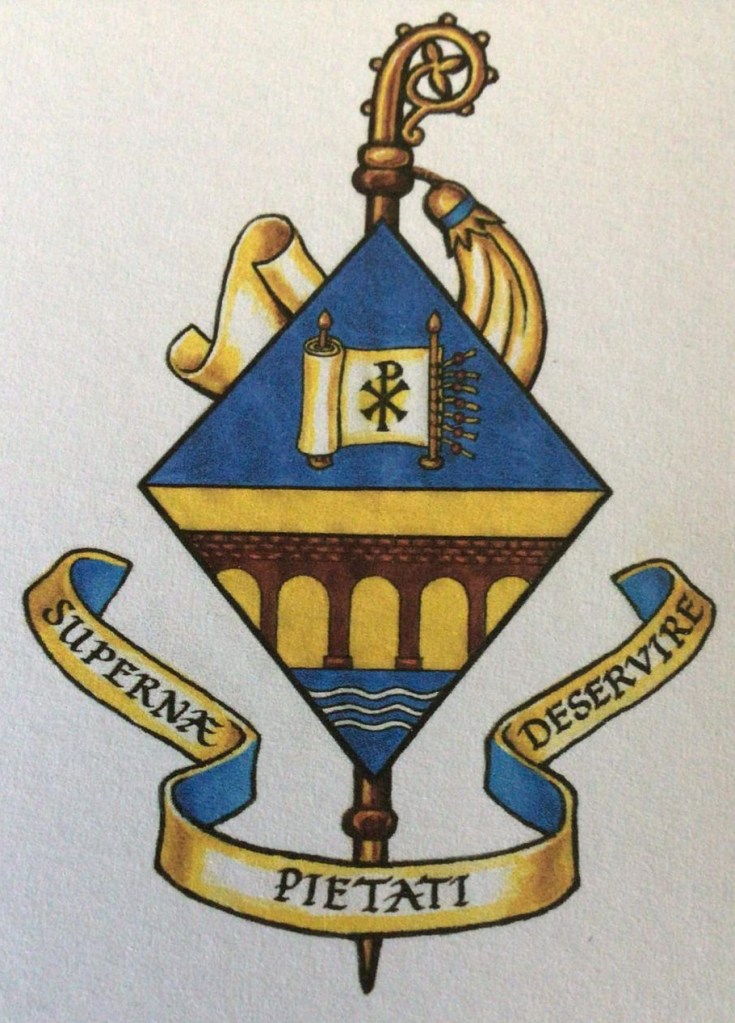
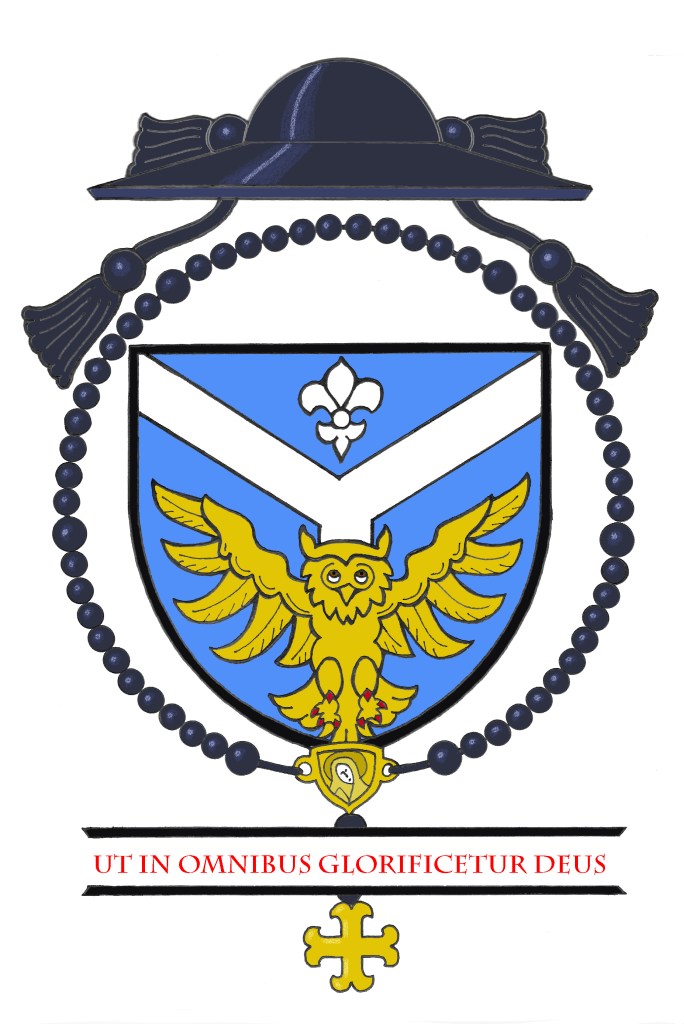
Here is one of my more recent commissions. It is the armorial bearings of a priest who is also a Professed Religious in vows. The black galero at the top of the achievement indicates his status as a priest. The chaplet – not often seen these days in heraldry – is used in the achievement as an external ornament indicating a person in Religious Vows. It is often seen in the arms of an Abbess (along with the veiled crozier) who, unlike an Abbot, does not make use of the galero. It is also seen in the armorial achievements of Professed Knights of Malta, whose Knights of Justice are Professed Religious in the Roman Catholic Church.
This armiger is both a monk and a priest. The motto is taken from the Holy Rule of St. Benedict.
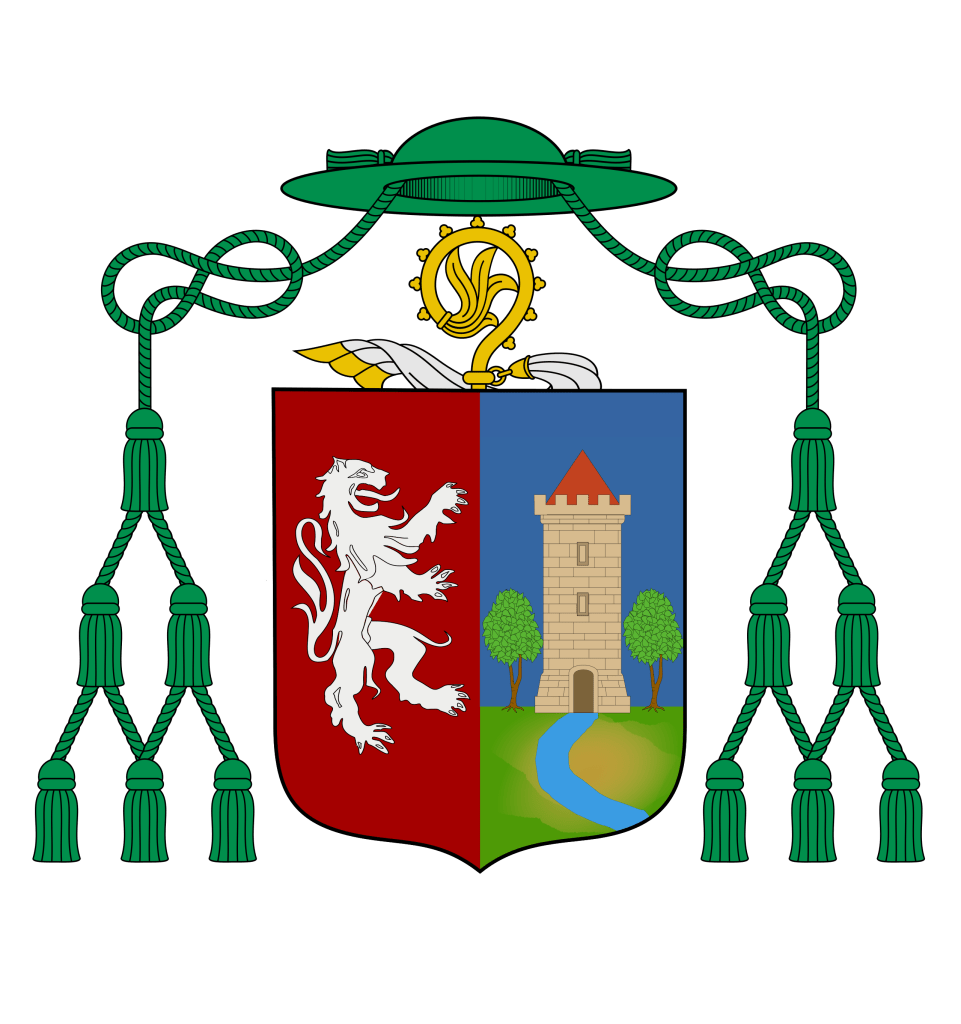
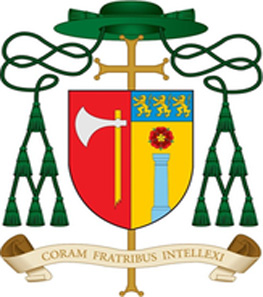
On October 3, the Most Rev. Erik Varden, OCSO, (46) formerly the Abbot of the Cistercian Abbey of Mt. St. Bernard in the UK and a convert to Catholicism was ordained a bishop in the Church and also installed as the 6th Territorial Prelate of the Prelature of Trondheim, Norway, his native country. It is interesting to note that his episcopal ordination took place in the Lutheran Nidaros cathedral, the traditional site of the consecration of the Kings of Norway which was built in the 12th Century and was originally a Catholic Cathedral.
A helpful reader directed me to the following information: The lions are taken from the arms of Mt. St. Bernard Abbey, Bishop Erik’s monastery. The pillar comes from the motto that he had used as abbot (“Columna in templo Dei”) – “A pillar in the temple of God”, a quote from the Book of Revelation. The rose symbolizes the flower that sprang from Root of Jesse, a reference to the mystery of the incarnation. The coat of arms was designed by Archbishop Charles Scicluna.
They are clear, simple and nicely designed. The artwork is also rather nice too.
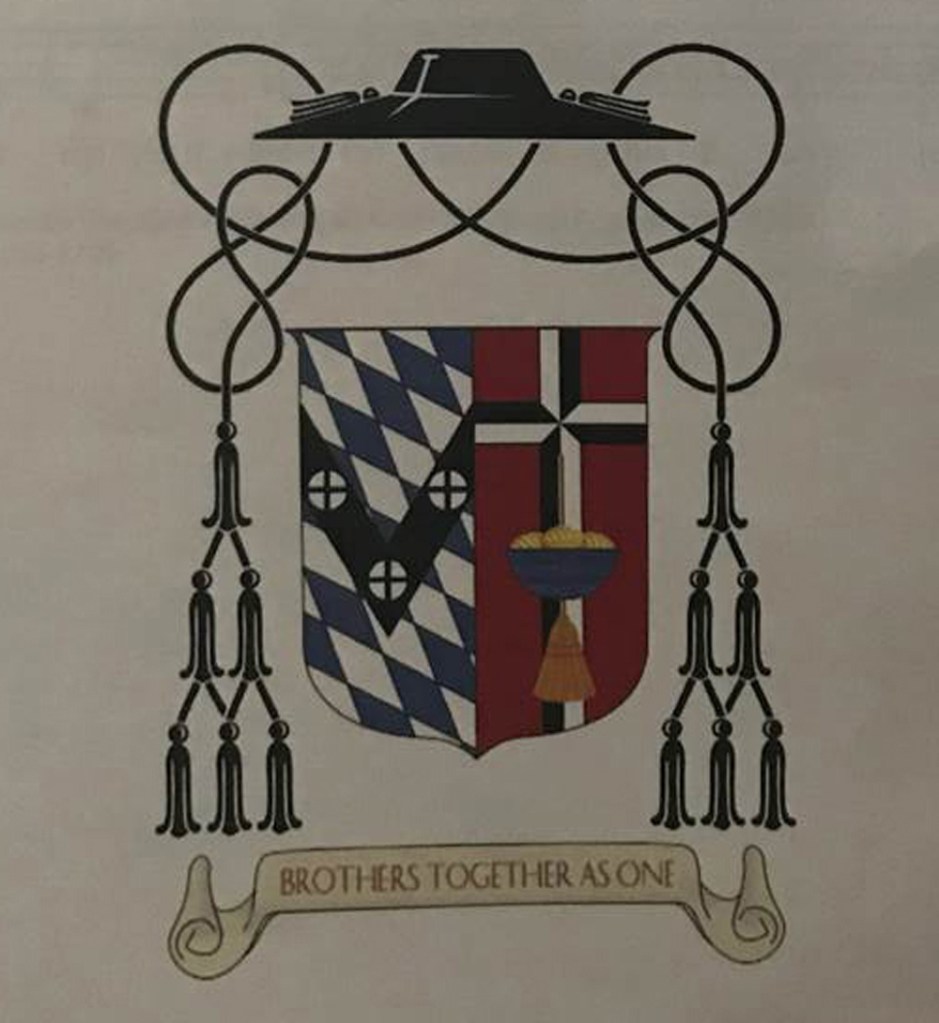
On June 23 the Rt. Rev. Martin de Porres Bartel, OSB (65) was elected by the monks of St. Vincent Archabbey in Latrobe, PA as their 12th Archabbot. On July 10th at Mass he received the abbatial blessing from the Most Rev. Edward Malesic, the Bishop of Greensburg, PA which is the diocese in which the Archabbey, America’s oldest Benedictine Monastery and currently the largest Benedictine Abbey in the world, is located. I studied for my Master of Divinity at St. Vincent Seminary and I used to be a monk in the Community there.
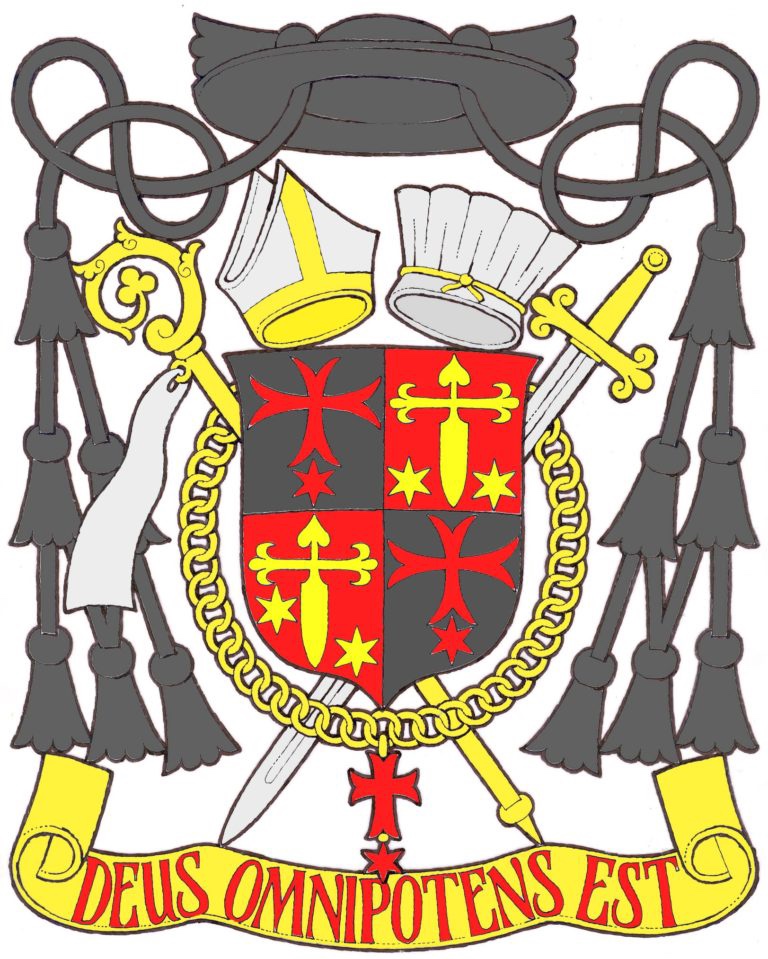
The new Archabbot has assumed a coat of arms:
I’m a bit conflicted in my assessment of this coat of arms. I know the Archabbot and I also know the monk who designed it and executed the artwork. I have a great deal of respect for Archabbot Martin as a priest and a monk and I don’t wish to be too harsh in my critique. I think the best I can say is that it isn’t “horrible”. Another way to say it would be, “It could have been worse” but that is, admittedly, damning with faint praise.
I will not say a word about the artwork because that is not usually the subject of any of my criticism on this blog. Different artist’s draw differently. The style is strongly reminiscent of that of the late Wilfred Bayne, OSB a monk of Portsmouth Abbey in Rhode Island who was an eminent heraldist in his day.
My first, and principal, criticism is that, as has happened in many instances before, the veiled crozier that is the primary heraldic symbol of the coat of arms belonging to an abbot is missing. When St. Paul VI (pope from 1963-1978) decided to remove both the mitre and crozier from the coats of arms of bishops and leave only the episcopal cross in their heraldic achievements many took this to affect the arms of abbots as well. In former times abbatial achievements contained the mitre and the crozier. However, Paul VI’s directive was truly addressing the arms of bishops and cardinals only. The coat of arms of an abbot is still supposed to have a crozier placed behind the shield with a veil (sudarium) attached. It’s origin comes from a time when abbots made use of the crozier (in fact abbots have used the crozier longer than bishops have done) but did not enjoy the privilege of pontifical gloves. The veil served the function of protecting the crozier from dirt and oil that can be present on the hand. It is not usually used practically anymore but it has remained as a heraldic symbol and – I repeat – the heraldic symbol of the coat of arms of an abbot. Other clergy are entitled to the black galero with twelve tassels. Such a galero may be used in the armorial bearings of Vicars General, Vicars Episcopal, Provosts, Major Religious Superiors and, on occasion, some others holding a particular office. Alone, it does not indicate the coat of arms of an abbot.
The arms adopted by the Archabbey in the early 20th Century are very nicely designed and combine well when impaled with the personal arms of the Archabbot.
As for Archabbot Martin’s personal arms: the cross quartered Sable and Argent is a reference to both the Dominican Sisters who educated him as a boy and the order to which his patron, St. Martin de Porres, belonged. Over these is a basket containing bread and a broom. These are, apparently, symbols associated with St. Martin de Porres and the bread is also an allusion to the Holy Eucharist.
There is no problem with the black in the cross up against the red of the field. The so-called “rule” of tincture (i.e. that a color should not be placed on a color nor a metal on a metal) does not come into play with complex fields or charges. Because the cross is both black (Sable) and white (Argent) it may be placed on a field of a single tincture. (For example: the complex field Azure & Argent of the arms of the Archabbey may have an entirely Sable inverted chevron on it without violating this “rule” because of the complex appearance of the field). However, I think it would have looked better if a lighter shade of red had been used giving the arms a brighter appearance.
I find that the basket of bread is ill-placed as is the broom. In addition, there seems to be no good justification for the basket to be blue. Introducing multiple tinctures into a coat of arms without good reason is unsupportable, heraldically. The broom I suppose to be considered gold (Or). I have not seen an actual blazon of these arms, if one exists. If it is not intended to be gold but brown, of any shade, then it should be noted that brown is not used in heraldry. If it were blazoned as “Proper“, a term which means a particular charge is shown as it appears in nature, I don’t see this as being justifiable either since there is no naturally occurring broom and, therefore, no color which would be considered its “proper” color. Some more attention should have been paid to both the placement and the tinctures of the basket and broom.
So, I return to where I started. This design isn’t “bad” per se. But, having said that, it could have been considerably better. With some further consultation on the design the armiger might have been better served. Of the twelve Archabbots of St. Vincent nine of them have borne unique coats of arms. (The first four used the same coat of arms). Of those nine coats of arms, with 1 being the best and 9 being the worst, I would say that Archabbot Martin’s ranks 8th. The final word I can say is that I have seen abbatial coats of arms that are absolutely horrible and ugly. This is most definitely NOT one of those. But, it is merely…OK.
The Rt. Rev. Douglas R. Nowicki, OSB who served as Archabbot of St. Vincent Archabbey from January 8, 1991 until May 11, 2020. His successor will be elected June 22. During his tenure as Archabbot of the Archabbey he bore his personal arms impaled with those of the Archabbey itself. This form of marshaling two different coats of arms together, called “impaling” is rather the same as combining the two separate coats of arms of two armigerous people who are married to each other. Because the Archabbot has jurisdiction over the monastery his arms (in the position of the “groom”) are displayed together with the arms of his jurisdiction (in the position of the “bride”) on the same shield. When the tenure giving him such jurisdiction comes to an end the privilege of impaling his arms also comes to an end and he bears his personal arms alone. Accordingly, as of May 11, 2020 Archabbot Douglas’ coat of arms now appears as illustrated.
I designed his personal coat of arms in 1991 and prepared the original artwork used at the time of his archabbatial blessing.
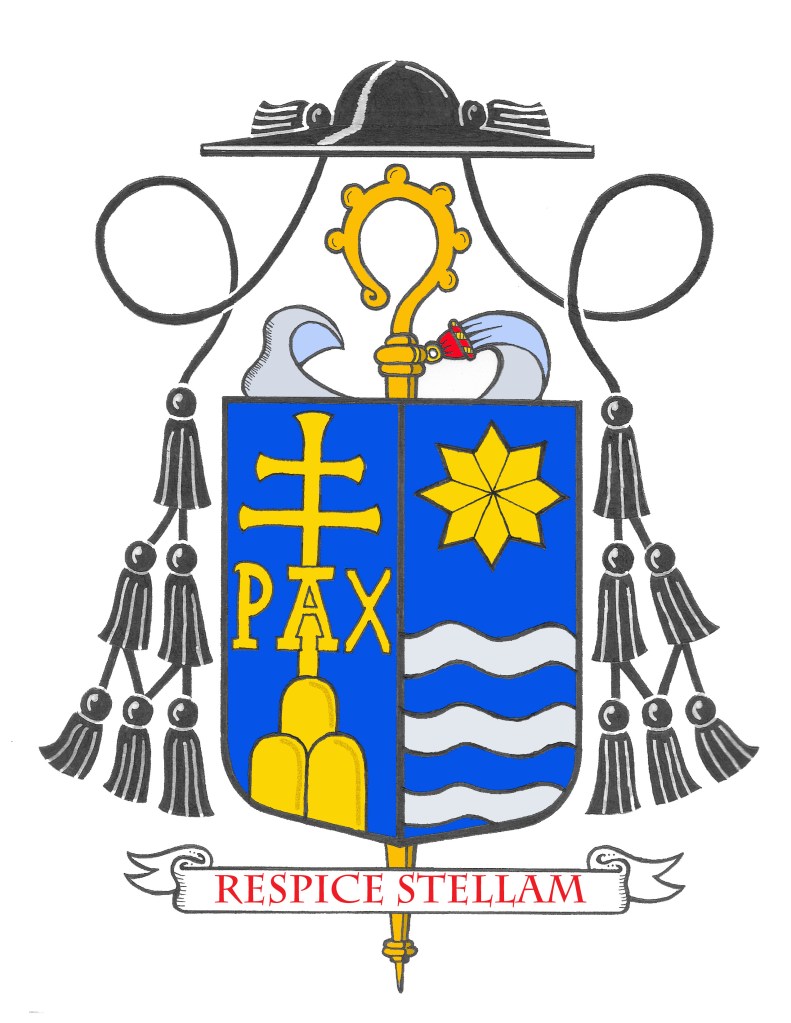
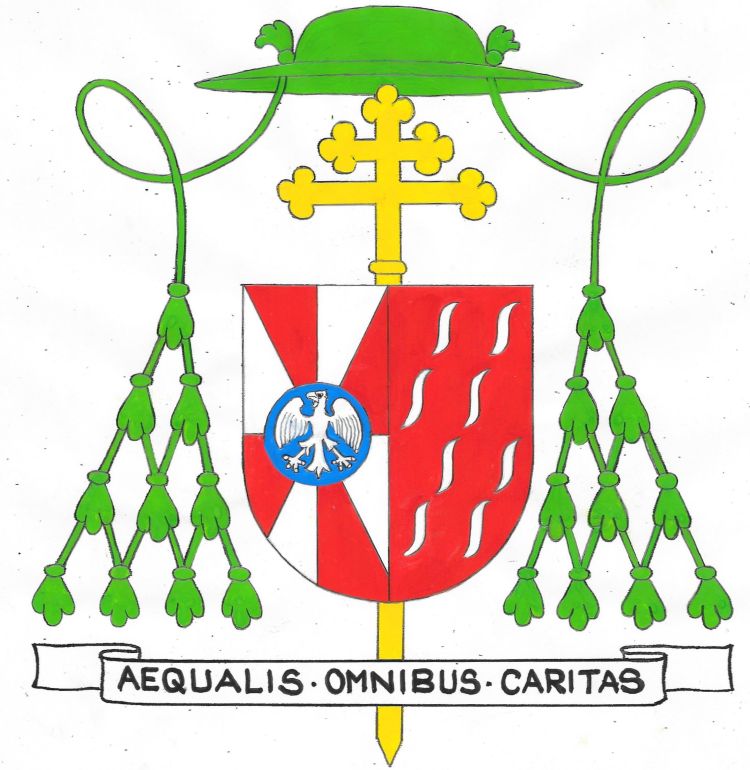
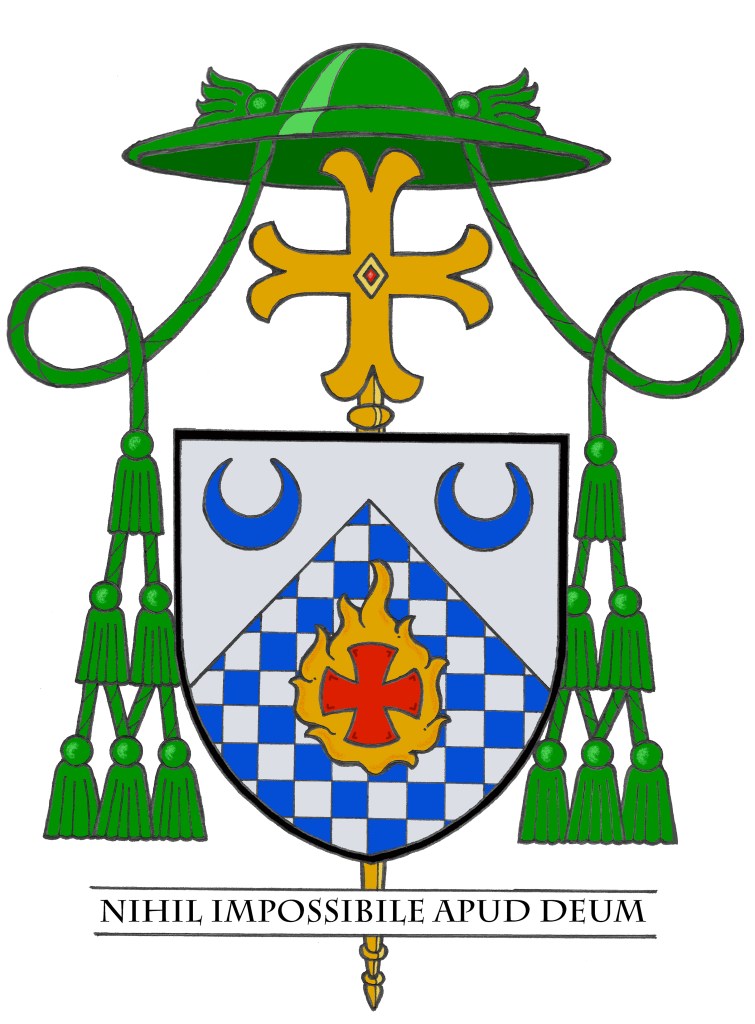
On June 30, 2020 the Most Rev. Elias Lorenzo, OSB (59) up until now the Abbot-Praeses of the American-Cassinese Congregation of Benedictine Monks and a monk of St. Mary’s Abbey in Morristown, New Jersey will be ordained as the Titular Bishop of Tabuda and Auxiliary Bishop of the archdiocese of Newark, New Jersey. The coat of arms assumed by him is the following:
Upon his election as Abbot-Praeses (i.e. President) of the American-Cassinese Congregation in 2016 I had the privilege of designing the coat of arms he would assume as an Abbot. Upon his appointment to the episcopacy Bishop Lorenzo decided, correctly in my opinion, not to change his arms in any way except to update the external ornaments from those of an Abbot to those of a Bishop. His armorial bearings reflect his family name, the community of his profession, his past ministry and his monastic patron.
The shield is divided by a line shaped like a chevron. This creates the general shape alluding to a mountain, in this case Mount Carmel, the mountain associated with the prophet Elijah from whose name the name Elias is derived. The large tongue of fire in the center of the lower portion of the shield (referred to as “in base”) combined with the mountain allude to St. Elias.
In addition, the blue and silver (white) checked pattern also has a multi-layered meaning. The American-Cassinese Congregation was founded by Benedictines from St. Michael’s Abbey in Bavaria. The motherhouse of the Congregation, St. Vincent Archabbey in Pennsylvania, makes use of the blue and silver fusils (a kind of elongated diamond pattern) from the coat of arms of Bavaria in its own coat of arms. Several other monasteries in the Congregation which are daughter houses or grand daughter houses of St. Vincent also make use of this pattern. One such abbey is St. Mary’s in Morristown, New Jersey. At this monastery Bishop Elias entered monastic life, made his profession of vows and was ordained. In his coat of arms the blue and silver (white) fusils have been turned sideways forming a grid of blue and white squares or checks. The grid pattern suggests the gridiron on which St. Lawrence was roasted alive as the means of his martyrdom. This is an allusion to the Abbot’s surname, “Lorenzo” which in Italian means “Lawrence”. The grid of blue and white squares combined with the fire represents St. Lawrence while at the same time the blue and white squares are a slightly differenced reference to the coat of arms of St. Mary’s Abbey as well as Bavaria in general as the homeland of the Congregation’s founders.
At the center of the flame there is a red rounded cross. This cross is taken from the coat of arms of Sant’Anselmo in Rome where, for seven years before his election as Abbot-President , the armiger was served as Prior of the monastic community.
Above the chevron in the upper portion of the shield (referred to as “in chief”) there are two blue crescents. The crescent has long been associated with Our Lady in particular under her title of the Immaculate Conception. That title is also the one by which Mary is the Patroness of the United States of America. In addition, crescents appear in the coat of arms of St. Mary’s Abbey and the coat of arms of the Delbarton School, the Abbey’s principal apostolate, both of with which Bishop Elias is closely associated.
The motto below the shield is taken from Luke 1:37 and is translated as, “Nothing is impossible with God”.


 EXARANDORUM