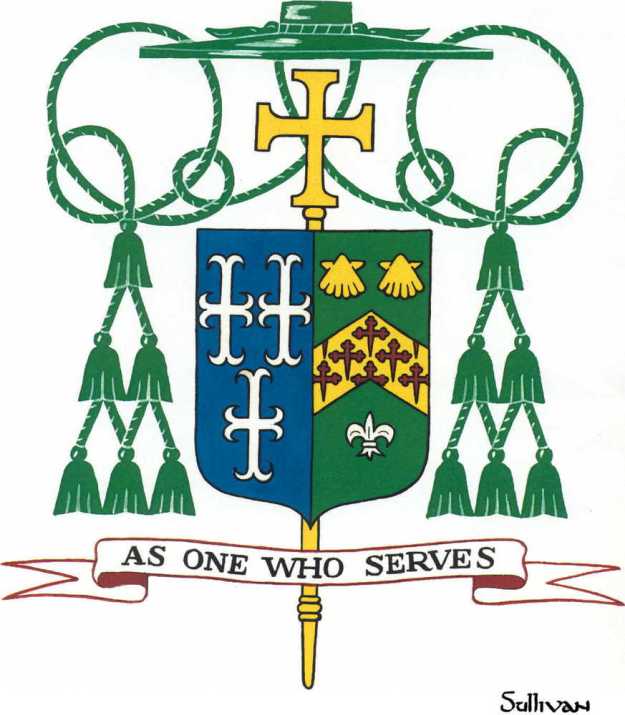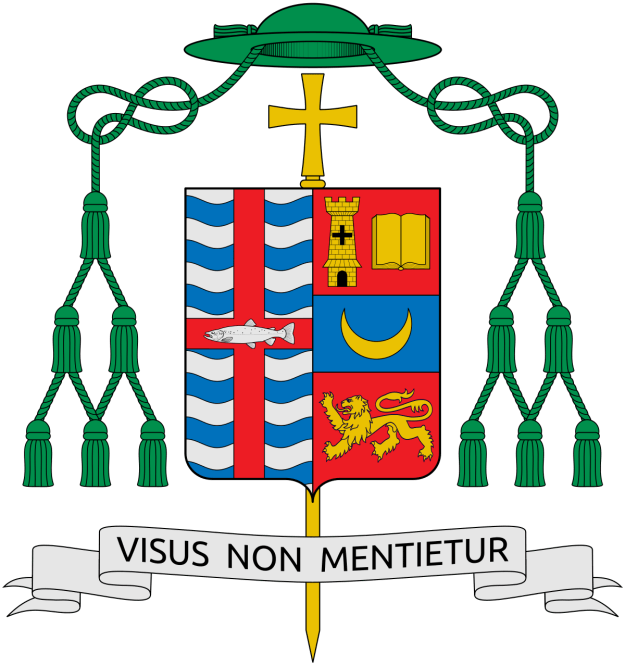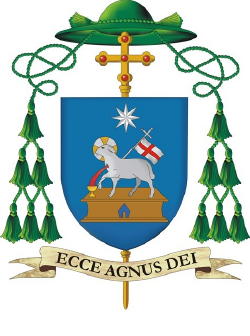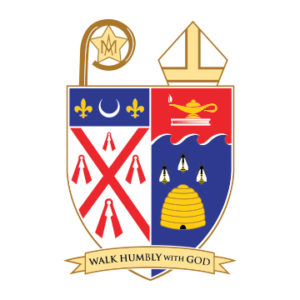
Author Archives: guyselvester

Abbess Hildegard Dubnick, OSB of Eichstätt

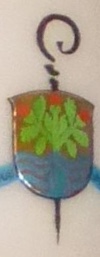
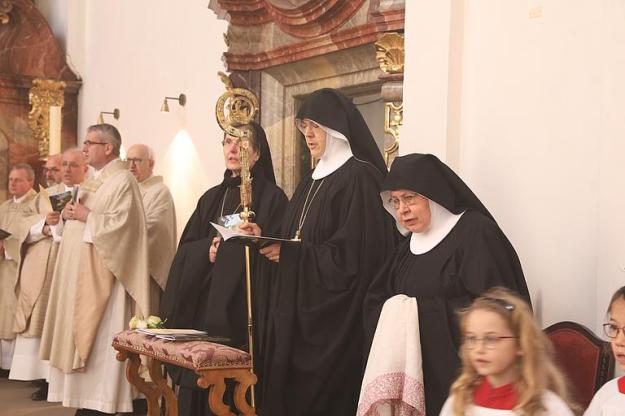
919px-Wappen_Hildegard_Dubnick.svgOn January 4, 2019 the nuns of St. Walburga Abbey in Eichstätt, Bavaria elected Mother Hildegard Dubnick, OSB, (57) an American and a nun at their daughter foundation, St. Walburga Abbey in Virginia Dale, Colorado, to succeed Mother Franziska Kloos, OSB who had served as Abbess of Eichstätt for 34 years and retired from office on December 27, 2018. Abbess Hildegard received the abbatial blessing from Bishop Gregor Maria Hanke, OSB of Eichstätt on February 23, 2019.

An abbess in the Catholic Church makes use of some of the same pontifical insignia as an abbot. Abbesses wear the pectoral cross and ring and also carry a crozier. In addition, they usually have a personal coat of arms. The coat of arms assumed by Mother Hildegard is described in an article from the Eichstätt Courier as:

“Mutter Hildegards Wahlspruch aus Psalm 47 (47,10 Vulgata) “Suscepimus Misericordiam Tuam” lautet übersetzt: “Wir haben dein Erbarmen empfangen.” Der Spruch umfließt ein Wappen mit drei Eichen im Mittelpunkt, deren Stamm sich aus Wasser speist. Es nimmt in den Eichen Bezug auf den tschechischen Nachnamen Mutter Hildegards, der übersetzt “kleine Eiche” bedeutet, ebenso auf ihren Geburtsort Oak Park in Illinois (USA) und stellt letztlich eine schöne Verbindung zu ihrem neuen Wirkungsort Eichstätt dar. Die drei Wellen versinnbildlichen den im Wahlspruch erwähnten Strom des Erbarmens und der Gnade Gottes, das Ölfläschchen weist hin auf das Geschenk des Walburgisöls, das am Grab der heiligen Walburga fließt.” Translated that is:
IMG_1867

Mother Hildegard’s motto from Psalm 47 (47.10 Vulgata) “Suscepimus Misericordiam Tuam” translates: “We have received your mercy.” The saying is on a scroll around a coat of arms with three oaks in the center, whose trunk is fed from water. The oaks refer to the Czech surname of Mother Hildegard, which means “small oak tree”, as well as to her birthplace Oak Park in Illinois (USA) and ultimately represents a beautiful connection to her new place of Eichstätt. The three waves symbolize the the river of mercy and grace of God mentioned in the motto, the bottle of oil points to the gift of Walburgis oil that flows at the tomb of St. Walburga.

Ad Multos Annos, Mother Hildegard!
csm_aebtissinnenweihe-15_4b3ccd2ad3


Grand Master of the Teutonic Order

1200px-insignia_germany_order_teutonic.svg

In August of 2018 the Teutonic Order (Deutscher Orden), a formerly medieval military order of chivalry which had, by the 20th Century, been transformed into a Religious Order, elected Fr. Frank Bayard, O.T. as its Grand Master. The Grand Master of the order has the rank of abbot. Fr. Bayard succeeds Fr. Bruno Platter who was elected as Grand Master of the Teutonic Order in 2000 and re-elected in 2006.

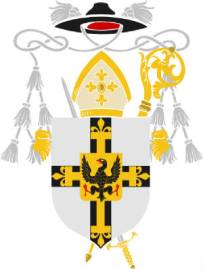
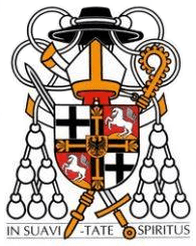
The coat of arms of the Grand Master is ensigned with the external ornaments of an abbot and the galero is black with cords and tassels that are white. deutscherordengm.jpg.w300h397By custom the mitre is also included in the achievement despite the 1969 Instruction from the Holy See stating otherwise. In addition, the secular sword is included which is tolerated given the order’s history as an order of chivalry prior to becoming a Religious Order within the Church. The arms of the Grand master traditionally follow a pattern which makes use of a basic shield depicting the arms of the order as used by the Grand Master which divides the field into four quarters by a sable cross charged with a gold cross fleuretty and an inescutcheon overall depicting Or, an imperial eagle Proper. In the first and fourth quarters the usual arms of the Order (Argent a cross throughout Sable) are placed. The personal arms of the individual Grand Master then occupy the 2nd and 3rd quarters of the shield.
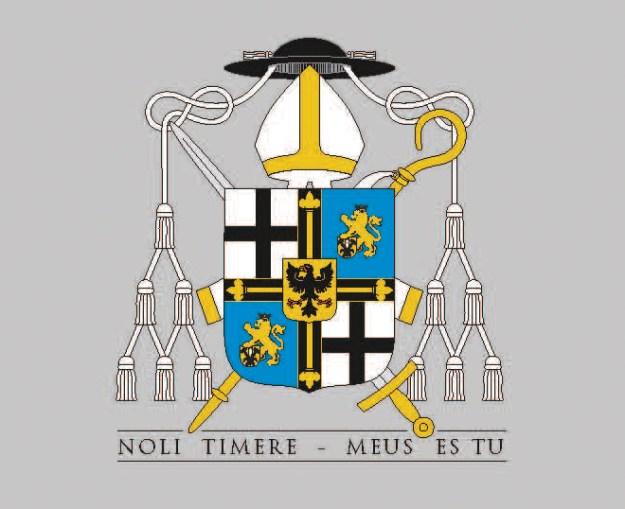
In November, 2018 The Rt. Rev. Frank Bayard received the abbatial blessing from Christoph Cardinal Schönborn, O.P. of Vienna, where the headquarters of the Order is located. The arms assumed by Grand Master Bayard are:

abtsbenediktion2

The coat of arms used by the previous two Grand Masters, Bruno Platter and Arnold Weiland followed the same pattern.

general-abbot-bruno-platter-grand-master-of-the-teutonic-order coat-of-arms-of-the-abbot-arnold-othmar-wieland-grand-master-of-the-teutonic-order-1988-2000

Most Rev. John M. Smith, RIP


bishopsmith_emeritus_crest

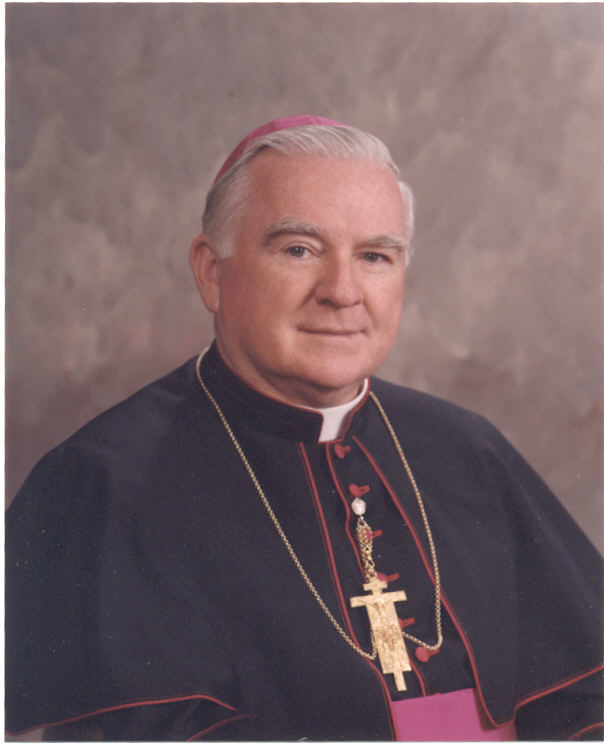
On Jan. 22, 2019 of the Most Rev. John Mortimer Smith, Bishop Emeritus (2010-2019) and Ninth Bishop of the Diocese of Trenton (1997-2010), former Coadjutor Bishop of Trenton (1995-1997), former Bishop of the Diocese of Pensacola-Tallahassee in Florida (1991-1995) and former Auxiliary Bishop of the Archdiocese of Newark (1988-1991) passed into eternal life.  Bishop Smith died in Morris Hall Meadows, Lawrenceville, after a long illness. He was 83 years old.

His coat of arms (above) was assumed at the time he was ordained an Auxiliary Bishop in 1988. It is, in my opinion, a little too “busy” insofar as he tried to do too much. All those various charges represent different events/aspects of his priestly life and ministry, a kind of pictorial CV, which is precisely the type of thing I encourage new armigers to avoid all the time. It was particularly problematic and a little bit unattractive when it was marshaled to the arms of a See, such as Trenton, because all this was then squeezed into a narrow impalement (below). Perhaps, it would have been better to marshal the arms differently or to have simply borne his personal arms alone (something of which most American bishops cannot conceive because they think it isn’t permitted!)

sc003412d4

Aside from his less-than-wonderful coat of arms I met Bishop Smith on several occasions and found him to be a warm, outgoing and very kind man. He was very down-to-earth and easy to talk with. In the days when he was bishop of Trenton I hosted a 30-minute weekly radio program for my diocese and he told me on more than once occasion how he enjoyed listening to it in the car while driving to some event at which he was to preside. He was one of our biggest fans. May he rest in peace and receive the reward of his labors in the Lord’s vineyard.

(Artwork for both images by Deacon Paul Sullivan)

Conrad Swan, R.I.P.

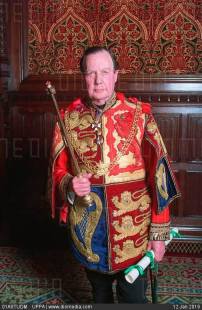
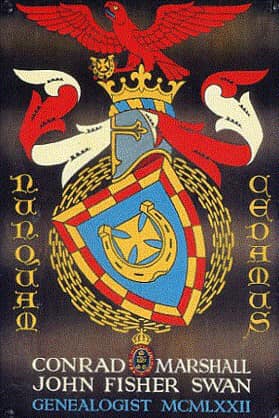
swanSir Conrad Marshall John Fisher Swan KCVO FSA (born 13 May 1924) was a retired long-serving officer of arms at the College of Arms in London. Having been first appointed to work at the College in 1962, he rose to the office of Garter Principal King of Arms in 1992, a position he held until 1995. He was the first Canadian ever to be appointed to the College of Arms. He was first appointed Rouge Dragon Pursuivant of Arms in Ordinary in 1962 and six years later became York Herald of Arms in Ordinary. In these capacities, he was among the Earl Marshal’s staff for the State Funeral of Sir Winston Churchill in 1965, the Investiture of the Prince of Wales in 1969, and was Gentleman Usher-in-Waiting to Pope John Paul II during his visit to the United Kingdom in 1982.

Swan was appointed Garter Principal King of Arms in 1992 on the retirement of Sir Alexander Colin Cole. His own retirement came in 1995, after having been diagnosed with cancer.
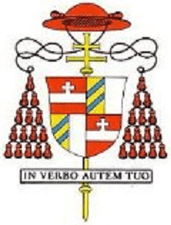
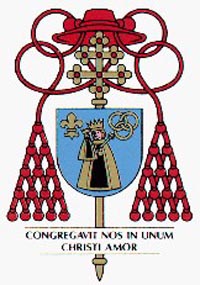
Swan was knighted by Her Majesty The Queen in 1994 as a Knight Commander of the Royal Victorian Order (KCVO). He is also a Knight Grand Cross of the Order of the Nation of Antigua and Barbuda (KGCN), Knight of Honour and Devotion of the Order of Malta, Cross of Commander of the Order of Merit of the Republic of Poland, Knight’s Cross of the Order of the Grand Duke Gediminas (Lithuania), Knight Grand Cross of Justice of the Sacred Military Constantinian Order of Saint George, Knight Grand Cross of the Royal Order of Francis I (GCFO) and Knight Grand Cross of the Royal Order of the Lion of Rwanda.
swan2

He was also a Knight of the Most Venerable Order of St. John of Jerusalem and Knight Principal of the Imperial Society of Knights Bachelor (1995–2000); Commander (with Star) of the Royal Norwegian Order of Merit; Grand Cross with Grand Collar of the Imperial Order of the Holy Trinity (Ethiopia); Coronation Medal of the King of Tonga. He received the Commemorative Medal for the Centennial of Saskatchewan in 2005.
May he rest in peace.

Sacerdotal Arms of Gaunt

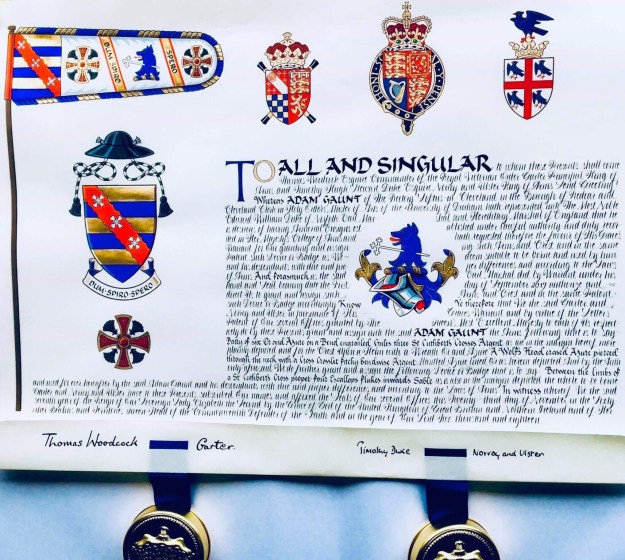
Recently a priest from the UK shared with me the recent (November, 2018) grant of arms he received from HM College of Arms. Of course there was a very fine example of Letters Patent illustrating the grant as well as laying out the blazon of arms. This is not an inexpensive or a quickly done process. Being a subject of HM, the Queen it was altogether correct, however, for Fr. Adam Gaunt to petition for and receive a grant of arms from the legitimate heraldic authority within the country in which he lives. It may take some time; it may cost a rather tidy sum but in the end it is well worth it.
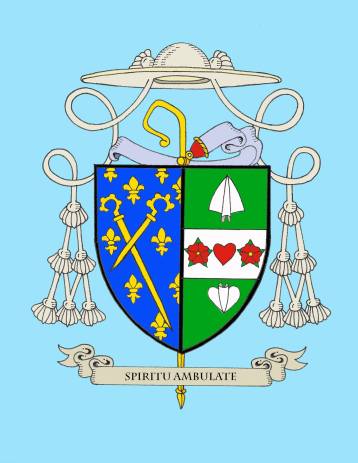
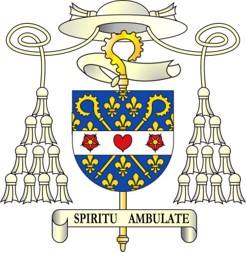
img_1035

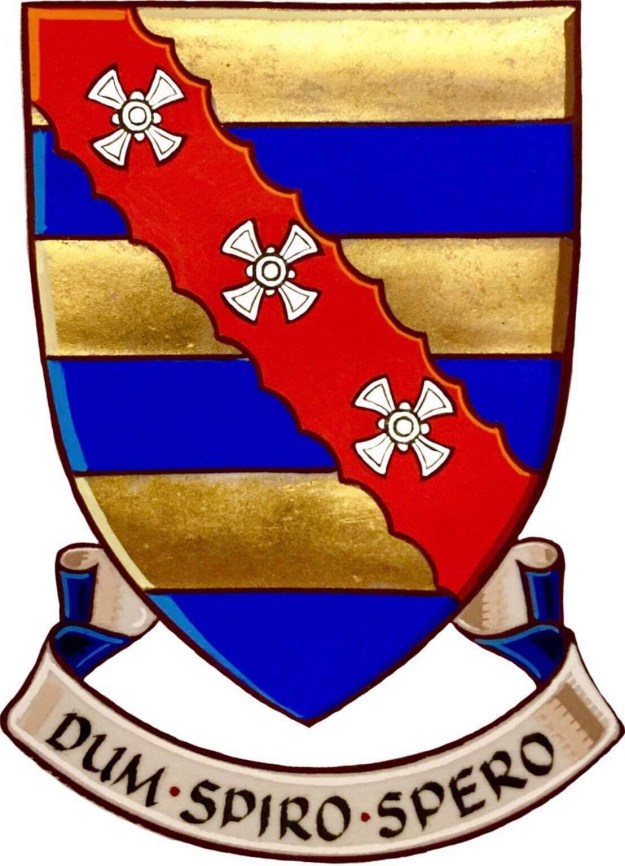
The coat of arms itself (below) is illustrated ensigned by the appropriate ecclesiastical hat for a priest of the Church of England. That is to say with two black tassels suspended from cords composed of black and white skeins twisted together.

img_1036

The Letters Patent also depict an heraldic crest on a helm with a horse and mantling which is most often seen employed in the arms of a layman not in holy orders. (below)

img_1037

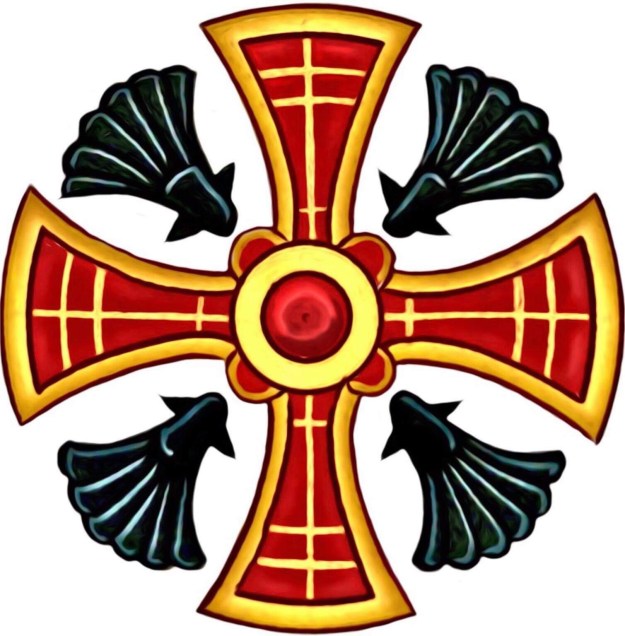
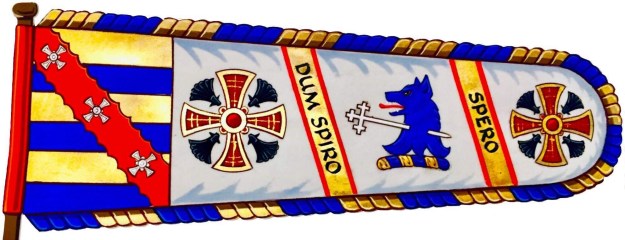
In addition, there are illustrations included of a heraldic badge, as well as an heraldic standard which is composed of the arms, crest and badge. (below)

img_1038

img_1039

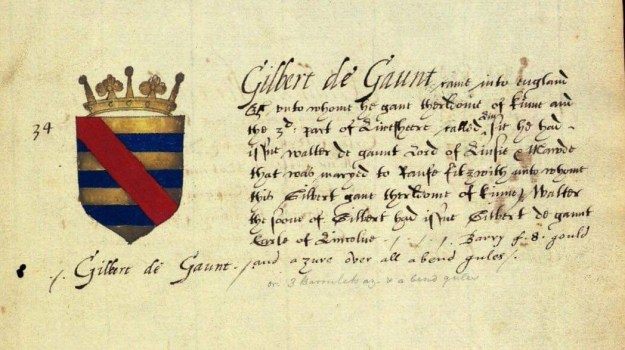
Father Gaunt was kind enough to explain that, “The arms are an adaptation of those attributed by “ancient and uniform tradition” to my ancestor Gilbert de Gaunt, Earl of Lincoln.”

img_1042

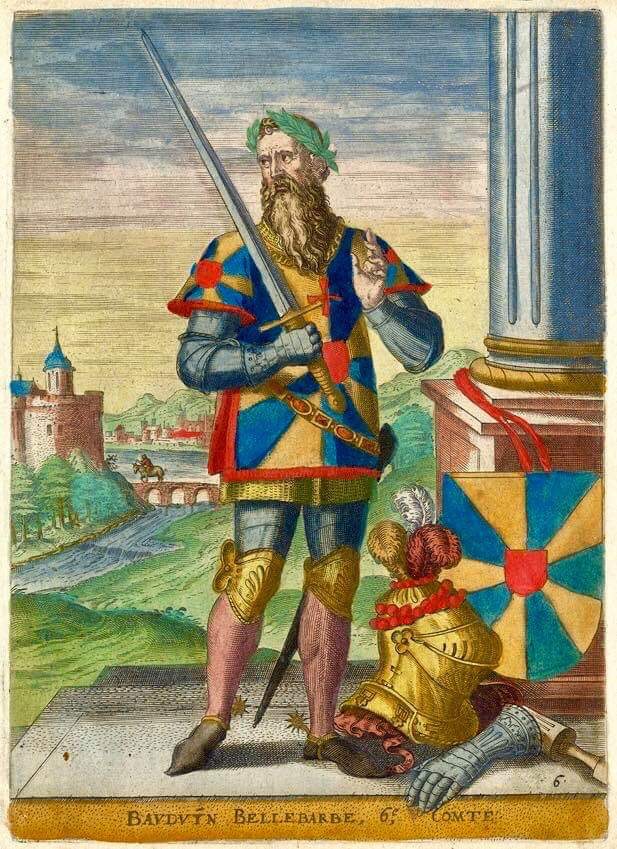
“He, (Gilbert) was of Flemish origin and related to the Counts of Flanders, who used the same heraldic colors and metals.”

img_1041

Here in the United States we do not have a heraldic authority. That is not to say that Americans cannot employ coats of arms. On the contrary, Americans are armigerous but we may legally and correctly, which are two different things, assume a coat of arms. That is to say we are able simply to design and adopt a coat of arms for our own use. In England there is a heraldic authority which is not a government office but a private corporation which operates as a part of the royal household. While it is technically illegal for a person to assume a coat of arms in England there isn’t a very great likelihood that there will be any legal repercussions to doing so as there might be in, say, Scotland or South Africa. However, it is quite incorrect simply to assume arms in England.

Instead, it is both right and, I would hazard a guess, quite delightful to do as Fr. Gaunt has done and receive a grant of arms from HM College of Arms. Well done Fr. Gaunt!

Bishop Mulvee, RIP

Bishop Mulvee-1

On December 28 the Most Rev. Robert Mulvee (88) retired VII Bishop of Providence, Rhode Island, formerly Bishop of Wilmington, Delaware and Auxiliary Bishop as well as a priest of Manchester, New Hampshire passed away. He will be buried on January 10th.

May he Rest in Peace.

Mulvee Coat of Arms

Bishop Morlino RIP

On November 24, 2018 the Most Rev. Robert Charles Morlino (71), Fourth Bishop of Madison, Wisconsin since 2003, died peacefully after a brief illness.

His coat of arms as described in information from the diocese:

Coat_of_arms_of_Robert_Charles_Morlino.svg

“The arms of the diocese are composed of a field that is wavy bars of silver (white) and blue. This is the traditional heraldic representation for water and the field of “water” is divided by a red cross into four sections to remind us of the lakes of the region around Madison. On the red cross is a fish and this conjunction of symbols is a classic symbolic representation for Saint Raphael, the titular of the Cathedral Church of Madison. Raphael means “healer of God” and his ministrations to men make interesting reading in the Book of Tobit in the Old Testament. The fish recalls the episode where Raphael ordered Tobias to cook a fish to eat but removed the heart, liver and gall for future medicinal use. Later the liver was used by Tobias to drive out the devil, who had slain seven of the previous husbands of Sara, his wife, while the gall was used to restore sight to his blind father.

The upper most part of the bishop’s arms contain a gold tower which symbolizes a place of refuge, strength and of safety.  There is also a book which serves to reference the bishop’s thirst for knowledge of things that concern God and His Church.

There is also a gold crescent moon on a blue fess. The blue fess serves to recall not only the blue in which Our Lady is traditionally depicted, but also of water.

The “lion passant” of gold in the lowest part of the shield alludes to the strength and liveliness of His Excellency in all that he does, but most especially in defending the faith. This charge further seeks to reveal His Excellency’s strong devotion to Pope Saint Leo the Great that began to develop during the formation of his master’s thesis.

The red background, overall, calls to mind the blood of the martyrs.

The motto, “The Vision Will Not Disappoint” is from Habbakuk 2:3″

Requiescat in Pace.


Bishop Betancourt

Coat-of-Arms-BBetancourt-250

The Coat of Arms of Bishop Juan Miguel Betancourt, SEMV, depicts the Lamb of the Book of Revelation, slaughtered but victorious, the one who is the lamp for the Church (Rev 5:6; 21:23). The victory of Christ over sin and death through his sacrifice is reflected in the rays of power around his head (Rev 5:12; 17:14). The Lamb, giving his life for his Bride, the Church, through the shedding of his blood denotes the life of love and service of an ordained minister of the Church (Rev 14:1). The Lamb of God gives his life voluntarily so his Church can live and continue her mission of salvation in the world (John 10:17-18). The Lamb rests on a plain and unadorned wooden altar, evoking a life of simplicity, a life that wants to be spent in service signaling everyone to the Lamb, Christ the Savior. Finally, the Lamb also reminds us of Bishop Betancourt’s home, Puerto Rico, whose coat of arms is the oldest still in use in the New World.

The red and white banner, held by the Lamb, represents the local church of Hartford, which Bishop Betancourt has been called by the Lord to serve and give his life with joy and compassion, as well as his titular see of Curzola.

The Schoenstatt Shrine at the center of the altar represents the spirituality in which Bishop Betancourt has been formed through the charism of the Servants of the Holy Eucharist and of the Blessed Virgin Mary. The blue background is the presence of the Blessed Mother in the Church and the life of Bishop Betancourt. “Nothing without you, nothing without us” (Fr. Joseph Kentenich). “She is the great missionary, she will perform miracles” (St. Vincent Pallotti). The background also reminds Bishop Betancourt of the Church in the Archdiocese of Saint Paul and Minneapolis where he practiced his ministry of pastor, Scripture professor and formator of seminarians for more than a decade.

That strong presence of Mary is highlighted by the star. Mary, Stella Maris, reigns with her power of intercession and protection over every single member of the Body of Christ. In times of strife and distress in the Church, the Blessed Mother is the beacon of hope, promising strength, unity and security, inviting us to imitate the holiness and self-giving of her Son for the sake of his Bride. Traditionally, the eight-point star represents resurrection, salvation, super-abundance (of grace) and new beginnings.

He was ordained as the Auxiliary Bishop of Hartford on October 18, 2018.

Norbertines in the USA

While neither of these abbots was elected very recently, within the last year there were two new Premonstratensian (aka Norbertine) abbots elected and blessed in the USA, one in Wisconsin and the other in Pennsylvania.

sna-radecki-coat-of-arms-300x300

The Rt. Rev. Dane J. Radecki, O.Praem elected on April 4, 2018 as the VII Abbot of St. Norbert Abbey in DePere, WI. He was blessed on July 11, 2018.

29177298_1599020133520476_268264765409722368_n

The Rt. Rev. Domenic Rossi, O.Praem, elected on January 23, 2018 as the IV Abbot of Daylesford Abbey in Paoli, PA. He was blessed on April 14, 2018.

Chicago’s Three New Auxiliaries

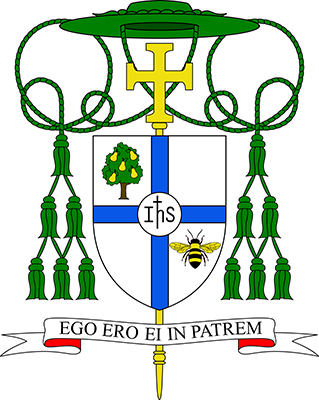
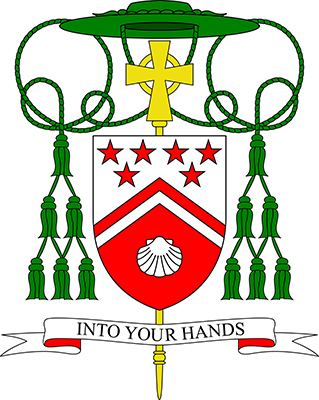
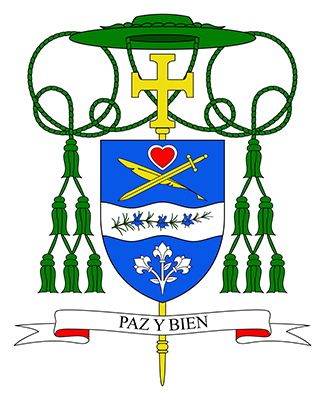
On September 17 Blase Cardinal Cupich, Archbishop of Chicago will ordain three new Auxiliary Bishops. They and their newly assumed coats of arms are:

Mark Bartosic (57) Titular Bishop of Novatcata

wbartosic coat of arms new

BLAZON: Argent, at center, upon a cross throughout azure, a plate charged with the monogram of the Holy Name, sable; to chief dexter a pear tree and to base sinister a bumble bee, both proper.

Robert Casey (50) Titular Bishop of Thuburbo Maius

wcasey_revised coat of arms

BLAZON: Argent and gules; a chevron party per chevron between in chief six stars, in two groups each two and one and in base an escallop all counterchanged.

Ronald Hicks (51) Titular Bishop of Munatiana

wHicks revised coat of arms

BLAZON: Azure, upon a fess wavy argent a sprig of rosemary proper; to chief per saltire a sword upon a quill below a heart gules fimbriated of the second, in base a spring of lily of three blossoms, also of the second.

All three (the work of Deacon Paul Sullivan) show a happy composition, good limited use of colors and make for nice clear designs. The arms of Bishop-elect Hicks is the most “crowded” and the fimbriation around the heart is probably there so that the heart could be depicted as red on a blue field. That’s unfortunate. It’s a “trick” to get around the tincture “rule” (of no color on color) but its a weak design element. It would have been better simply to have the heart be of gold or silver.


Norbertine Cardinals

There have been fewer cardinals in the Church from the Order of Canons Regular of Prémontré (aka Norbertines) than there have been of other orders and, as far as I can tell, two of those known to be associated with that Order were Abbots in Commendam only. The Premonstratensian Cardinals are:

riche

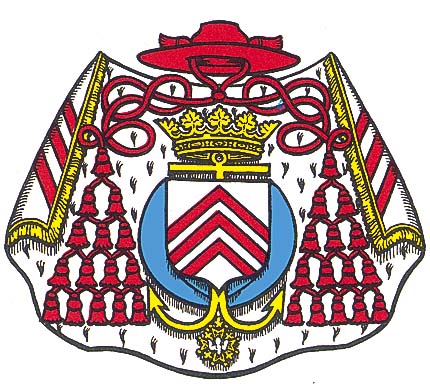
Armand Jean du Plessis, Duke de Richelieu, Bishop of Luçon, Commendatory Abbot of Prémontré, (also Territorial Abbot of Cluny and Abbot in Commendam of Citeaux)

mc BUCCA GIOVANNI 437

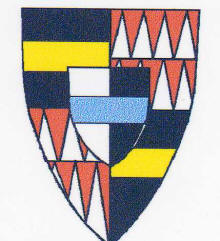
Johannes von Bucka, O.Praem. Archbishop of Olomouc

este2

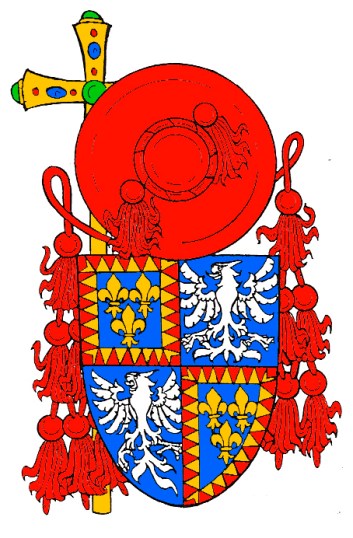
Ippolito II d’Este, Archbishop of Auch, Archbishop of Arles, Commendatory Abbot of Prémontré

Benedictine Cardinals

Throughout the Church’s history there have been many members of the hierarchy who were members of Religious Communities. The present pope is a member of the Society of Jesus (Jesuits) and the first from that Order elected to the papacy. One of the oldest Orders in the Western Church is the Order of St. Benedict. Many monks have been made bishops and quite a few have been raised to the Sacred Purple as Cardinals. The following is by no means exhaustive but gives a sampling of some of the Benedictine Cardinals in recent history. (My gratitude to the fine website called Araldica Vaticana for many of these examples.

Enjoy!

Chiaramonti CORRECTION Chiaramonti Pius VII0001

Gregory Cardinal Chiaramonte, OSB (later Pope Pius VII)

pitra_stemma2a

Jean Cardinal Pitra, OSB

Maria Nova card Schiaffino stemma

Placido Cardinal Schiaffino, OSB Oliv

Ganglbauer manteled0001

Celestine Cardinal Ganglbauer, OSB (Archbishop of Vienna)

SEP28 Gasquet

Aidan Cardinal Gasquet, OSB (Vatican Archivist)

DUSMET GIUSEPPE BENEDETTO

Bl. Giuseppe Cardinal Dusmet, OSB (Archbishop of Catania)

COA_cardinal_HU_Vaszary_Ferenc_Kolos2

Kolos Cardinal Vaszary, OSB (Primate of Hungary)

2015 Saraiva 07051845

Francisco de S. Luiz Cardinal Soraiva, OSB (Patriarch of Lisbon)

NOTE: Cardinal Soraiva also had a version of his arms with a galero but also used the triple tiara as was customary for the Patriarchs of Lisbon until very recently.

SERAFINI DOMENICO 05031918

Domenico Cardinal Serafini, OSB

Schuster design0001CCC

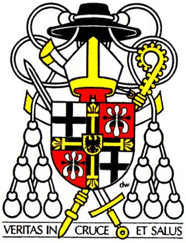
Ildephonse Cardinal Schuster, OSB (Abbot of St. Paul Outside-the-Walls and later Archbishop of Milan)

BB-05 SEREDI0001

Justinian Cardinal Seredi, OSB (Primate of Hungary)

Coat_of_arms_of_Joaquín_Anselmo_María_Albareda_y_Ramoneda.svg

Joachim Cardinal Albareda y Ramoneda, OSB (Vatican Librarian)

51CS) Stemma Card. Gut Benno Walter (1897-1970)

Benno Cardinal Gut, OSB

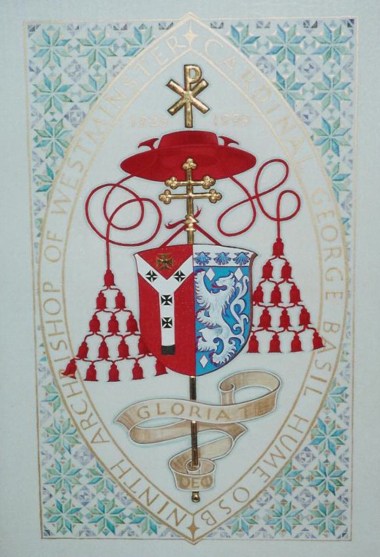
Image 3

Basil Cardinal Hume, OSB (Archbishop of Westminster)

archbishop-hans-hermann-cardinal-groer-of-vienna-1986-1995

Hans Herman Cardinal Groer, OSB (Archbishop of Vienna)

88155b

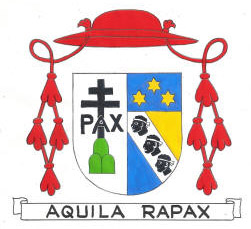
Paul Augustine Cardinal Mayer, OSB

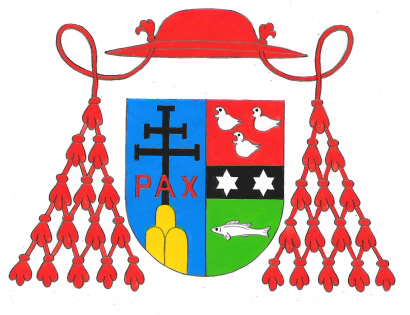
Archbishop Comensoli of Melbourne

On August 1, the Most Rev. Peter Comensoli (54) was installed as the Archbishop of Melbourne, Australia.

IMG_8322


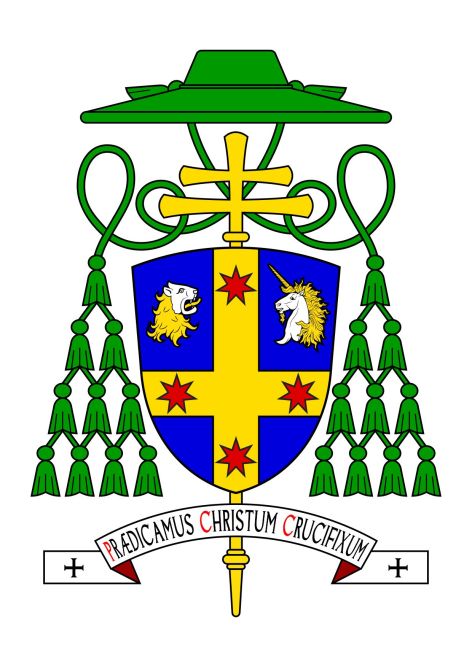
The personal Arms of Archbishop Peter Comensoli were assumed in 2011 on his ordination as titular Bishop of Tigisi in Numidia and borne by him as Auxiliary of the Archdiocese of Sydney (2011-2014). He bore them impaled with the Arms of the Diocese of Broken Bay as its third Bishop (2014-2018). According to the usual custom in Melbourne he has chosen to use his personal arms alone.
The arms and motto are blazoned as follows: Azure, on a Latin cross inverted Or four seven-pointed mullets (or Commonwealth stars) Gules, in the first quarter a lion’s head erased Argent crined and langued Or and in the second a unicorn’s head erased Argent crined and armed Or respectant.
The motto ‘Praedicamus Christum Crucifixum’ is a quotation from the Apostle Paul’s first epistle to the Corinthians (1Cor1.23), and can be translated as ‘We preach Christ crucified.’
The inverted Latin Cross symbolises the Bishop’s nominal patron, the Apostle Peter and the stars reflect the Southern Cross, which shines out over the Great South Land of the Holy Spirit. The lion and the unicorn respectively symbolise the mind and the heart of love.
I was privileged to help design these arms back in 2011 along with Richard d’Apice. They are emblazoned by Sandy Turnbull.

Abbot-General of the Norbertines

abgen

The armorial bearings of the newly elected Abbot-General of the Order of Canons Regular of Prèmontrè (aka the Norbertines) the Most Rev. Josef Wouters, O.Praem., former abbot of Averbode. This coat of arms was originally designed by Luc Duerloo and contains charges on a fess normally associated with the Community at Averbode with the addition of personal symbols (the lance head and plow blade). The impalement here is with the arms of the Order. I understand that, as Abbot-General, he has decided to use some other arrangement which, oddly, combines the symbols for Averbode with the arms of the Order and omits any personal symbols whatsoever.

abgen2

Archbishop McCarrick

Here is a heraldic oddity. It involves the reduction in rank or demotion of a prelate. Now that Theodore McCarrick has resigned from the College of Cardinals he will no longer enjoy the privileges associated with it. For the time being he retains a coat of arms, although, I suppose that remains to be seen as well, and it bears the personal arms he assumed when he first became a bishop as Auxiliary Bishop of NY. He retains the double-barred cross and galero with 20 tassels of an archbishop because he is the Archbishop-emeritus of Washington, DC. The arms of theSee of Washington are not impaled with his personal arms because he is no longer the incumbent of that See. Having laid aside the dignity of a Cardinal he reverts to being Archbishop McCarrick.


TMAC3

Bishop Richard Henning

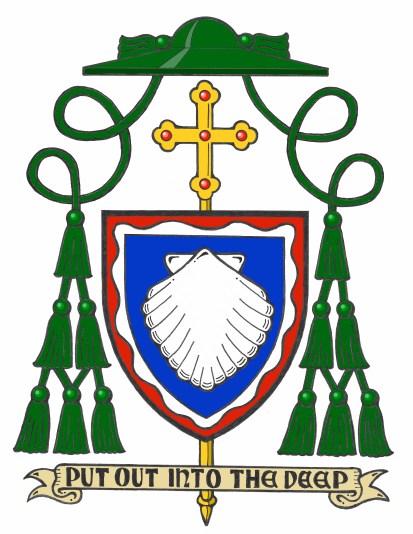
On Tuesday, July 24, the Most Rev. Richard G. Henning (53), a priest of Long Island’s Diocese of Rockville Centre and currently Rector of the Seminary of the Immaculate Conception, will be ordained a bishop and become Titular Bishop of Tabla and Auxiliary Bishop of Rockville Centre. Shortly after his appointment he asked me to assist in the design of his arms. The Bishop and I are classmates from our days attending Chaminade High School in Mineola, NY. His coat of arms is:

HenningFinal1c


The blazon of the arms is: Azure, within a bordure parted wavy Argent and Gules an escallop shell Argent. The shield is ensigned with an episcopal cross Or charged with five jewels Gules and a bishop’s galero with cords and twelve tassels flanking the shield disposed in three rows of one, two and three all Vert. On a scroll below the shield is the motto, “Put Out Into The Deep”.

The shield is composed of a design depicted in red (Gules), white (Argent) and blue (Azure) which are the national colors of the United States.

Both the blue background and the single escallop shell allude to the sea as evoking the Bishop’s own background and the shell is also borrowed from the coat of arms of the See of Rockville Centre, the diocese in which he was born and raised and which he serves as a priest and bishop. The shell image also recalls the Bishop’s heritage in the Diocese of Brooklyn, dedicated to its patron, St. James. The ordination of the bishop takes place on the eve of the Feast of St. James. In concert with the Bishop’s motto, the shell is a traditional symbol of baptism and pilgrimage. It is in the depths of these waters that Christians find their salvation in Jesus Christ.

The white wavy line surrounding the blue field is similarly taken from the arms of Rockville Centre and it alludes to the diocese’s location on Long Island, NY. Furthermore, it indicates the sea as the place where the barque of St. Peter, an image used to evoke the Church, is located.

The blue background also evokes the Bishop’s devotion to the Blessed Virgin Mary and his years of service as a Professor and Rector at the Seminary of the Immaculate Conception. The red wavy portion of the border evokes the Bishop’s devotion to the Most Sacred Heart of Jesus and his service as the Director of the Sacred Heart Institute for the Ongoing Formation of the Catholic Clergy.

The external ornaments include a gold episcopal cross placed vertically behind the shield decorated with five red jewels symbolic of the wounds of Christ. This is often mistaken for a processional cross like the one used in liturgical processions. However, like other heraldic ornaments the episcopal cross has its origins in something which is no longer actually used. At one time all bishops had, in addition to the processional cross at the head of the procession, another cross carried directly in front of them by a cleric. This other cross was a sign of the office of bishop. While no longer actually used it has remained a symbol of the episcopal office in heraldry.

Similarly, the broad-brimmed green galero was, at one time, worn by bishops in outdoor processions and cavalcades. No longer used it remains a heraldic symbol of the office of bishop and takes the place of the helmet, mantling and crest that would appear in the coat of arms of a layman. In Catholic heraldry the color and number of tassels on the galero indicates the rank of the bearer. The single barred episcopal cross and the green galero with twelve tassels signifies the coat of arms of a bishop according to the Instruction of the Holy See, “Ut Sive” issued in 1969.

The motto chosen by Bishop Henning appears on a scroll below the shield. “Put Out Into The Deep” which is taken from Luke 5:4.