On February 24, the Most Rev. Manuel de Jesus Rodriguez (52), a native of the Dominican Republic and a former Salesian who, in 2012, incardinated into the Diocese of Brooklyn, NY will be ordained and installed as the 6th Bishop of Palm Beach, Florida. The Diocese of Palm Beach, erected in 1984, has a long-standing relationship with the Diocese of Brooklyn. Its founding bishop, Thomas Daily, was later translated to Brooklyn in 1990 and Bishop Rodriguez’s immediate predecessor, Gerald Barbarito, was a priest and Auxiliary Bishop of Brooklyn.
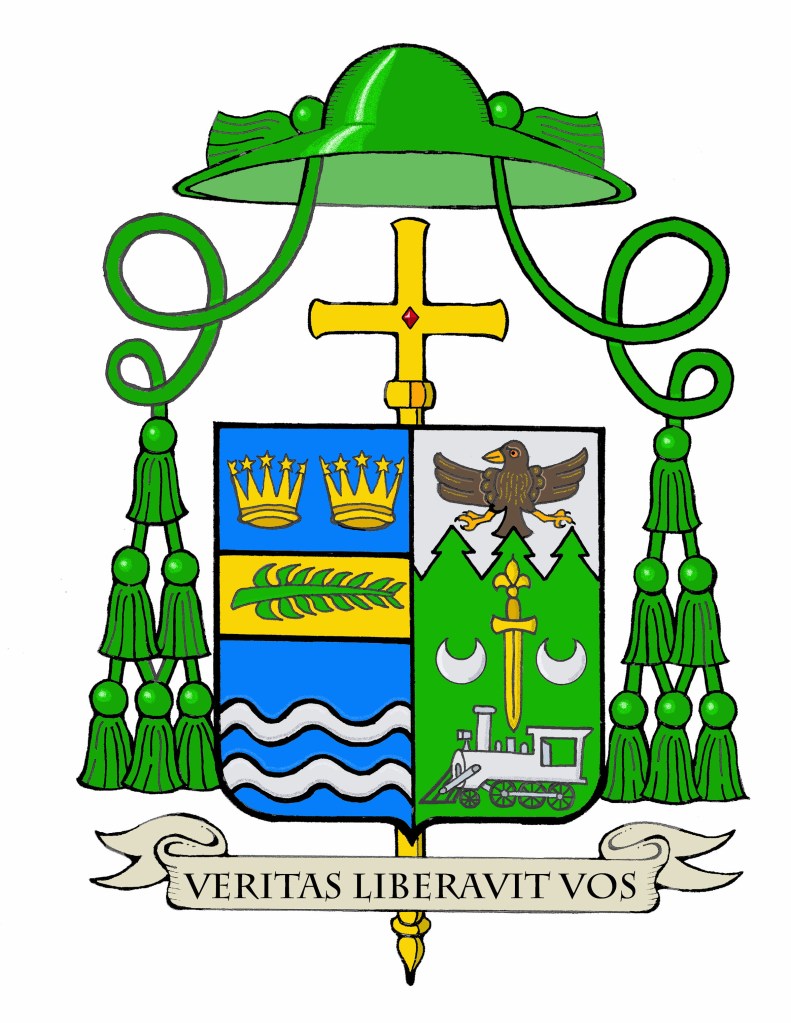
BLAZON: Arms impaled. In the dexter: Azure, on a fess Or between in chief two celestial crowns Or and in base two barrulets wavy Argent, a palm branch Vert (Palm Beach). In the sinister: Vert between two crescents Argent a sword, point downward with the pommel in the shape of a fleur-de-lis Or above in base an antique locomotive Argent; on a chief per sapiné Argent a Cigua Palmera rising Proper (Rodriguez). The shield is ensigned with an episcopal cross Or and a bishop’s galero with cords and twelve tassels flanking the shield disposed in three rows of one, two and three all Vert. On a scroll below the shield is the motto, “Veritas Liberavit Vos”.
EXPLANATION: The armorial bearings of Bishop Manuel Rodriguez impale the coat of arms of his episcopal See with his personal coat of arms. These evoke his heritage as well as his ministry. The coat of arms is composed of a shield with its charges (symbols), a motto and the external ornamentation. The shield is described (blazoned) in terms that are archaic to our modern language, and this description is presented as if given by the bearer with the shield being worn on the arm. Thus, where it applies, the terms dexter (right) and sinister (left) are reversed as the device is viewed from the front.
It is customary in heraldry that the arms of a Diocesan Bishop, or Ordinary, are joined side by side on the same shield with the arms of his See. In this case, these are the arms of the Diocese of Palm Beach. Such marshaling is called impalement and employs the same method used when joining the coats of arms of two people who are married. In this way, the coat of arms, like the episcopal ring, is symbolic of the bishop being “married” to his diocese.
The arms of the Diocese of Palm Beach are composed of a blue field on which are placed two small wavy silver (white) bars at the bottom of the shield that signify the waters of the Atlantic Ocean, which dominates the geography of the region. In the center of the shield is a gold (yellow) bar, called a “fess,” on which is seen a green palm branch. These symbols play on the name of the See City by placing a palm branch on the golden sands of a beach, producing a symbol for Palm Beach. Above the fess are two gold (yellow) crowns topped with stars to honor the Blessed Virgin Mary in her titles of “Queen of Heaven” and “Star of the Sea.”
Bishop Rodriguez’s personal coat of arms is now assumed by him as he becomes a bishop. The main part of the field is green and upper part of it terminates in a division line in the shape of a line of fir trees suggesting a forest. This is to honor St. John Bosco, the founder of the Salesian Order to which the Bishop originally belonged before becoming a priest in Brooklyn. The name “Bosco” means woods or forest in Italian and the trees are used, also, on the coat of arms of the Salesians. In addition, the trees represent the oaks and pines abundant in the U.S.A. Finally, trees like these also appeared in the coat of arms of Bishop Barbarito to symbolize the same saint, Don Bosco. So, by repeating the image here Bishop Rodriguez also honors his episcopal predecessor, who was also a priest of Brooklyn before coming to Palm Beach as its bishop.
In the center of the field is a gold (yellow) sword, a symbol of St. Michael the Archangel, the pommel of which is shaped like a fleur-de-lis as an allusion to St. Joan of Arc. The fleur-de-lis is used as a symbol in heraldry for France and the stylized lily is also in the coat of arms of St. Joan, the Maid of Orleans. On either side of the sword are two silver (white) crescents. These represent several things. The crescent is used in heraldry as a symbol of Our Lady under the title of The Immaculate Conception so the crescent itself is a symbol of Mary in heraldry. In addition, the Immaculate Conception is the patroness of both the United States of America and the Diocese of Brooklyn. So, the two crescents honor the Bishop’s adopted country and the diocese he served as a priest.
At the bottom of the shield is a stylized depiction of an antique locomotive. This is a symbol of Moca, the Bishop’s hometown in the Dominican Republic. In addition, it also serves as a symbol of migrants, a special group of people to which the Bishop himself belongs and who the Church is always called to accompany. On the upper third of the shield, called a “chief” we see a Cigua Palmera, the national bird of the Dominican Republic colored as it would appear in nature. By using this symbol the Bishop honors his native land.
The external ornaments include a gold episcopal cross placed vertically behind the shield. This is often mistaken for a processional cross like the one used in liturgical processions. However, like other heraldic ornaments the episcopal cross has its origins in something which is no longer actually used. At one time all bishops had, in addition to the processional cross at the head of the procession, another cross carried directly in front of them by a cleric. This other cross was a sign of the office of bishop. While no longer actually used it has remained a symbol of the episcopal office in heraldry.
Similarly, the broad-brimmed green galero was, at one time, worn by bishops in outdoor processions and cavalcades. No longer used it remains a heraldic symbol of the office of bishop and takes the place of the helmet, mantling and crest that would appear in the coat of arms of a layman. In Catholic heraldry the color and number of tassels on the galero indicates the rank of the bearer. The single barred episcopal cross and the green galero with twelve tassels signifies the coat of arms of a bishop according to the Instruction of the Holy See, “Ut Sive” issued in 1969.
The motto chosen by Bishop Rodriguez appears on a scroll below the shield. “Veritas Liberavit Vos” which translates to “The truth will set you free” is taken from Jn 8:32.
The use of the locomotive as a charge is rather unusual. More modern elements can, on occasion, be incorporated into a coat of arms even though they seem somewhat incongruous. I did attempt to persuade the bishop to use some other charge to symbolize the railroad that might have been more suitable, or at least more abstract. However, he was quite insistent that the antique locomotive itself be used as it was too strongly associated with his home town. Since it was not wholly wrong to use it I gave in and permitted it because, after all, this is his coat of arms and should reflect those things he wishes as long as they aren’t entirely inappropriate and/or violate the rules of heraldry.
It was my honor and pleasure to assist the bishop with the design and execution of his coat of arms.

 EXARANDORUM