On February 6, 2026 the Most Rev. Ronald Hicks (58), originally a priest and Auxiliary Bishop of the Archdiocese of Chicago and, since 2020 the Bishop of Joliet, Illinois will be installed as the 14th Bishop and 10 Metropolitan Archbishop of New York, one of the most prestigious Sees in the United States and in the whole world.
At the time he became a bishop in 2018 Archbishop Hicks assumed a coat of arms designed by the late Deacon Paul Sullivan which was then marshaled to those of the See of Joliet by me in 2020. Now, as he is translated to the See of New York he once again changes the impalement of his arms to reflect his new position.
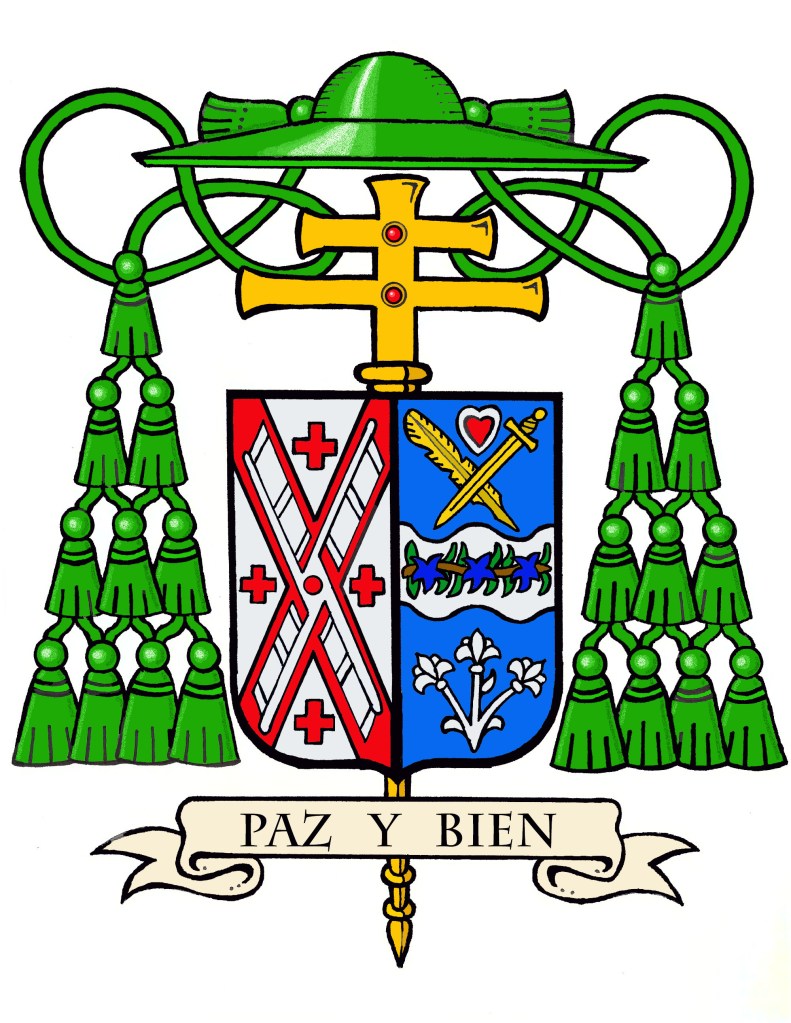
BLAZON: Arms impaled, in the dexter: Argent, on a saltire between four Greek crosses all Gules, the sails of a windmill arranged in saltire Argent. (Archdiocese of New York); in the sinister: Azure, on a fess wavy Argent a sprig of rosemary Proper; in chief a sword and a quill in saltire Or below a heart Gules fimbriated Argent; in base a sprig of lily of three blossoms Argent. (Archbishop Hicks). The achievement is ensigned with an archiepiscopal cross Or behind the shield and an archbishop’s galero Vert cords and twenty tassels disposed in four rows of one, two, three and four all Vert. On a scroll below the shield the motto: “ Paz Y Bien”.
On the left side of the shield as we view it is the coat of arms of the Archdiocese of New York. It is composed of a silver (white) field on which is displayed a red saltire; a cross in the form of the letter “X.” This is known in heraldry as a “Cross of St. Patrick,” and by its use an allusion is made to the titular patron of the cathedral church in New York and of the archdiocese. Upon the saltire is a silver (white) mill-sail (a wind mill), which is also seen in the seal of New York City, to reflect the Dutch heritage of the founders of the city that was originally known as “New Amsterdam.” Within the four areas of the field created by the saltire are seen four small red crosses with arms of equal length, referred to as “Greek crosses” in heraldry, for the four Gospels, emblematic of the Church’s mission to bring “The Good News” to those entrusted to its care.
The personal coat of arms assumed by Archbishop Hicks combines symbols that are meaningful to him reflecting his life and priestly ministry. On a blue field we see a silver (white) wavy bar across the center, heraldically known as “a fess.” This is indicative of water, symbolizing Lake Michigan, to honor the bishop’s home town of South Holland, Illinois. On the fess wavy is a sprig of rosemary, depicted “proper,” that is, as it appears in nature, to honor the martyred archbishop of El Salvador, St. Oscar Romero. The Spanish word for the herb rosemary is “romero” and the saintly bishop had this as a charge in his own coat of arms as well.
Above the fess are a quill pen and sword, both gold (yellow) and crossed in a saltire, alluding to St. Paul, because the sword was the instrument of his execution and martyrdom and the pen of his writings that were so important for the archbishop, who grew up in an ecumenical family. These charges are placed below a red heart, outlined or fimbriated in silver (white) in order to set it off from the blue field. This heart is included to remember the archbishop’s service with the NPH (Nuestros Pequeños Hermanos, “Our Little Brothers and Sisters”), a “heartfelt people,” who care for orphans and abandoned children throughout Central and South America.
Below the fess is a silver (white) three-blossom sprig of lilies that is taken from the arms of the University of St. Mary of the Lake in Mundelein, where the archbishop attended the seminary, earned his doctorate in ministry and served on the faculty and staff.
The motto below the shield is, “Paz Y Bien” the Spanish for “Peace and Good”. This phrase, attributed to St. Francis, emphasizes that true peace comes from Christ and all the good he shares through his word and sacraments.
The external ornaments include a gold archiepiscopal cross with two horizontal bars (sometimes referred to as a patriarchal cross) placed vertically behind the shield decorated with red jewels. This is often mistaken for a processional cross like the one used in liturgical processions. However, like other heraldic ornaments the archiepiscopal cross has its origins in something which is no longer actually used. At one time all bishops had, in addition to the processional cross at the head of the procession, another cross carried directly in front of them by a cleric. This other cross was a sign of the office of bishop. It originated as a custom that such a cross was carried before archbishops only. Later, the cross was adopted for use by all bishops so archbishop’s added a second horizontal bar to their crosses to distinguish them from the episcopal cross of simple bishops. While no longer actually used it has remained a symbol of the archiepiscopal office in heraldry. There are other clerics who make use of the ecclesiastical hat with its many tassels but the one true heraldic emblem of an archbishop—and the only essential one—is the archiepiscopal cross placed behind the shield.
It is not, as is sometimes supposed, a symbol of the office of Metropolitan because the archiepiscopal cross is used by all archbishops, even those who are not Metropolitan Archbishops.
Above the shield is the ecclesiastical hat, called a galero which, in heraldry, replaces the martial helmet, mantling and crest. “The hat with pendant tassels (green, purple or black) on each side is universally considered in heraldry as the sign of prelacy. It, therefore, pertains to all who are actually prelates.” (Heim, Bruno B., Heraldry in the Catholic Church 1978, page 114). This broad-brimmed green galero was, at one time, worn by bishops and archbishops in outdoor processions and cavalcades. No longer used it remains a heraldic symbol of the office of (arch)bishop. In Catholic heraldry the color and number of tassels on the galero indicates the rank of the bearer. Green is used in the coats of arms of bishops and archbishops because, again at one time, green was the color worn by those prelates before they later adopted the familiar Roman purple. The double barred archiepiscopal cross and the green galero with twenty tassels signifies the coat of arms of an archbishop according to the Instruction of the Holy See, “Ut Sive” issued in 1969.
It was a great pleasure and a real privilege for me to assist the Archbishop with the preparation of his armorial bearings.
 EXARANDORUM
Hello father Guy
Congratulations with “Hicks in New York” !
I consider the archdioceses New York and Vienna equal in hierarchy. And then I see something remarkable;
The new a.b. for Vienna already gained the pallium in his coa, even before his consecration.
For the new a.b. of New York, installed, I did not see such pallium. Should ‘nt mgr. Hicks no also get a pallium.
Greetings, Hans van Heijningen
No. The pallium will never appear in the arms of Abp. Hicks for the simple reason that including the pallium as an external ornament to the shield is inappropriate. I agree with Heim who says that there is no good and effective way that is also aesthetically pleasing to include the pallium in an achievement. Placing it below the shield is a bad idea because it ends up looking like an order of chivalry. The pallium (pall), if used at all, belongs ON the shield incorporated into the design of the arms itself. The practice in recent years of placing the pallium in the heraldic achievement is a bad innovation. I never include the pallium in the achievements for Metropolitan Archbishops that I create.