On July 17, 2025 the Most Rev. Michael Pham (58), a priest of the Diocese of San Diego who, since 2023 has also served as Auxiliary Bishop there, will be installed as the VII Bishop of San Diego.
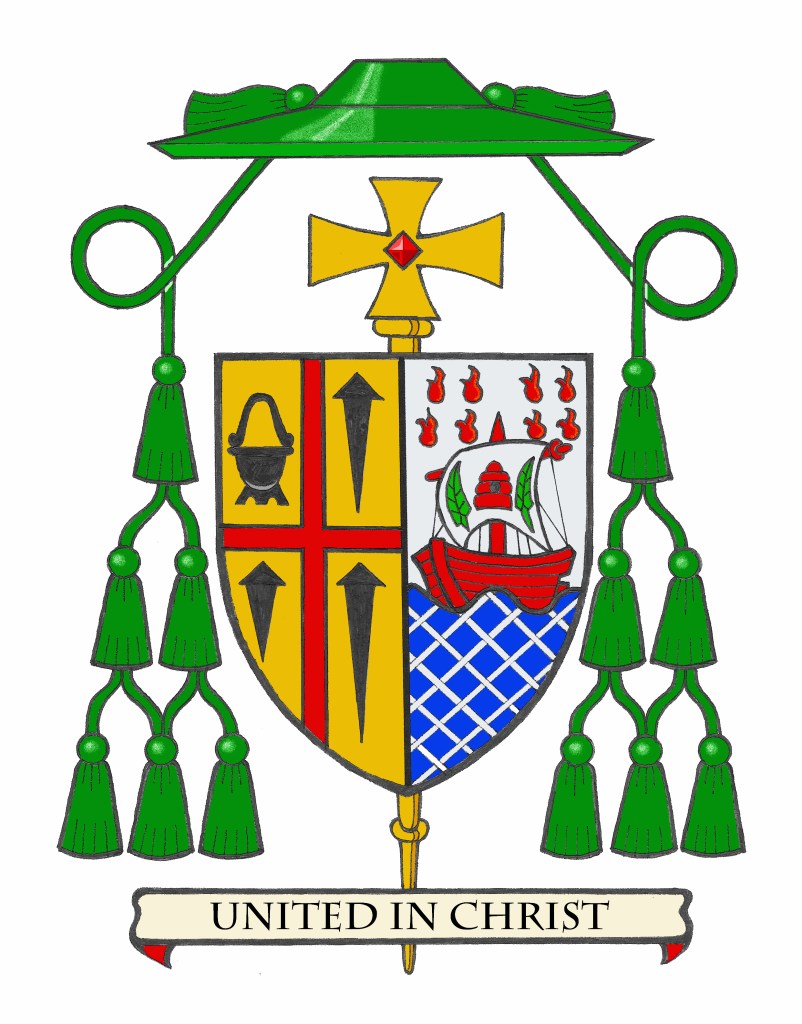
The arms that he assumed when he became a bishop in 2023 remain unchanged, as is most correct. They have, however, simply been marshaled with the existing, and very nice, coat of arms of the diocese.
BLAZON: Arms impaled. In the dexter: Or, a cross throughout Gules between in the dexter chief quarter a Spanish stew pot and in the other three quarters a nail all Sable (San Diego) In the sinister: Per fess wavy Argent and Azure; in base fretty Argent; in chief a fishing boat Gules with a sail unfurled Argent charged with a beehive Gules flanked by two palm branches to dexter and sinister Vert; in chief eight tongues of fire all Gules. Shield ensigned with an episcopal cross Or behind the shield and a bishop’s galero Vert cords and twelve tassels disposed in three rows of one, two and three all Vert. On a scroll below the shield the motto: “United in Christ”.
EXPLANATION: The Bishop’s coat of arms, is composed of a shield upon which there are symbolic charges, a motto and the external ornaments of rank. The shield which is the most important feature of any heraldic device is blazoned (i.e. described) in heraldic language from the point of view of the bearer with the shield being held on his arm. Thus, where it applies, the term “dexter” (right) and “sinister” (left) are reversed as the device is viewed from the front.
By heraldic custom observed in North America, the arms of a diocesan bishop are “impaled” side by side on the same shield to the arms of his jurisdiction, in this case, the Diocese of San Diego. This signifies that the diocesan bishop is “married” to the See. The same method of impalement is employed in the coat of arms of two married people who are armigerous.
The coat of arms of the See of San Diego is composed of a gold (yellow) field and symbols of San Diego (St. Didacus in Latin), the diocesan patron saint. Diego was born to poor Spanish parents shortly before the year 1400. His love of poverty never left him. As a Franciscan brother he was a selfless servant of the poor and was known to heal the sick with the Sign of the Cross, the central charge of the diocesan coat of arms. The Spanish stew pot in the upper left quadrant indicates Diego’s boundless charity and tireless efforts to feed the hungry. San Diego had a special devotion to the Lord in his Passion, symbolized by the three nails in the other three quadrants. Diego died on Nov. 12, 1463, at the Franciscan monastery in Alcalá, Spain, pressing a crucifix to his heart and repeating the words of the Good Friday chant: “Dulce lignum, dulce ferrum, dulce pondus sustinet” (Precious the wood, precious the nails, precious the weight they bear.)
The personal coat of arms assumed by Bishop Pham when he was made Auxiliary Bishop in 2023 combines symbols that are meaningful to him. The shield is divided horizontally to depict a silver (white) sky above a blue wavy ocean. The ocean is criss-crossed by diagonal lines in order to create a pattern suggestive of a fisherman’s net. It represents that after 1975 while still living in Vietnam the bishop’s father became a fisherman to provide for his family. In addition, the net indicates not only the task of an apostle (or a successor to an apostle) of being a “fisher of men” but it also alludes to the New Evangelization where we are exhorted to put out into the deep (Duc in Altum). This symbolizes both the bishop’s priestly and episcopal ministry.
In the upper part of the shield the boat also alludes to the work of a fisherman. In addition, a boat, in heraldry, is often used as a symbol of the Church itself, often referred to as the barque of Peter, who was himself, a fisherman. On the sail of the boat in the center is a red beehive flanked by two green palm branches. The beehive is a symbol of St. John Chrysostom, the bishop’s baptismal patron saint who was renowned for his inspiring preaching. So, he was known as a “honey-tongued” preacher. The palm branches are an ancient symbol of martyrdom. The bishop’s family comes from the first diocese in the north of Vietnam where his ancestors were among the first martyrs for the faith in that part of the world.
On either side and above the boat are eight red tongues of fire. They are symbols of the Holy Spirit which descended on the Apostles as tongues of fire at Pentecost. This was the beginning of their ministry to go out into the world to preach the Gospel so it is another symbol of Evangelization. Several flames represent a diversity of communities. Bishop Pham strengthened the cultural communities found in the diocese and shared them with the larger Catholic community. He has served as Episcopal Vicar of the Office of Ethnic & Intercultural Communities. So, symbols of the Holy Spirit were seen to appropriately reflect this ministry. It also reflects how, on Pentecost, when the Holy Spirit descended, people from different places, languages and cultures heard the Apostles speaking in their own languages. The red of the boat, the beehive and the tongues of fire is a further allusion to the blood of the martyrs.
It was my great pleasure to design and emblazon the bishop’s arms in 2023 when he became a bishop. At this time it was also my pleasure to marshal them to the arms of the See and emblazon them once again.
 EXARANDORUM