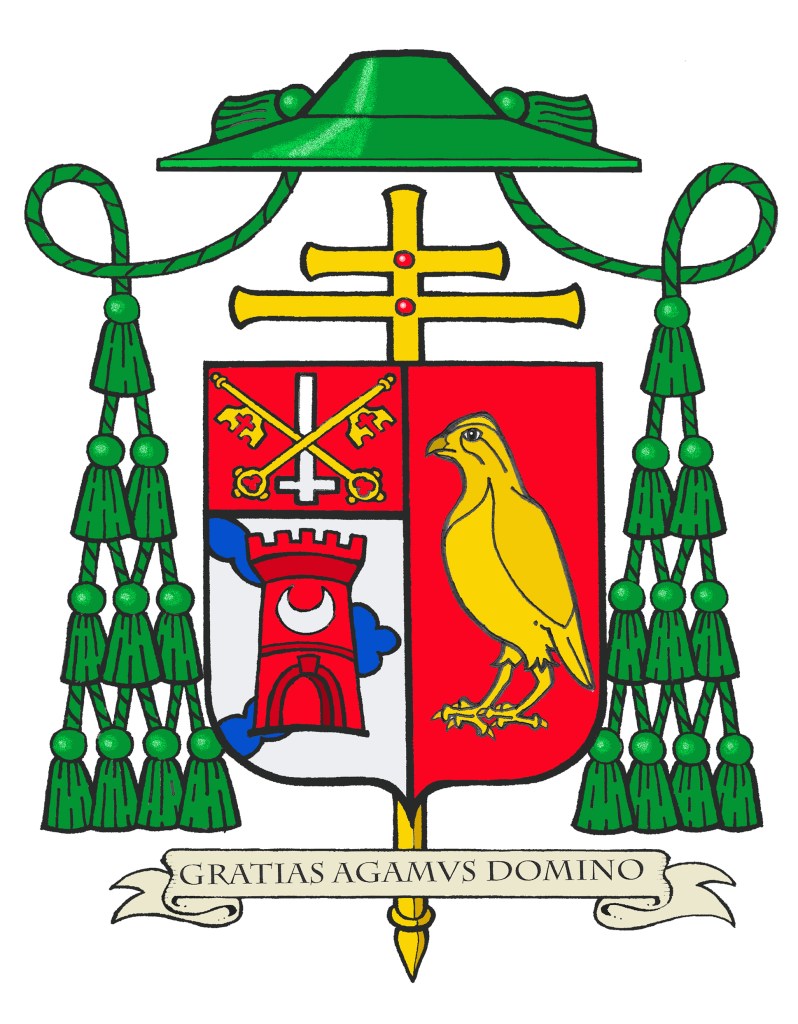
The Most Rev. Shawn McKnight (56) was installed as the fifth Archbishop of Kansas City in Kansas on May 26. I already talked about the very nice version of his coat of arms prepared for that occasion by Matthew Alderman. Immediately after his installation, the archbishop contacted me and asked for another rendering of his arms done by me. While that is somewhat unusual it is not unprecedented. It’s not uncommon for an armiger to have and use different renditions of his coat of arms done by different artists.
So, I undertook to do an emblazonment of the archbishop’s coat of arms for his use.
BLAZON: Arms impaled. In the dexter: Argent, a chevron invected issuant from the dexter, overall a tower embattled Gules charged with a crescent Argent; on a chief Gules a Latin cross reversed Argent surmounted by two keys in saltire Or. In the sinister: Gules a quail statant Or. The shield is ensigned with an archiepiscopal cross Or and an archbishop’s galero with cords and twenty tassels flanking the shield disposed in four rows of one, two, three and four all Vert. On a scroll below the shield is the motto, “Gratias Agamus Domino”.
EXPLANATION: The armorial bearings of Archbishop McKnight impale the coat of arms of his archiepiscopal See with his personal coat of arms. The coat of arms is composed of a shield with its charges (symbols), a motto and the external ornamentation. The shield is described (blazoned) in terms that are archaic to our modern language, and this description is presented as if given by the bearer with the shield being worn on the arm. Thus, where it applies, the terms dexter (right) and sinister (left) are reversed as the device is viewed from the front.
It is customary in heraldry that the arms of a Diocesan Bishop, or Ordinary, are joined side by side on the same shield with the arms of his See. In this case, these are the arms of the Archdiocese of Kansas City. Such marshaling is called impalement and employs the samemethod used when joining the coats of arms of two people who are married. In this way, the coat of arms, like the episcopal ring, is symbolic of the archbishop being “married” to his archdiocese. The arms of the Archdiocese of Kansas City are composed of a silver (white) field on which there is a blue chevron issuing from the side. The sides of the chevron are “invected” which means a line that consists of a series of circular arcs curving in the same direction, meeting at angles, forming points inward. This is to symbolize the Missouri River. Laid over this chevron is a red tower with an open archway and an embattled top. Imposed on the tower is a silver (white) crescent. The tower is a symbol of Fort Leavenworth. The original designation of the Archdiocese was the Diocese of Leavenworth (1877) and the church of the Immaculate Conception was the titular of the cathedral there. The crescent moon in heraldry is a symbol of Our Lady’s Immaculate Conception. The upper third of the shield, called a “chief” contains two crossed gold (yellow) keys superimposed over a silver (white) Latin cross upside down. These are symbols of St. Peter, the titular patron of the cathedral church. The keys are the “keys of the kingdom” bequeathed by Christ to St. Peter and the upside down cross recalls the manner of his crucifixion.
The personal coat of arms of Archbishop McKnight illustrates his personal devotion. The field is red and the one and only charge is a large gold (yellow) quail. The red color alludes to the devotion of Archbishop McKnight to the Sacred Heart of Jesus as well as the Immaculate Heart of the Blessed Virgin Mary. Quail are a symbol of God’s providential blessing and an Old Testament prefiguration of the Eucharist, as the Lord provided for his people in the desert with manna in the morning and quail in the evening (see Exodus 16:11-13; Numbers 11:31-32; Psalm 78:27 and Psalm 105:40). Quail-hunting is also a favorite sport of the Archbishop, an activity which requires the use of pointing, flushing and retrieving hunting dogs, and through which he experiences the beauty, harmony and providence of God in nature.
The external ornaments include a gold archiepiscopal cross with two horizontal bars (sometimes referred to as a patriarchal cross) placed vertically behind the shield decorated with red jewels. This is often mistaken for a processional cross like the one used in liturgical processions. However, like other heraldic ornaments the archiepiscopal cross has its origins in something which is no longer actually used. At one time all bishops had, in addition to the processional cross at the head of the procession, another cross carried directly in front of them by a cleric. This other cross was a sign of the office of bishop. It originated as a custom that such a cross was carried before archbishops only. Later, the cross was adopted for use by all bishops so archbishop’s added a second horizontal bar to their crosses to distinguish them from the episcopal cross of simple bishops. While no longer actually used it has remained a symbol of the archiepiscopal office in heraldry. Similarly, the broad-brimmed green galero was, at one time, worn by bishops in outdoor processions and cavalcades. No longer used it remains a heraldic symbol of the office of bishop and takes the place of the helmet, mantling and crest that would appear in the coat of arms of a layman. In Catholic heraldry the color and number of tassels on the galero indicates the rank of
the bearer. The double barred archiepiscopal cross and the green galero with twenty tassels signifies the coat of arms of an archbishop according to the Instruction of the Holy See, “Ut Sive” issued in 1969.
The motto chosen by Archbishop McKnight appears on a scroll below the shield, “Gratias Agamus Domino”. This is taken directly from the opening dialogue of the preface at the beginning of the Eucharistic Prayer at Mass (“Let us give thanks to the Lord”), and is derived from Psalm 107:1 and Psalm 118:1 (“Give thanks to the Lord Who is good, Whose love endures forever”).
 EXARANDORUM