This question has been posed to me by numerous people since the Holy See released the image of the Pope’s coat of arms as pope. My answer is simply this: it looks pretty much like I expected.
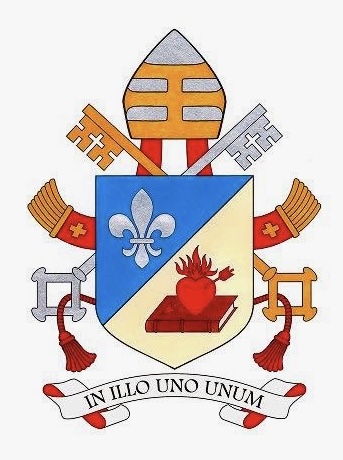
Pope Leo already had a very good coat of arms as a bishop. I’m glad to see he didn’t feel the need to entirely change the design as others have done in the past. A coat of arms is a means of identification. It identifies you. It becomes associated with you in such a way that it shouldn’t be changed cavalierly. A change of position should warrant the use of different external ornaments to signify the new rank, not a full scale change in what is on the shield itself. So, I’m happy to see that the Pope left alone the arms that he assumed as a bishop 11 years ago.
I was not surprised to see the papal tiara rendered in the form of a kind of mitre. This began with Pope Benedict XVI and continued with Pope Francis I. So, we have now seen this for twenty years and I assumed it would be continued. It is, perhaps, important to note that the tiara has not been replaced with a mitre. Rather, it is the papal tiara rendered as a kind of mitre/tiara hybrid. This occurred at all because of ignorance. The argument to Benedict XVI was that since the tiara is, practically speaking, no longer worn it should not be depicted in the coat of arms. Nothing could be farther from the truth. In fact, since it is no longer worn that’s all the more reason it should be used in the coat of arms. It remains a symbol of the papacy. Most of the world’s monarchs no longer actually wear a crown but the use of a crown heraldically remains. Cardinals and bishops no longer wear an actual galero but the galero remains a heraldic emblem. (It is worth noting here that the tiara with the keys remains the emblem of the Holy See.)
St. Paul VI, in his reforms of 1969, decreed that the mitre and crozier which used to be in the coats of arms of all bishops in addition to the galero and episcopal/archiepiscopal cross should no longer be used in the arms of such prelates. He reasoned that the crozier and mitre were still used liturgically as emblems of the episcopal office and their practical use made using them as heraldic symbols redundant and inappropriate. (NOTE: the same is also true for the pallium) Whereas, the episcopal cross and galero—used at one time—had fallen into practical disuse and so were very appropriate to be used purely as heraldic ornaments. By that logic the same is true of the papal tiara. Since recent popes have chosen not to be crowned the use of the tiara as a purely heraldic emblem makes all the more sense.
Yet, those advising Benedict XVI, principally among them Archbishop Piero Marini and the late Cardinal di Montezemolo, argued that the tiara should be modified in its appearance to show that it is no longer actually worn. This was bad advice then and it has now been codified into enduring, though still equally poor advice. Nevertheless, it was easy to anticipate that Pope Leo would simply follow suit. So…no real surprise there.
Similarly, the slight change in tincture of the division of the field in base from Argent (silver or white artistically) to a kind of beige or buff color shows an appalling lack of understanding of heraldry. This is also displayed in the description of this tincture as “light”. Just what, precisely, is THAT supposed to mean ?!?! There isn’t an actual blazon to help clarify this. The lack of a proper blazon could be because no one at the Vatican knows how to write one; they simply don’t find it important enough to care about; or they feel it would be too esoteric and unintelligible for the average person. One can only hope that the reason is one of the latter two rather than the former.
But there isn’t a lot of evidence to dissuade me. For example, the tiara and keys and motto banner are all clearly just a “cut & paste” job from the arms of Pope Francis I. Really? With all the many competent heraldic artists and heraldic experts available to them no one at the Vatican bothered to reach out to anyone and just figured this could all be handled “in house” by someone with a computer? Is that the most appropriate way to prepare a new pope’s coat of arms? it shouldn’t be a matter of who can get it done first but of who can do it best. What a shame that it has been deemed acceptable simply to cobble something together from existing images.
It’s also probably worth noting that—just like all bishops—all of the popes have had an episcopal motto. However, by longstanding tradition and custom a motto is not supposed to be included in the armorial achievement of the Pope. In his seminal work, Heraldry in the Catholic Church (1978) Archbishop Bruno Heim notes that, “It is widespread custom to put a motto under the shield. It is often held, wrongly, by those who know little about heraldry, that the motto is indispensable; yet it is an addition which does not properly belong to the armorial bearings themselves.” (page 80)
So we see that, all in all, the new Pope’s coat of arms is unsurprising in its composition, disappointing in its execution, and uninspiring in its depiction with numerous errors that could have been avoided with a little creativity and some consultation with people who know what they are doing.
For example, in the hands of an artist of some merit the same exact design can be rendered in a manner that looks considerably better just by the good use of composition and artistic style.
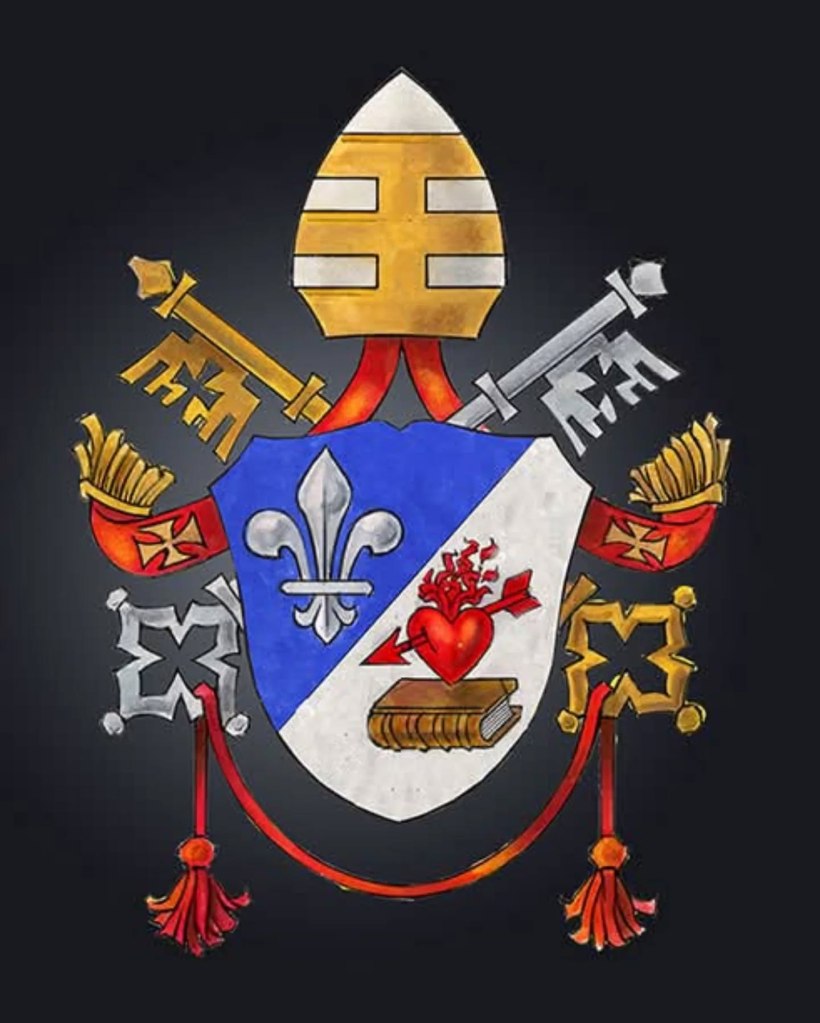
Take, for example, this sketch of the arms of Pope Leo XIV done on the evening of his election by the noted and competent heraldic artist, Marco Foppoli. We can see here that, in the hands of an expert with a great deal of experience, the original heraldic design can be rendered with the appropriate external ornaments in a way that maintains the simplicity that is desired while also creating a new and unique achievement for the armiger. Too bad that someone like Foppoli wasn’t consulted by officials at the Holy See.
Papal heraldry has been in a slow decline since the death of Archbishop Heim. It is sad but true. Unfortunately, at the outset of this new pontificate, there are no signs that this is going to change for the better anytime soon.
God Bless Pope Leo XIV!
 EXARANDORUM
Dear Fr. Selvester,
Well said !!
Best Wishes ! Dwyer
In the heraldry of the USArmy, “buff” is an official color.
Perhaps this applies here?
No.
Foppoli’s rendering is much better. I dislike it when argent is depicted with different colors (silver and white) on the same shield, not to mention “buff”. It’s disappointing that ecclesial heraldic tradition is being disregarded and lost.
So, how do we get you appointed the official heraldic authority for the Catholic Church, Fr. Guy?
Ha ha ha. Who knows? Maybe with an American pope the chances are better? Ha!
it seems white could be the metal Ivory as well as white can be the metal argent silver. But only when dealing with the Pope. According to the Italian heralds????????
It’s all just nonsense.
Did anyone else notice that the coat of arms on the banner beneath the papal apartment’s window, during his second Angelus, depicted the azure field as white?
Well stated, Father. It is quite disappointing that no-one seems to have had the presence of mind to consult an expert, especially at such a momentous occasion. The Vatican officials were of course somewhat pressed for time, but seeing the speed with which artists like Mr. Foppoli have managed to provide superior renderings of this coat of arms, there is no real excuse for this slapdash approach to heraldic design. (Bad graphics result in bad ‘optics’: the lack of serious effort looks bad on a moral level as well.) On the other hand: the concept of an “official rendering” has no real standing in heraldic tradition, and I see no reason why this particular image shouldn’t be replaced (in ‘in-house’ Vatican usage) by an artistically superior version of the same design – *if* someone in a position of influence takes responsibility for the matter. Hopefully sooner rather than later, i.e. before too many ‘papally-branded’ items go into mass production …
It’s been revealed today in the Holy See official statement signed by Antonio Pompili, Vice President of the Italian Heraldic-Genealogical Institute, who’s apparently responsible for the blazon of the papal coat of arms and also designed a few heraldic signs for contemporary bishops as well as co-authored a book guideline for their design, that the unfortunate replacement of the argent tincture in (otherwise heraldically correct) Prevost’s cardinals coat of arms was motivated by the fact that argent should be represented as ivory in the papal heraldry. Where, on earth, did they take such a concept from?