Monthly Archives: January 2025

New Bishop in Oslo

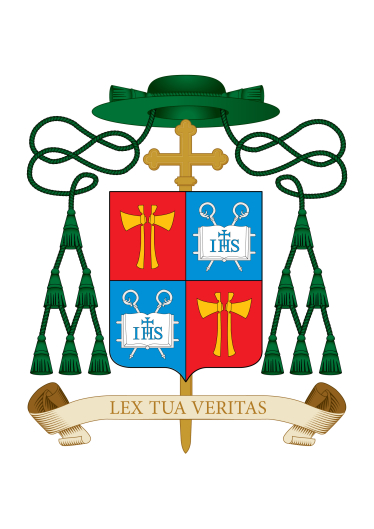
The Most Rev. Frederik Hansen (45) was ordained a bishop on January 18 and became Coadjutor Bishop of Oslo, Norway with the automatic right of succession to Bishop Bernt Ivar Eidsvig, CRSA, who is currently 71. When he succeeds to the See, Bishop Hansen will be the 9th Bishop of Oslo.

In the interests of full disclosure, the new bishop, who spent some time working for the diplomatic corps of the Holy See and was in residence in a parish in my native diocese of Rockville Centre, NY contacted me upon his appointment to design his coat of arms. However, he later was informed that the diocese of Oslo had already secured the services of another heraldist, Archbishop Charles Scicluna of Malta.

The Bishop’s arms are quartered with those of the Diocese of Oslo, somewhat unusually for someone who is not yet the diocesan bishop but more of a “diocesan bishop-in-waiting”. This will, of course, save him the trouble of having a new rendering made when the time comes that he succeeds to the See. nevertheless, it is unusual because he does not yet possess jurisdiction over the See.

For his personal arms, seen in the second and third quarters, the heraldic colors, blue and silver, are from Drammen’s city coat of arms. The “IHS” is the monogram of the name “Jesus” and points to Jesus’ holy name and Bishop Hansen’s devotion to “the name above all names” (Phil 2,9–10) which is given to mankind for salvation (see Acts 4,12). The open book refers to Bishop Hansen’s work in church administration and in priestly formation and teaching. The two croziers allude to two Norwegian saint-bishops: St. Torfinn, bishop of Hamar, and St. Eystein, Primate-Archbishop of Nidaros.

Despite not having worked on this project I’d say the bishop was in good hands and has achieved an excellent result (pun intended).

Native Cheesehead Goes Back to Wisconsin

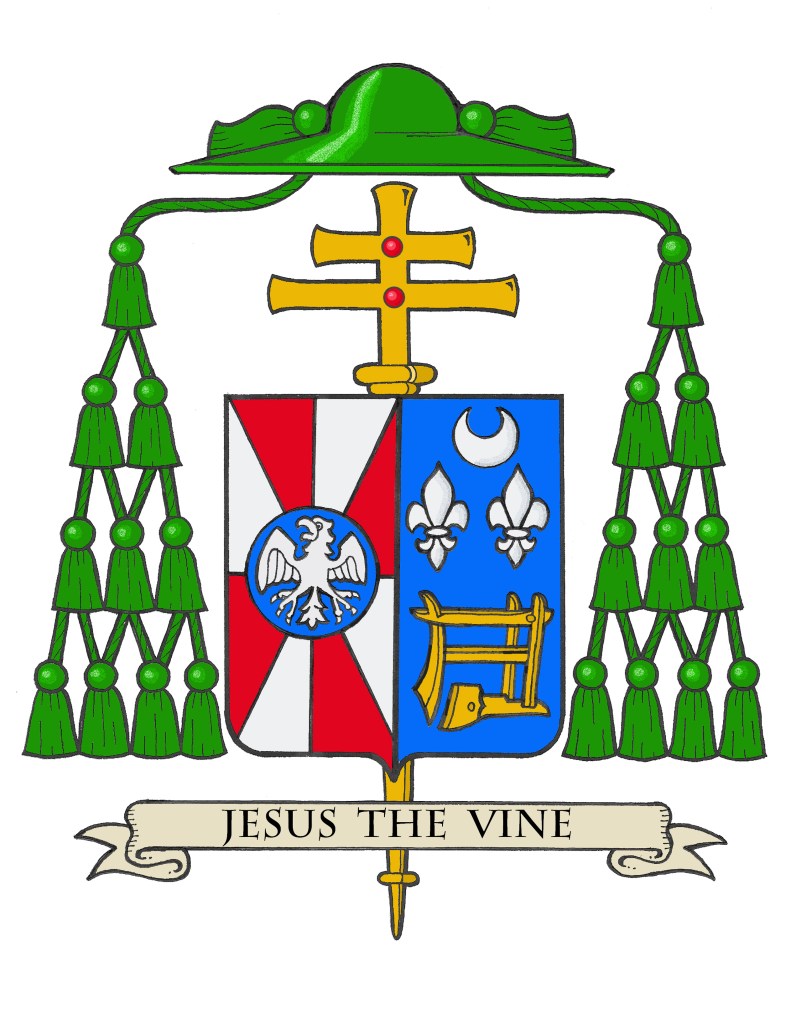
On January 14, 2025 the Most Rev. Jeffrey Grob (63), a priest and, since 2020 an Auxiliary Bishop of Chicago, will return to his native Wisconsin and be installed as the 12th Archbishop of Milwaukee, Wisconsin. The armorial bearings he assumed in 2020 were slightly modified and impaled with those of Milwaukee and are:

The blazon is: Arms impaled. In the dexter: Gyronny of eight Gules and Argent, at the counterpoint a hurt charged with an eagle displayed abaissé Argent. In the sinister: Azure in base an antique plow Or; in chief between two fleur-de-lis a crescent all Argent. The shield is ensigned with an archiepiscopal cross Or and an archbishop’s galero with cords and twenty tassels flanking the shield disposed in four rows of one, two, three and four all Vert. On a scroll below the shield is the motto, “Jesus The Vine”.

The armorial bearings of Archbishop Grob impale the coat of arms of his archiepiscopal See with his personal coat of arms. The coat of arms is composed of a shield with its charges (symbols), a motto and the external ornamentation. The shield is described (blazoned) in terms that are archaic to our modern language, and this description is presented as if given by the bearer with the shield being worn on the arm. Thus, where it applies, the terms dexter (right)  and sinister (left) are reversed as the device is viewed from the front.

It is customary in heraldry that the arms of a Diocesan Bishop, or Ordinary, are joined side by side on the same shield with the arms of his See. In this case, these are the arms of the Archdiocese of Milwaukee. Such marshaling is called impalement and employs the same method used when joining the coats of arms of two people who are married. In this way, the coat of arms, like the episcopal ring, is symbolic of the archbishop being “married” to his archdiocese.

The arms of the Archdiocese of Milwaukee are composed of a field composed of eight sections in alternating colors of red and silver (white). The colors are taken from the flag of Switzerland, the birthplace of Milwaukee’s first Archbishop, John Henni. The four red sections meet at the center in a symbolic reference to the meeting of waters, the Milwaukee and Menomonee rivers and Lake Michigan in Milwaukee. Over the center point is a blue roundel called a “hurt” in heraldry. This, in turn, is charged with a silver (white) eagle with its wings spread out. This is a symbol of St. John, the titular patron of the cathedral church.

The personal coat of arms of Archbishop Grob symbolize his origins, his personal devotion and the place in which he has spent his ministry as a priest and auxiliary bishop. The field is blue and the main charge is a large gold (yellow) antique plow. This not only alludes to the ministry of spreading the Gospel as symbolized by plowing a field to prepare for seed to be sown but is an allusion to the bishop’s early life growing up on a Wisconsin dairy farm.

Above the plow are a silver (white) crescent, a symbol of Our Lady under her title of the Immaculate Conception who is the patroness of the USA. The two silver (white) fleur-de-lis represent several things. First, they are a symbol of St. Joseph to whom the bishop has a special devotion as a kind of patron saint because he was born on the Solemnity of St. Joseph (March 19). The fleur-de-lis is a stylized version of the lily and St. Joseph is often depicted holding a staff from which lilies are blossoming. Second, they allude to St. John XXIII who used them in his own coat of arms. The bishop has a devotion to this great 20th Century saint. Finally, there are two fleur-de-lis in the coat of arms of the Archdiocese of Chicago where the bishop had served as a priest and bishop.

The external ornaments include a gold archiepiscopal cross with two horizontal bars (sometimes referred to as a patriarchal cross) placed vertically behind the shield decorated with red jewels. This is often mistaken for a processional cross like the one used in liturgical processions. However, like other heraldic ornaments the archiepiscopal cross has its origins in something which is no longer actually used. At one time all bishops had, in addition to the processional cross at the head of the procession, another cross carried directly in front of them by a cleric. This other cross was a sign of the office of bishop. It originated as a custom that such a cross was carried before archbishops only. Later, the cross was adopted for use by all bishops so archbishop’s added a second horizontal bar to their crosses to distinguish them from the episcopal cross of simple bishops. While no longer actually used it has remained a symbol of the archiepiscopal office in heraldry.

Similarly, the broad-brimmed green galero was, at one time, worn by bishops in outdoor processions and cavalcades. No longer used it remains a heraldic symbol of the office of bishop and takes the place of the helmet, mantling and crest that would appear in the coat of arms of a layman. In Catholic heraldry the color and number of tassels on the galero indicates the rank of the bearer. The double barred archiepiscopal cross and the green galero with twenty tassels signifies the coat of arms of an archbishop according to the Instruction of the Holy See, “Ut Sive” issued in 1969.

The motto chosen by Archbishop Grob appears on a scroll below the shield, “Jesus The Vine”.

It was my privilege and my pleasure to design the archbishop’s original coat of arms in 2020 as well as to modify them (the original plow-blade alone was replaced with an entire antique plow) and marshal them to the arms of his See.
Cardinal McElroy Translated to Washington, DC

Today, the Holy Father announced to transfer of Robert Cardinal McElroy (70), the Bishop of San Diego, to succeed Wilton Cardinal Gregory (77) as Metropolitan Archbishop of Washington, DC.

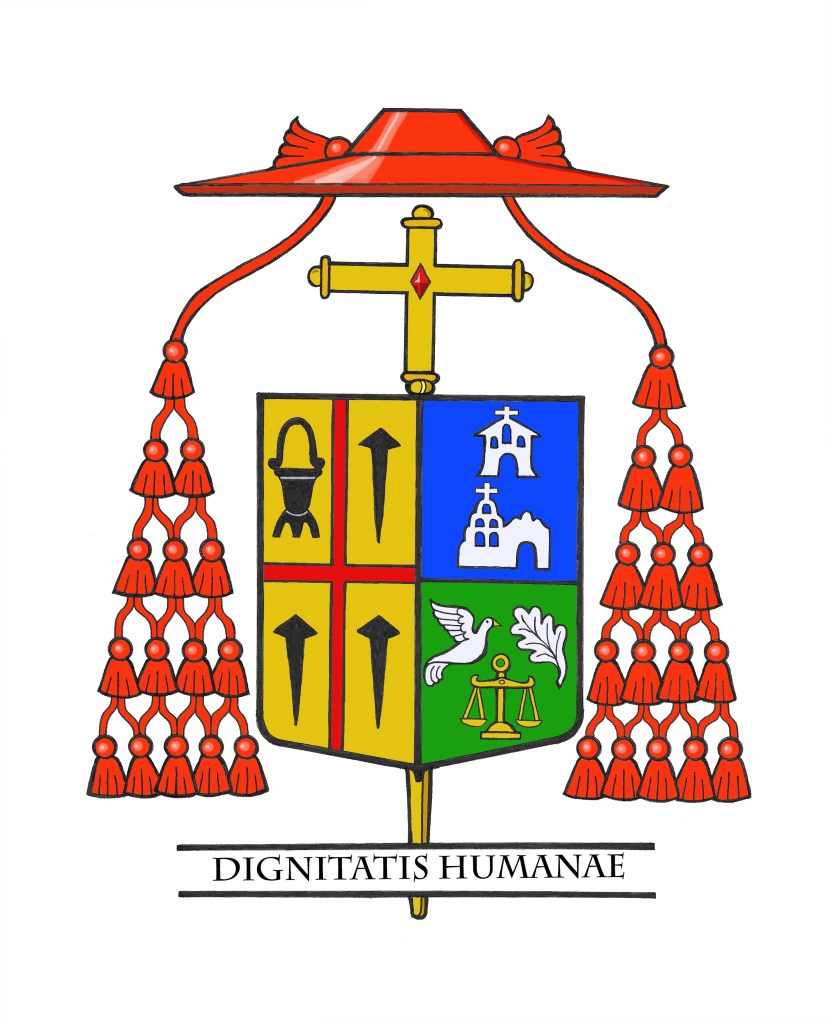
I did not design the Cardinal’s coat of arms but I did prepare the current emblazoning on his elevation to the College of Cardinals.

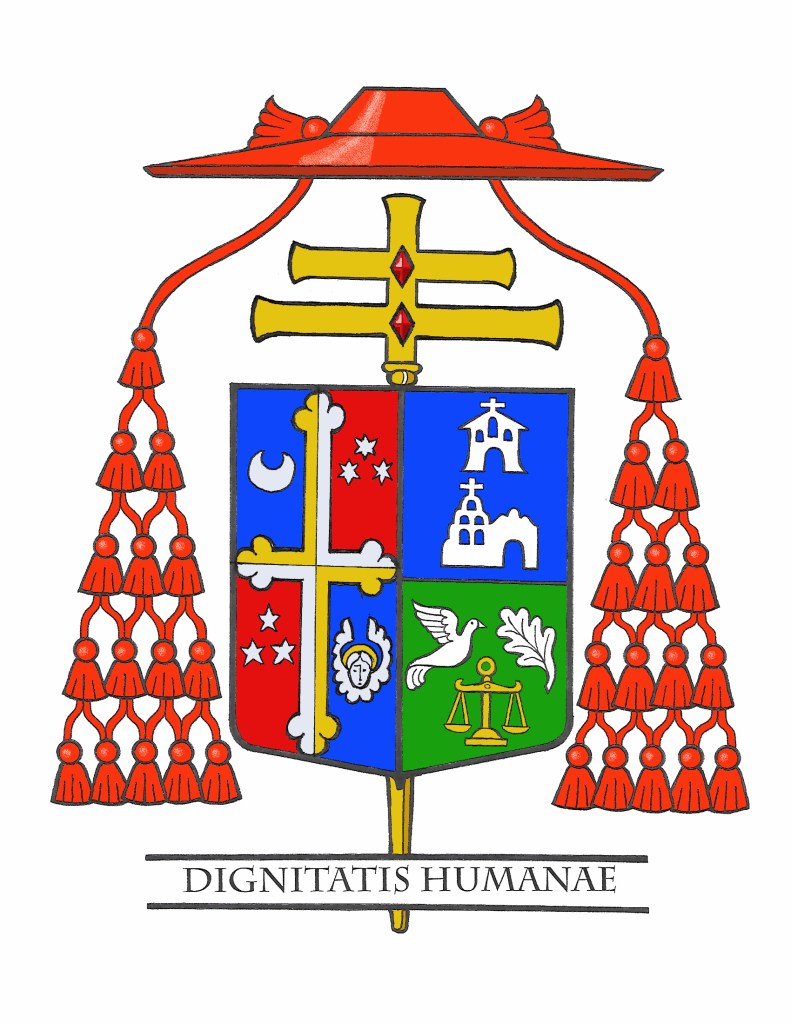
In addition to a new impalement and the addition of an archiepiscopal cross it will be interesting to see if the Cardinal modifies his personal arms at all. The two charges in chief represent two California historic Mission Churches in San Francisco (where he served as a priest) and in San Diego (where he has been serving as diocesan bishop).

Of course I’m no fan of bishops modifying their arms when they move but I could see how he might wish to eliminate these two very Californian references. On the other hand, they both also serve to honor the places of his origin and previous ministry. So, retaining them could also be a good thing. Time will tell.

Below is how his coat of arms may appear after he is installed in Washington:

Danish Coat of Arms Updated

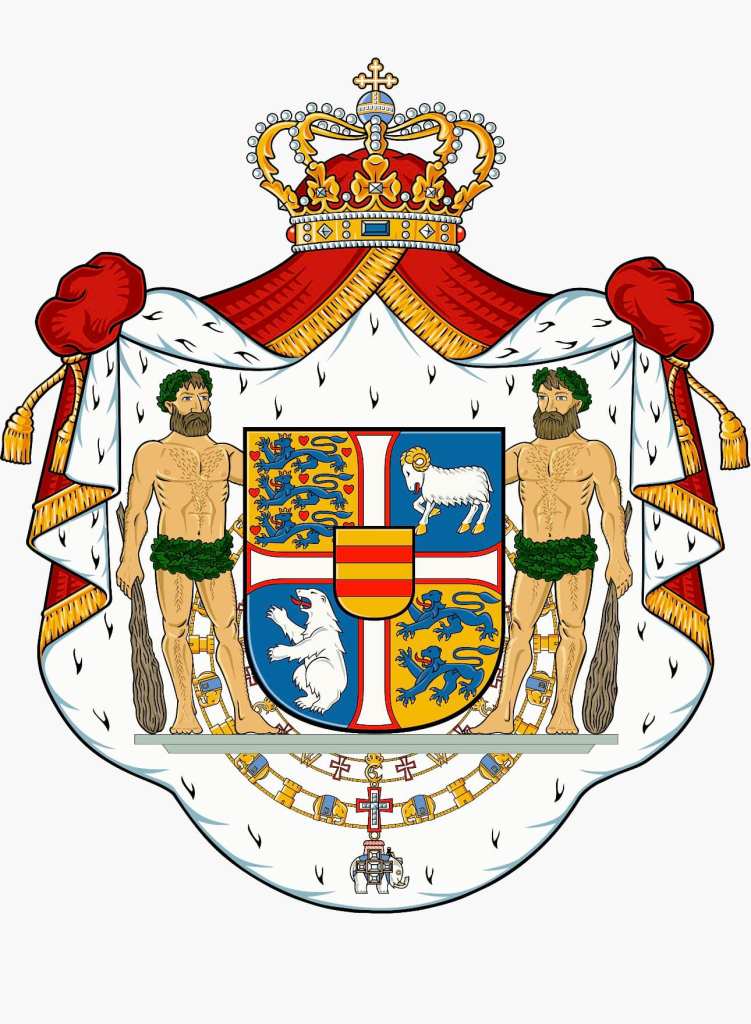
HM, King Frederik X has undertaken to issue a new, updated version of the Danish royal coat of arms dated December 20, 2024. The new version, prepared by Ronny Skov Andersen, simplifies the overall design.

It removes the three crowns of the Kalmar union and gives the arms of the Faeroe Islands and Greenland their own quarterings. It also places the arms of Denmark, originally the arms of the House of Estridsen, in the first quarter and instead of repeating it in the fourth quarter the arms of Schleswig are placed there. In addition, the Dannebrog, the cross that divides the shield into four quarters, has been returned to a more traditional form with the ends of the arms slightly flared. Overall, there remains the dynastic inescutcheon for the arms of the House of Oldenburg. The new version is:

The blason could be written as: A shield quartered by a cross pattée throughout Argent fimbriated Gules; first quarter Or, three lions passant in pale Azure crowned and armed Or langued Gules, nine hearts Gules (for Denmark); second quarter Azure a ram passant Argent armed and unguled Or (for the Faroe Islands); third quarter, Azure a polar bear rampant Argent (for Greenland); fourth quarter, Or two lions passant in pale Azure armed Or langued Gules (for Schleswig). Overall an escutcheon Or two bars Gules (for Oldenburg) the whole surrounded by the Collars of the Order of the Dannebrog and the Order of the Elephant. Supporters two woodwoses armed with clubs Proper standing on a pedestal. All surrounded by a mantle Gules doubled Ermine crowned with a royal crown and tied up with tasseled strings Or.

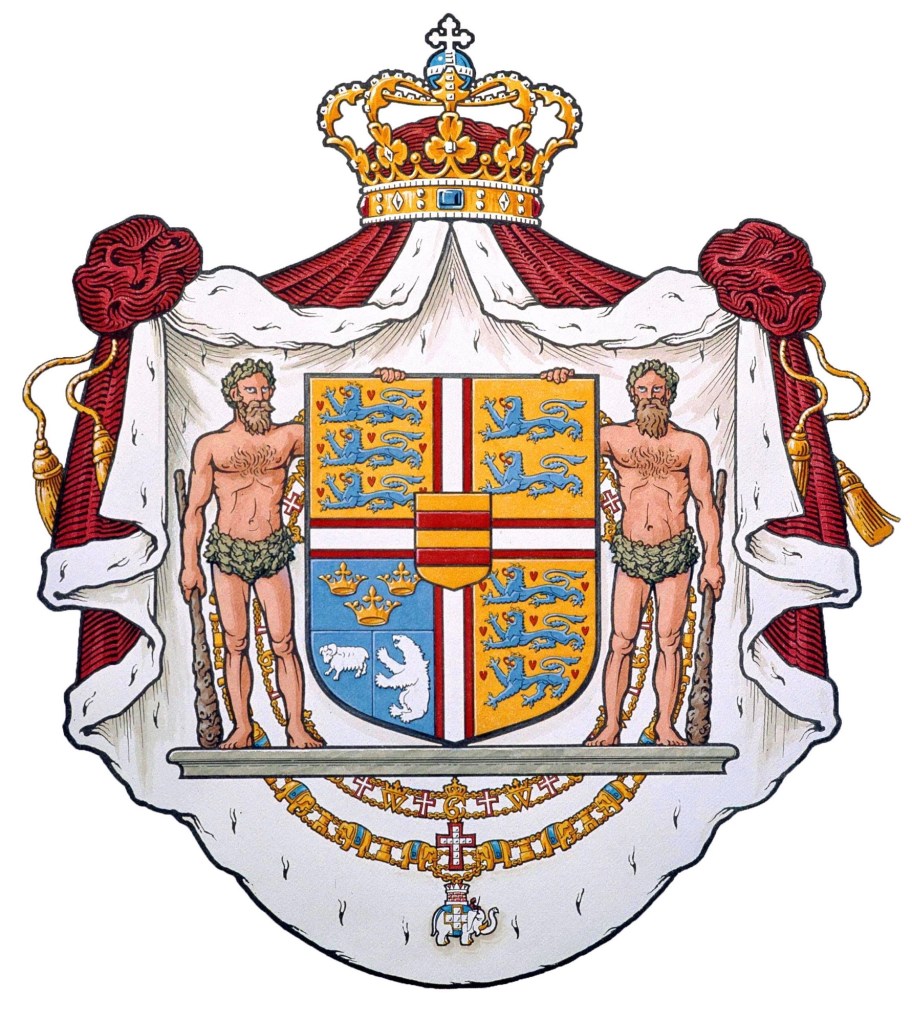
This replaces the version of the coat of arms that had been modified after the reign of King Frederik IX by Queen Margrethe which had been in use since 1972. (below)

I think this updated version is aesthetically more pleasing. It is a slightly less busy composition and the juxtaposition of the arms of Denmark and those of Schleswig provide a more pleasing visual. There is no longer the multiplication of lions and the two quarters with fields Or look better on a diagonal from each other, as do the two quarters with fields Azure. It all seems less imbalanced. I also happen to think the style of the cross looks better that the simple cross throughout.

It is exciting to see heraldry—long erroneously thought by the ignorant to be stagnant and encrusted with the weight of history and therefore irrelevant to today’s society—being updated and dynamic. The current situation calls for an updated symbol of the monarchy. This was true in 1972 and it is just as true some 52 years later. I applaud the efforts of His Majesty and also Ronny Andersen and those who worked with him to devise this updated coat of arms.