On November 6, 2024 the Most Rev. Dennis Spies, (56) a priest of the Diocese of Joliet in Illinois will be ordained as the Titular Bishop of Cenculiana and Auxiliary Bishop of Joliet. The Bishop-Elect’s appointment by the Pope was announced only on September 27 and he will very quickly be ordained to the office of bishop, well before Advent and the holiday season is upon us.
The armorial bearings he will be assuming are as follows:
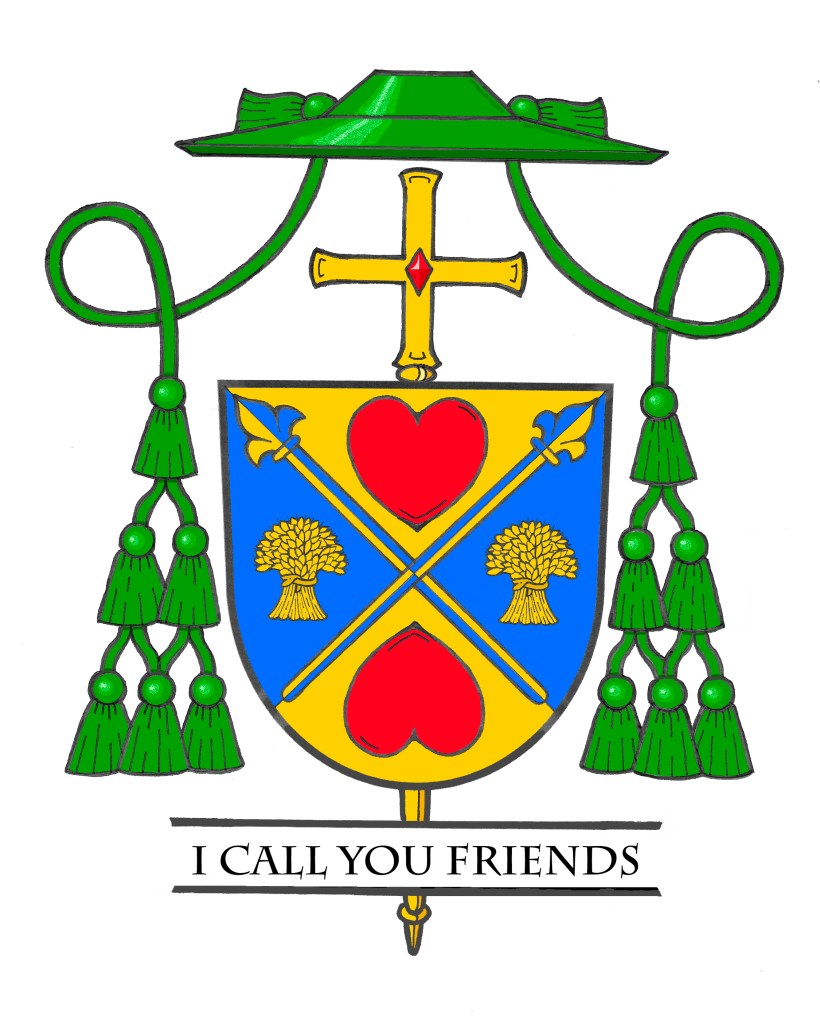
The blazon of his coat of arms is: “Per saltire Or and Azure; overall two spears in saltire points upward tipped with fleurs-de-lis Counterchanged between, in chief and in base a heart facing the centerpoint Gules; and to dexter and sinister a garb of wheat, Or. Shield ensigned with an episcopal cross Or behind the shield and a bishop’s galero Vert cords and twelve tassels disposed in three rows of one, two and three all Vert. On a scroll below the shield the motto: “I Call You Friends”.
The main colors of the shield, blue & gold, are the colors primarily used in the coat of arms of the Diocese of Joliet. So, by means of their use the diocese the bishop has served as a priest (and now as a bishop) is alluded to. The shield is divided in a saltire (an “X” shape) and the two main charges are two spears crossed in saltire. The surname Spies is German in origin and in German and Dutch it is a metonymic occupational name for a spear maker. It is derived from Middle High German “spiez”, meaning ‘spear pike’ or an occupational name from the same word in the sense of a ‘soldier armed with a spear’. So, the two spears allude to the family name. They appear slightly different from the typical spear in that their heads, rather than depicting the usual blade, have heads that are shaped like the fleur-de-lis. This, too, is taken from the coat of arms of the Diocese of Joliet where two fleurs-de-lis appear. This is an ancient heraldic symbol of both the Blessed Virgin Mary and the Most Holy Trinity. Counterchanging (where the color of an object and the background are alternated) serves as a symbol of conversion…the daily conversion to which we are all called as followers of Christ.
Above and below are two red hearts symbolizing the Sacred Heart of Jesus and the Immaculate Heart of Mary. The hearts are depicted with their points toward the center of the shield. The two hearts–in a sense–“facing each other” symbolize the love that God has for all His creation and the love that His children return to Him by their faith and devotion. Love is both given and received. The disposition of the hearts indicates this.
A heart shape, although with different symbolism, also appears in the coat of arms of Bishop Hicks, the Diocesan Bishop whose ministry Bishop Spies will assist and support. It is an old custom in heraldry to borrow a charge from the coat of arms of a superior or patron as a way of honoring them. So, the heart shape being repeated in the coat of arms of Bishop Spies honors this custom.
To the left and right are two gold (yellow) garbs of wheat. The garbs of wheat are symbolic of agriculture generally and the Bishop grew up on a farm. In addition, they are also symbolic of the Eucharist, the center of our lives as Christians. So, they are a fitting symbol of both his background and his faith.
The motto below the shield is, “I Call You Friends” from John 15:15 where Jesus says, “I no longer call you slaves, because a slave does not know what his master is doing. I call you friends, because I have told you everything I have heard from my Father.”
The shield is also ensigned with those external ornaments that indicate the bearer is a bishop. The gold (yellow) cross is placed vertically behind and extending above and below the shield. This is often mistakenly thought to be a processional cross like those used in liturgical processions. That is not entirely right. In former times archbishops, and later all bishops, had a second cross mounted on a staff carried immediately in front of them while in procession or on solemn occasions. This cross was a symbol of their rank as bishop. While such an episcopal cross is no longer used practically it has been retained heraldically. In fact, there are other clerics who make use of the ecclesiastical hat with its many tassels but the one true heraldic emblem of a bishop, and the only essential one, is the episcopal cross placed behind the shield.
Above the shield is the ecclesiastical hat, called a galero which, in heraldry, replaces the martial helmet, mantling and crest. “The hat with six pendant tassels (green, purple or black) on each side is universally considered in heraldry as the sign of prelacy. It, therefore, pertains to all who are actually prelates.” (Heim, Bruno B., Heraldry in the Catholic Church 1978, page 114). The galero is green with green cords pendant from it and twelve green tassels arranged in a pyramid shape on either side of the shield. At one time in history bishops and archbishops wore green before adopting the more Roman purple we see today. In heraldry the green hat and tassels was retained for prelates with the rank of bishop according to the Instruction of the Secretariat of State, “Ut Sive” of March, 1969.
It was my great privilege and pleasure to work with Bishop Spies on the design and execution of his armorial bearings and also preparing the blazon and explanation.
 EXARANDORUM
This is really an excellent coat of arms: artistically beautiful, heraldically correct. The charges, or combination of them, are unique to the bearer.
This is one of your best so far! It’s refreshing to see a bishop with taste – or at the very least trust in your good taste as a heraldist!