The new Cardinal Protodeacon of the Church—who announces the election of a new pope and who invests the pope with the pallium at his Installation (or coronation if there is one)—is the Frenchman, Dominique Mamberti (72).
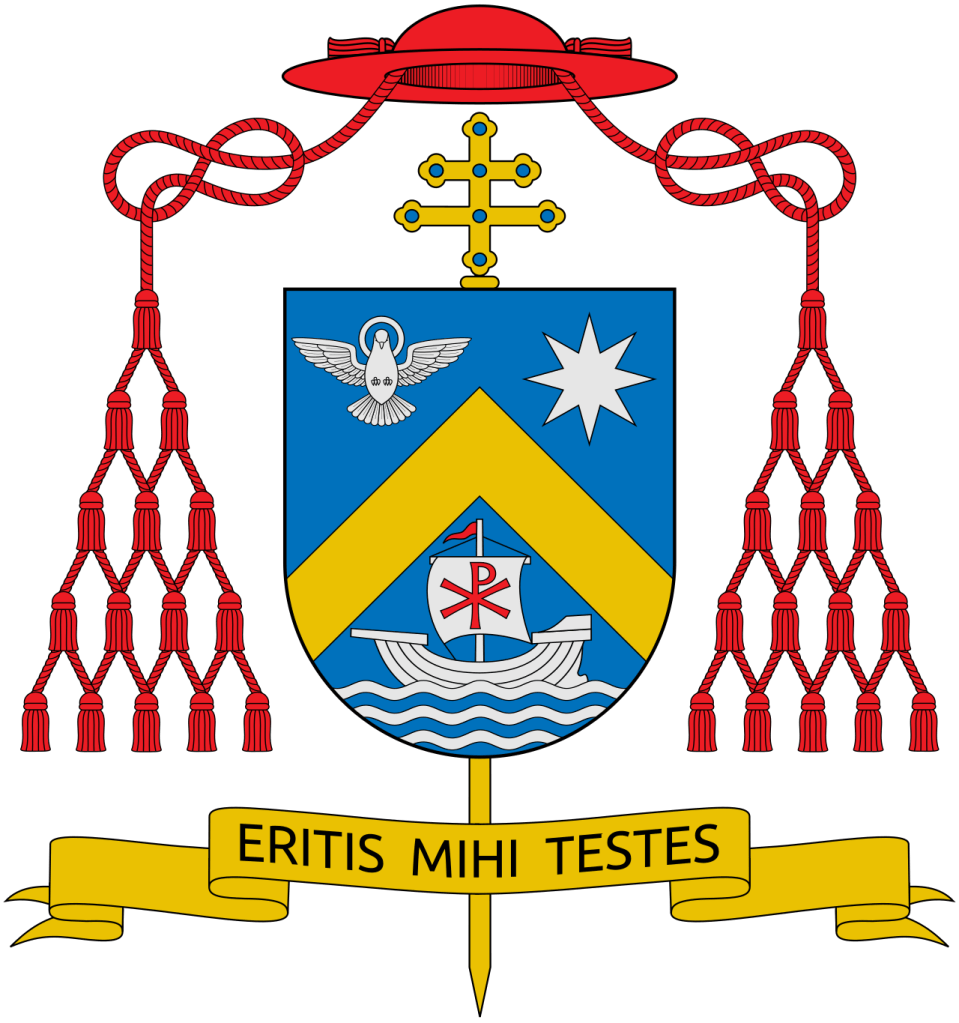
The new Cardinal Protodeacon of the Church—who announces the election of a new pope and who invests the pope with the pallium at his Installation (or coronation if there is one)—is the Frenchman, Dominique Mamberti (72).
Raffaele Cardinal Martino, the Proto Deacon of the College of Cardinals, passed away today at age 91. From 1986-2002 he was the Observer of the Holy See to the United Nations and lived in New York. May he rest in peace.
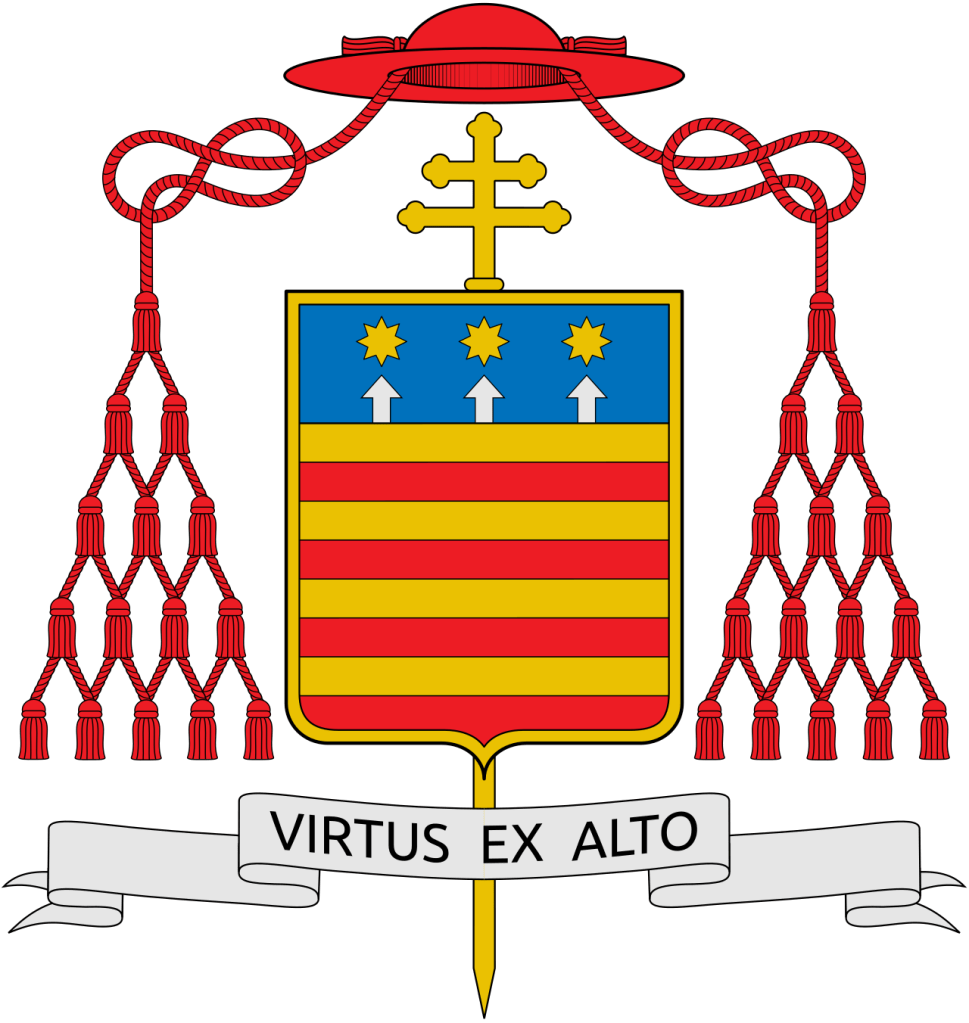
On October 24, the Most Rev. Wiesław Śmigiel (55) a priest of Pelplin, Poland who also served as Auxiliary Bishop there, and from 2017-2024 was the Bishop of Toruń, will be installed as the 6th Bishop and 4th Metropolitan Archbishop of Szczecin-Kamień.
His armorial bearings:
Not long ago, in my capacity as my bishop’s ecumenical & interfaith officer, I attended a meeting with representatives of the Hindu community here in central New Jersey in an ongoing effort to increase contacts with the Catholic community and people of other faiths. A small part of our conversation touched on general misunderstandings between faith communities and the swastika was used as an example. In the Hindu, Jain and Buddhist faiths the symbol is a positive one. For all time, it was ruined by its adoption by the nazi party in Germany. There it wasn’t actually a “swastika”. Rather, it was a hooked cross (hakenkreuz in German) which was not an uncommon form of the cross used in Europe until its association with the nazis ruined its connotation.
It is, I think, always important to absolutely repudiate the ideas of national socialism or its bizarre stepchild, neo-nazism, which, tragically, still exists. My intention by this post is not to offend, but to educate.
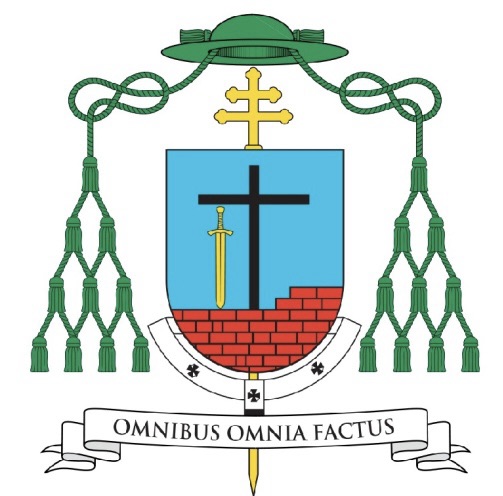
While its association with the horrors of WWII and the Holocaust will forever be with us the swastika (not the hakenkreuz), nevertheless, remains a religious symbol—and one without ANY nazi-related connotations—to other faiths. As such, it often has made its way into coats of arms in the past.
The image below depicts a banner with the armorial bearings of Hasekura Tsunenaga, also known as Don Felipe Francisco Hasekura after his conversion. He was a Japanese Samurai and emissary who traveled through the American continent and Europe in the 1600s. The arms and banner was granted to him after his conversion to Catholicism during his visit to Mexico City in 1614. An interesting blend of Japanese and European styles.
These days people would look upon this and THINK they know what it means…and be quite wrong. Such is the power of symbols. An positive religious symbol has been—in the West anyway—ruined forever because we cannot disconnect it from its terrible adoption by hateful people.
Back in 2015, I wrote a blog post about this same problem and the power of symbols which remain deeply rooted within us.
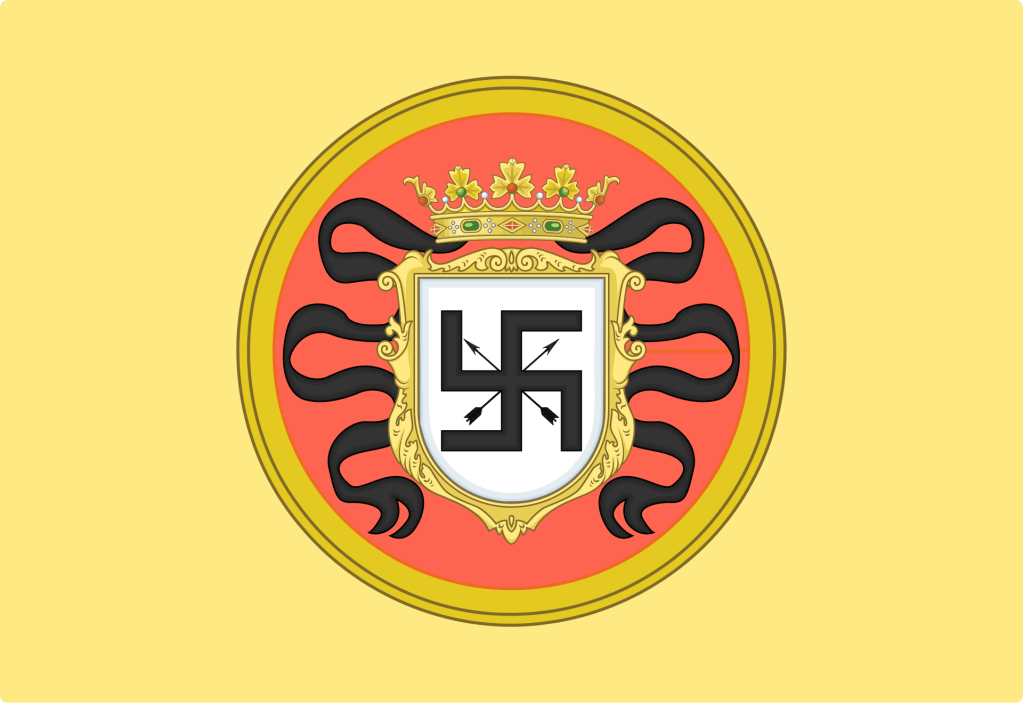
On November 6, 2024 the Most Rev. Dennis Spies, (56) a priest of the Diocese of Joliet in Illinois will be ordained as the Titular Bishop of Cenculiana and Auxiliary Bishop of Joliet. The Bishop-Elect’s appointment by the Pope was announced only on September 27 and he will very quickly be ordained to the office of bishop, well before Advent and the holiday season is upon us.
The armorial bearings he will be assuming are as follows:
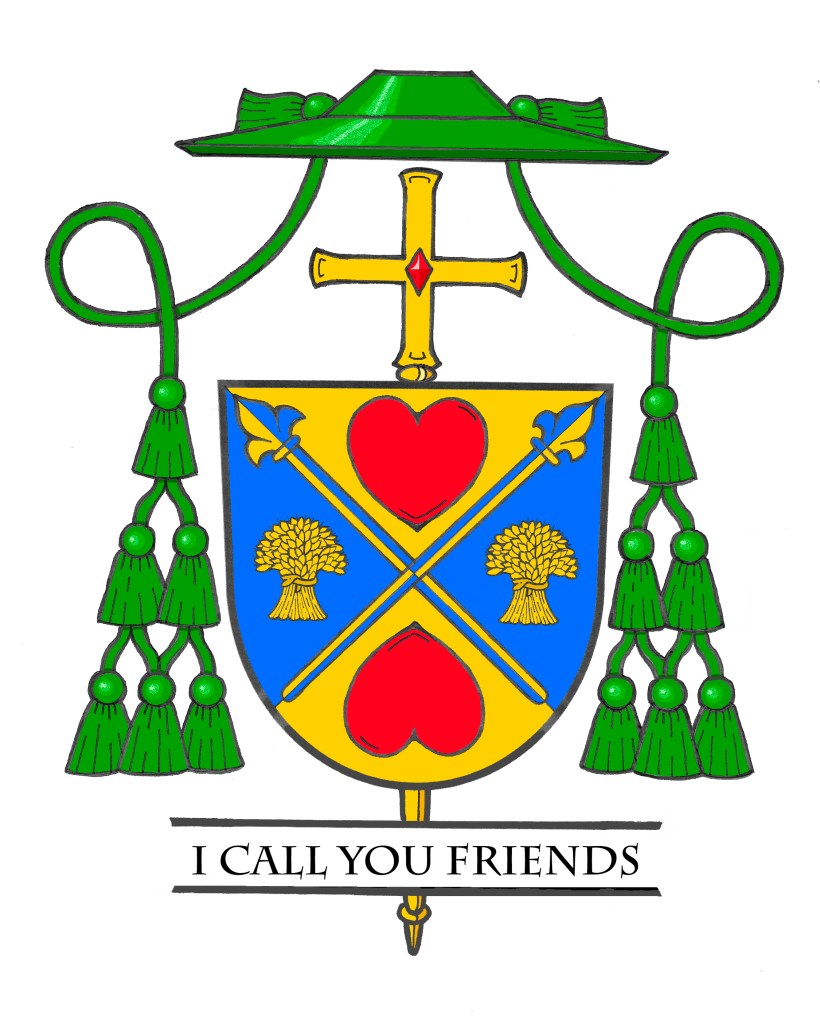
The blazon of his coat of arms is: “Per saltire Or and Azure; overall two spears in saltire points upward tipped with fleurs-de-lis Counterchanged between, in chief and in base a heart facing the centerpoint Gules; and to dexter and sinister a garb of wheat, Or. Shield ensigned with an episcopal cross Or behind the shield and a bishop’s galero Vert cords and twelve tassels disposed in three rows of one, two and three all Vert. On a scroll below the shield the motto: “I Call You Friends”.
The main colors of the shield, blue & gold, are the colors primarily used in the coat of arms of the Diocese of Joliet. So, by means of their use the diocese the bishop has served as a priest (and now as a bishop) is alluded to. The shield is divided in a saltire (an “X” shape) and the two main charges are two spears crossed in saltire. The surname Spies is German in origin and in German and Dutch it is a metonymic occupational name for a spear maker. It is derived from Middle High German “spiez”, meaning ‘spear pike’ or an occupational name from the same word in the sense of a ‘soldier armed with a spear’. So, the two spears allude to the family name. They appear slightly different from the typical spear in that their heads, rather than depicting the usual blade, have heads that are shaped like the fleur-de-lis. This, too, is taken from the coat of arms of the Diocese of Joliet where two fleurs-de-lis appear. This is an ancient heraldic symbol of both the Blessed Virgin Mary and the Most Holy Trinity. Counterchanging (where the color of an object and the background are alternated) serves as a symbol of conversion…the daily conversion to which we are all called as followers of Christ.
Above and below are two red hearts symbolizing the Sacred Heart of Jesus and the Immaculate Heart of Mary. The hearts are depicted with their points toward the center of the shield. The two hearts–in a sense–“facing each other” symbolize the love that God has for all His creation and the love that His children return to Him by their faith and devotion. Love is both given and received. The disposition of the hearts indicates this.
A heart shape, although with different symbolism, also appears in the coat of arms of Bishop Hicks, the Diocesan Bishop whose ministry Bishop Spies will assist and support. It is an old custom in heraldry to borrow a charge from the coat of arms of a superior or patron as a way of honoring them. So, the heart shape being repeated in the coat of arms of Bishop Spies honors this custom.
To the left and right are two gold (yellow) garbs of wheat. The garbs of wheat are symbolic of agriculture generally and the Bishop grew up on a farm. In addition, they are also symbolic of the Eucharist, the center of our lives as Christians. So, they are a fitting symbol of both his background and his faith.
The motto below the shield is, “I Call You Friends” from John 15:15 where Jesus says, “I no longer call you slaves, because a slave does not know what his master is doing. I call you friends, because I have told you everything I have heard from my Father.”
The shield is also ensigned with those external ornaments that indicate the bearer is a bishop. The gold (yellow) cross is placed vertically behind and extending above and below the shield. This is often mistakenly thought to be a processional cross like those used in liturgical processions. That is not entirely right. In former times archbishops, and later all bishops, had a second cross mounted on a staff carried immediately in front of them while in procession or on solemn occasions. This cross was a symbol of their rank as bishop. While such an episcopal cross is no longer used practically it has been retained heraldically. In fact, there are other clerics who make use of the ecclesiastical hat with its many tassels but the one true heraldic emblem of a bishop, and the only essential one, is the episcopal cross placed behind the shield.
Above the shield is the ecclesiastical hat, called a galero which, in heraldry, replaces the martial helmet, mantling and crest. “The hat with six pendant tassels (green, purple or black) on each side is universally considered in heraldry as the sign of prelacy. It, therefore, pertains to all who are actually prelates.” (Heim, Bruno B., Heraldry in the Catholic Church 1978, page 114). The galero is green with green cords pendant from it and twelve green tassels arranged in a pyramid shape on either side of the shield. At one time in history bishops and archbishops wore green before adopting the more Roman purple we see today. In heraldry the green hat and tassels was retained for prelates with the rank of bishop according to the Instruction of the Secretariat of State, “Ut Sive” of March, 1969.
It was my great privilege and pleasure to work with Bishop Spies on the design and execution of his armorial bearings and also preparing the blazon and explanation.
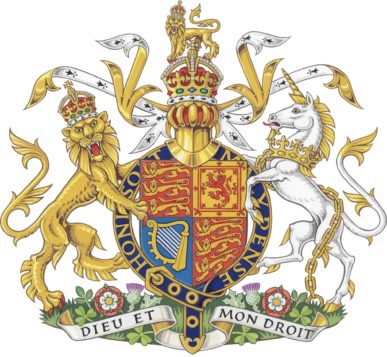
A new artistic rendering of the royal arms has been unveiled to be used during the reign of Charles III. The artwork is by the well known heraldic artist, Tim Noad, who also did the newer version of the arms of Queen Camilla as well as Charles III’s royal cipher.
The King made some changes to the appearance of the coat of arms, most notably by using the Tudor style crown in the achievement.
It has been very gratifying as a heraldist to have one project that I have been able to stay with through all its permutations. On October 31, the Most Rev. Richard G. Henning (60) who has served for the last 17 months as Bishop of Providence, R.I. and who was also Coadjutor of Providence for a further four months before that, and who was previously Auxiliary Bishop of Rockville Centre, N.Y., his native diocese where he became a priest in 1992, will be installed as the 10th Bishop and 7th Metropolitan Archbishop of the See of Boston, Massachusetts.
Back in 2018, the then Bishop-elect Henning contacted me to design a coat of arms for him. That’s not an unusual thing for me (I have designed coats of arms for three other bishops from Rockville Centre) but this one was more personal. I’m also a Long Island native and Archbishop Henning and I attended the same high school, Chaminade in Mineola, and we graduated together in the class of 1982. While not close friends, we have been acquainted with one another since we were teenagers. I was very happy to design his coat of arms for him. He entered the task with great enthusiasm and I think the coat of arms that we ended up with was simple, bold and very clear, all marks of good heraldry. On a personal not: at his episcopal ordination which I attended, the new Bishop, in his post-Communion remarks, thanked me publicly for assisting him in preparing his coat of arms. As I told him afterwards, that was very gratifying because in 39 years of doing this kind of work no bishop had ever done that before. I think it speaks volumes about what kind of person he is.
In late 2022 after he received the news of his appointment as Coadjutor of Providence I actually reached out to him to let him know that, as a Coadjutor, his coat of arms wouldn’t need any changes but that at some point in the future when he succeeded to the See, he’d have to modify his arms by marshaling them to the arms of the Diocese of Providence. He then asked me to begin on that right away because it was not certain when his succession would occur and he wanted to be prepared for that eventuality. I also thought that was “done and dusted” as they say and he was now set for the rest of his life.
However, in August of this year I was surprised and delighted to hear that the Holy Father had appointed him Archbishop of Boston. For the third time he contacted me. He said that several people in Boston assisting him with the needs of his transition had proposed people to prepare his coat of arms. But, he politely declined all those and said that he already had someone in mind. Again, I was really very pleased and honored at that. I see my designs as sort of my intellectual property. True, the coat of arms, once designed, is given over to the armiger to whom it truly belongs, but I feel like I still have a stake in it. So, I was very glad that I’d be able to assist Archbishop Henning yet again.
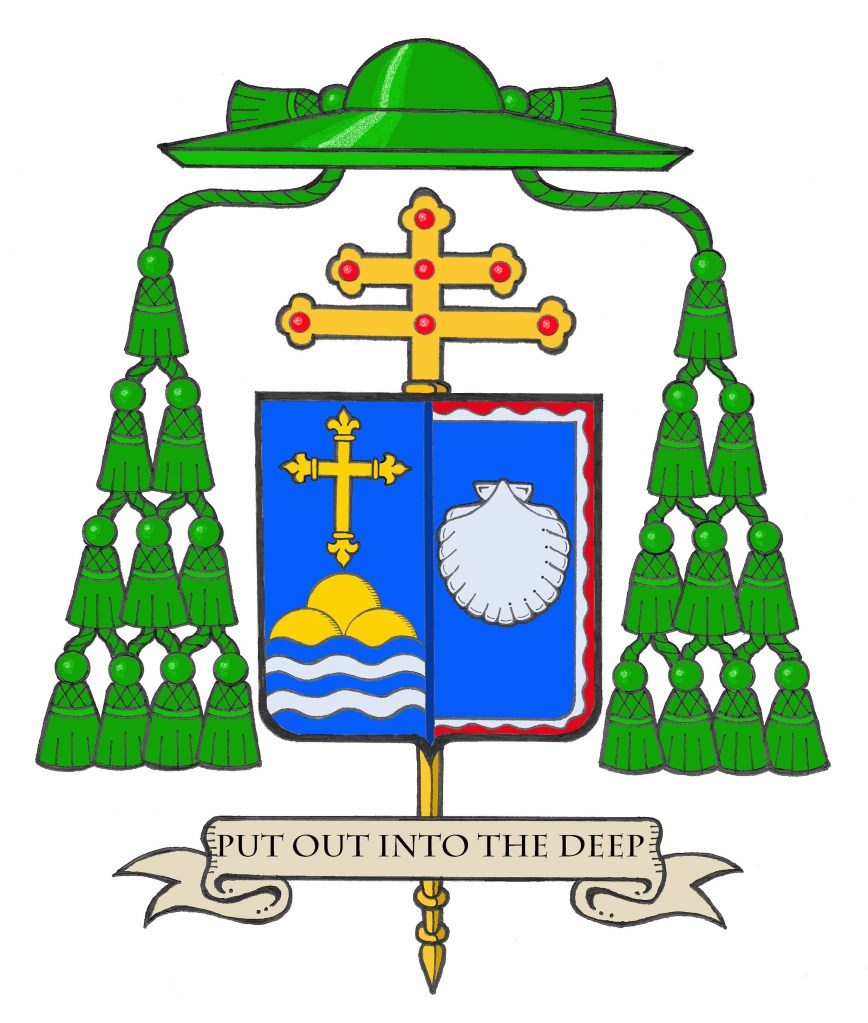
He retains the arms he first assumed in 2018. For this version, the escallop shell has been redrawn to a slightly more round shape and the bordure wavy has been slightly reduced in order to make more room for the shell which now occupies a much smaller field on one half of the shield. This is impaled with the arms of the See of Boston, designed by the great Dom Wilfrid Bayne, OSB of Portsmouth Abbey, R.I. in 1944. Because of the preponderance of blue in both coats of arms, the division line between the two is rendered in dark blue. It was decided that a black line looked a bit too jarring and the solution used for the same problem with the arms of the See of Providence which also has a blue field—a light, “bleu celeste” line—was seen as undesirable this time around. The blazon and explanation of the arms is as follows:
“BLAZON: Arms impaled. In the dexter: Azure, a Latin cross fleurettée Or, in base barry wavy of five Azure and Argent, issuing therefrom a mound of three coupeaux Or; In the sinister: Azure, within a bordure wavy parted wavy Argent and Gules an escallop shell Argent. The shield is ensigned with an archiepiscopal cross Or and an archbishop’s galero with cords and twenty tassels flanking the shield disposed in four rows of one, two, three and four all Vert. On a scroll below the shield is the motto, “Put Out Into The Deep”.
EXPLANATION: The armorial bearings of Archbishop Richard Henning impale the coat of arms of his archiepiscopal See with his personal coat of arms. These evoke his birthplace, his ministry and his personal devotion. The coat of arms is composed of a shield with its charges (symbols), a motto and the external ornamentation. The shield is described (blazoned) in terms that are archaic to our modern language, and this description is presented as if given by the bearer with the shield being worn on the arm. Thus, where it applies, the terms dexter (right) and sinister (left) are reversed as the device is viewed from the front.
It is customary in heraldry that the arms of a Diocesan Bishop, or Ordinary, are joined side by side on the same shield with the arms of his See. In this case, these are the arms of the Archdiocese of Boston. Such marshaling is called impalement and employs the same method used when joining the coats of arms of two people who are married. In this way, the coat of arms, like the episcopal ring, is symbolic of the archbishop being “married” to his archdiocese.
The arms of the Archdiocese of Boston are composed of a blue field on which are placed a gold (yellow) cross fleurettée, that is a Latin cross the arms of which are decorated on the ends with fleurs-de-lis. This is in honor of the titular of the cathedral, the Holy Cross as well as the first Bishop of Boston being from France. The cross is above a gold (yellow) mound composed of three smaller hills as a reference to Boston’s original name: Trimountaine which is, itself, a reference to the three hills on which the city is said to have been built. At the bottom the five wavy lines of blue and silver (white) alludes to Boston being a port city and that it is populated by people who arrived here from across the sea.
Bishop Henning’s personal coat of arms is composed of a design depicted in red (Gules), white (Argent) and blue (Azure) which are the national colors of the United States.
Both the blue background and the single escallop shell allude to the sea as evoking the Bishop’s own background and the shell is also borrowed from the coat of arms of the See of Rockville Centre, the diocese in which he was born and raised and which he served as a priest and auxiliary bishop. In addition, this same field of blue also recalls the blue field of the coat of arms of the See of Providence where he served as Coadjutor Bishop and later Diocesan Bishop. The shell image also recalls the Bishop’s heritage in the Diocese of Brooklyn, dedicated to its patron, St. James. The episcopal ordination of Bishop Henning took place on the eve of the Feast of St. James. In concert with the Bishop’s motto, the shell is a traditional symbol of baptism and pilgrimage. It is in the depths of these waters that Christians find their salvation in Jesus Christ.
The white wavy line surrounding the blue field is also taken from the arms of Rockville Centre and it alludes to the diocese’s location on Long Island, NY. Furthermore, it indicates the sea as the place where the barque of St. Peter, an image used to evoke the Church, is located.
The blue background also evokes the Bishop’s devotion to the Blessed Virgin Mary and his years of service as a Professor and Rector at the Seminary of the Immaculate Conception in Huntington, NY. The red wavy portion of the border evokes the Bishop’s devotion to the Most Sacred Heart of Jesus and his former service as the Director of the Sacred Heart Institute for the Ongoing Formation of the Catholic Clergy.”
It was, indeed, my profound pleasure , and my honor, once again to assist my old classmate, Archbishop Henning, with the preparation of his coat of arms.
Fr. Guy Selvester's blog of Ecclesiastical Heraldry
Fr. Guy Selvester's blog of Ecclesiastical Heraldry
Fr. Guy Selvester's blog of Ecclesiastical Heraldry
Fr. Guy Selvester's blog of Ecclesiastical Heraldry
Fr. Guy Selvester's blog of Ecclesiastical Heraldry
Fr. Guy Selvester's blog of Ecclesiastical Heraldry
Fr. Guy Selvester's blog of Ecclesiastical Heraldry
Fr. Guy Selvester's blog of Ecclesiastical Heraldry
Fr. Guy Selvester's blog of Ecclesiastical Heraldry
Fr. Guy Selvester's blog of Ecclesiastical Heraldry
Fr. Guy Selvester's blog of Ecclesiastical Heraldry
Fr. Guy Selvester's blog of Ecclesiastical Heraldry
 EXARANDORUM