You may recall that in a post about several new bishops’ installations I wrote the following about the coat of arms of Bp. Martin of Charlotte, N.C.:
“May 29 saw the ordination and installation of the Most Rev. Michael Martin, OFMConv (62) as the fifth Bishop of Charlotte, North Carolina.
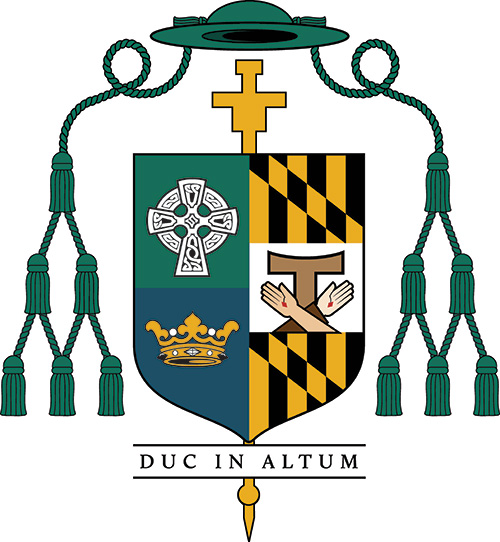
The diocesan website describes his personal arms, “To the viewer’s right is the Franciscan coat of arms. Featuring the traditional Franciscan Tau cross with two arms crossing one another, it is rich in symbolism. The two arms, one Christ’s and the other St. Francis of Assisi’s, both bear the stigmata. They symbolize God’s love and Francis’s loving response to the Word made incarnate, Taberski explained. It is an image found throughout the ministries, friaries, missions and sites served by the Franciscan order.
On the right side of the shield, the top (known as the “chief”) and the bottom (the “base”) feature references to George Calvert and his son Cecil Calvert – the first and second barons of Baltimore. The Calverts were among the first Catholics to arrive in colonial America. They established the then Province of Maryland as a safe place for English Catholics to emigrate to since they were no longer able to freely practice their faith at home. In the coat of arms, the use of six vertical stripes – alternately gold and black, with the diagonal stripe in color – recalls Bishop Martin’s hometown of Baltimore.”
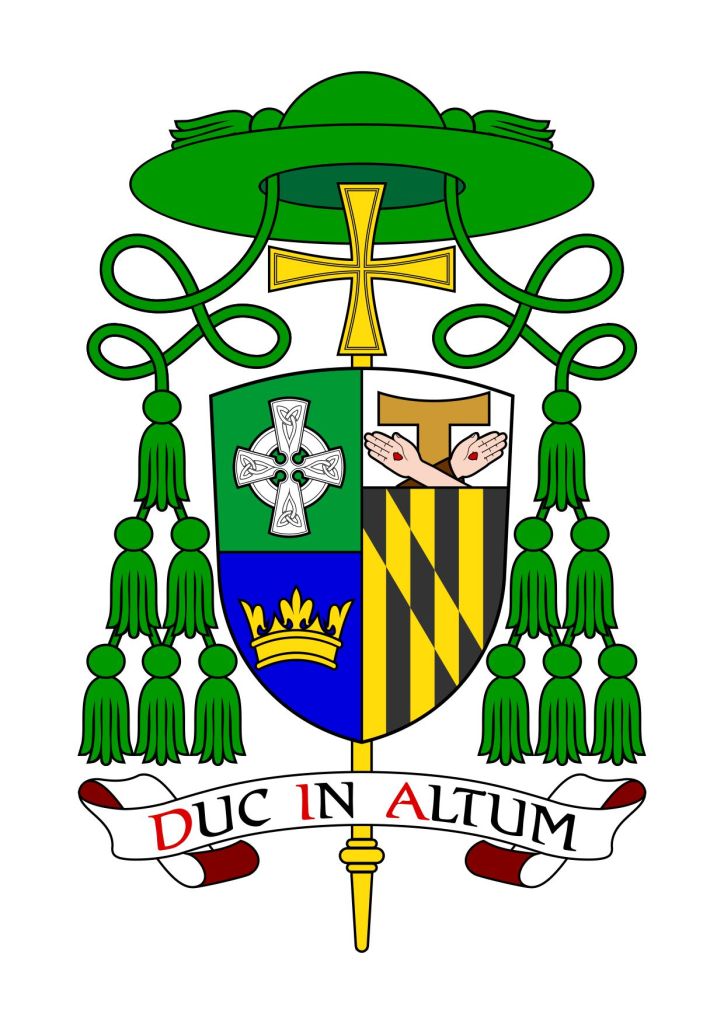
A nice simple design but perhaps the arms of Calvert would have looked better depicted once in the main part of the field with the Franciscan symbols occupying a chief?“
Well, my friend and frequent collaborator, Mr. Sandy Turnbull of the Australian Heraldry Society, read that post and decided to have a bit of fun and create a new emblazonment of Bp. martin’s coat of arms that followed my advice. I’d say the result (below) speaks for itself. I was right! The whole achievement does look better as I suggested. See? One can’t just throw things onto a shield and call it heraldry. How the design is arranged—to be aesthetically pleasing as well as heraldically correct—is a large part of good heraldic design.
 EXARANDORUM
The revision is aesthetically pleasing but, to my knowledge, Bishop Martin is not a member of the Calvert Family. Employment of Proprietors’ Arms may be appropriate for a diocese within their former jurisdictions ( e.g. the Archdiocese of Philadelphia using a variation of the Penn Arms) but a bishop would do well to use his own family Arms or create one which represents his surname.
The arms of Calvert are part of the coat of arms and the state flag (which is a banner of the arms) of Maryland. The bishop used that to indicate that he is from Maryland. It’s not uncommon for Americans to borrow from the insignia of their home state in their personal arms. In this case, it is seen as only part of the arms/flag of Maryland since it omits the quarter for Crosslands. In addition, the Calvert arms alone are the flag of the City of Baltimore from which the Bishop comes. So, the use of the Calvert arms in this case is a reference to Maryland and Baltimore. It may seem odd not to difference the arms at all but neither does the state of Maryland or the city of Baltimore. So, in a way not uncommon in the U.S. the bishop can’t be criticized too harshly for simply borrowing from his own state and city.