The Most Rev. James Beckman, (61) a priest of the Diocese of Nashville since 1990 was ordained a bishop and installed as the Fourth Bishop of Knoxville on July 26. For reasons I don’t fully understand, his installation Mass took place in a local convention center despite the fact that only a few years ago in 2018 the diocese undertook to build a $30 million dollar new cathedral with an area of 28,000 feet and a seating capacity of 1,358. It begs the question: what was the new cathedral for?
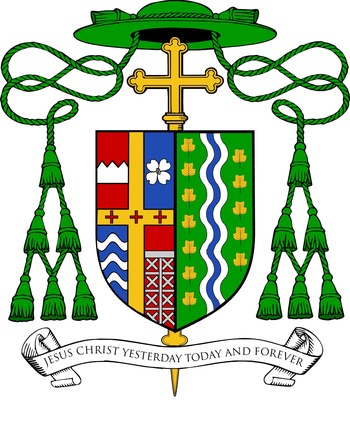
The armorial bearings he assumes upon becoming a bishop are the following. The diocesan coat of arms, designed when the diocese was established in 1988 are a dumpster fire and the less said about them the better. After all, this bishop had no hand in designing them and he wisely conformed to the convention of not changing them since they have been in use for 36 years already.
According to information from the Diocesan website his personal arms contain what they do because…
“Bishop-elect Beckman is an avid hiker and has a deep appreciation for the beauty of God’s creation. His coat of arms reflects this part of his life, in which he has found much solace and communion with God in prayer. His personal arms display a symbolic natural setting on a field of green (vert), which also has ties to the bishop’s heritage, and to Sacred Scripture.
The bishop’s surname is German, and derives from the word beck, which means a stream or brook. This is depicted by the wavy vertical lines (pale wavy) painted white and blue (argent and azure) in the center of the shield. This also recalls the prophecy related by St. John the Evangelist about the City of God, the New Jerusalem, which he sees in a vision near the end of the Book of Revelation: “Then the angel showed me, the river of the water of life, bright as crystal, flowing from the throne of God and of the Lamb through the middle of the street of the city” (Rev 22:1).
John also saw, “on either side of the river, the tree of life with its twelve kinds of fruit, yielding its fruit each month. The leaves of the tree were for the healing of the nations” (Rev 22:2). The tree of life and its fruit are alluded to here by twelve leaves of the tulip poplar (Liriodendron tulipifera). This was chosen as the state tree of Tennessee in 1947. It is an appropriate symbol for the state that comprises both the Diocese of Nashville, where Bishop-elect Beckman was born and served as a priest, and the Diocese of Knoxville, which he will serve as its bishop.
The charges were chosen for good reasons. The coat of arms is clear and uncomplicated. The only real down side is that they are impaled with the awful coat of arms of the See.
On July 25, the Feast of St. James the Apostle, the Most Rev. Kendrick J. Forbes (48), a priest of the Archdiocese of Nassau, Bahamas was ordained a bishop and installed as the tenth Bishop of Roseau, Dominica in the Antilles (West Indies).
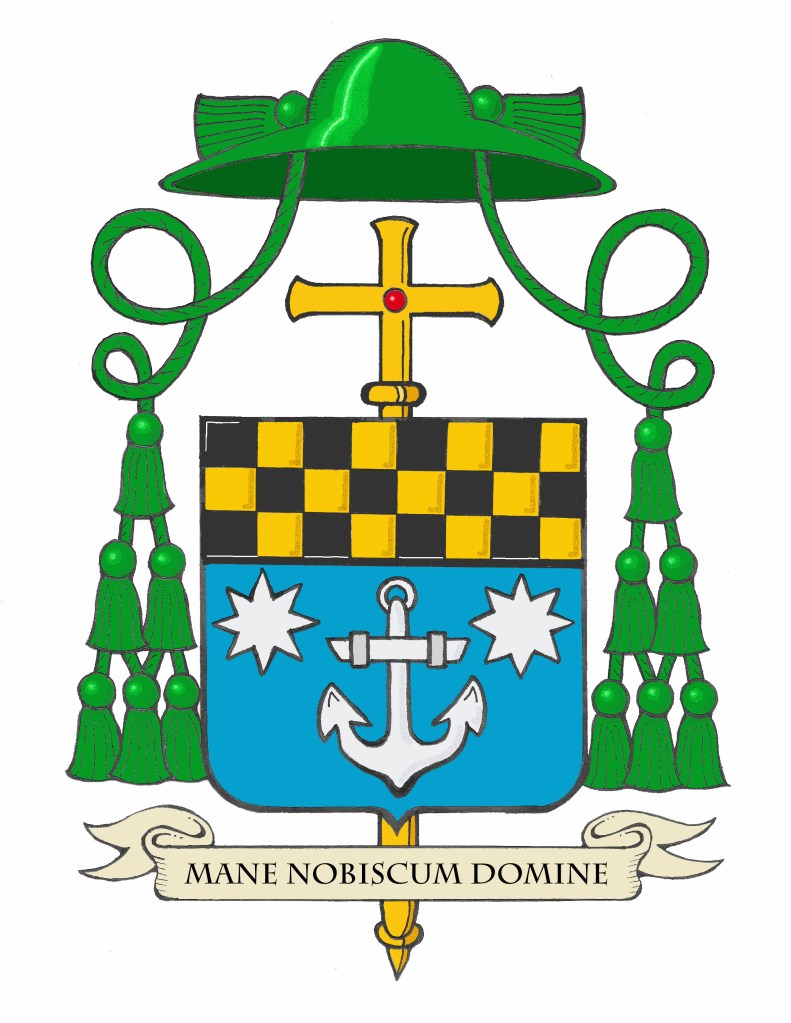
Upon his ordination to the episcopacy he has assumed the following coat of arms:
The personal coat of arms assumed by Bishop Forbes combines symbols that are meaningful to him reflecting his, origins, his spiritual life and priestly ministry. At present, the Bishop has elected to assume a personal coat of arms only. In the Catholic Church it is often customary for a diocesan bishop to combine his personal coat of arms side by side on the same shield with the coat of arms of his diocese in a form of marshaling called “impaling”. It represents his marriage to the diocese and his jurisdiction over it. However, this custom is far from a universal one and, at present, the Diocese of Roseau does not employ a unique coat of arms as a diocesan corporate symbol.
The main part of the shield shows a light blue field on which there is a silver (white) anchor. On either side of the anchor are two eight-pointed stars. For centuries, the anchor has been a symbol of hope used in art, in the liturgy and in heraldry. The eight-pointed star is borrowed from the coat of arms of Pope Francis who named Bishop Forbes to the episcopate. There are two for balance and symmetry. The upper third of the shield is called a “chief” in heraldry and it depicts the black and gold (yellow) checkered pattern borrowed from the coat of arms of the Archdiocese of Nassau where Bishop Forbes was ordained and served as a priest before becoming a bishop.
The motto below the shield is,“Mane Nobiscum Domine” taken from Luke 24:29 meaning “Stay with us Lord.”
It was both my privilege and my pleasure to design and to emblazon the bishop’s coat of arms for him.
Retired Archabbot of Saint Vincent Archabbey, Latrobe, Pennsylvania, Douglas R. Nowicki, O.S.B., (79), died Tuesday, July 23, in Allegheny General Hospital, Pittsburgh, following a brief illness. The eleventh Archabbot of Saint Vincent, he served from 1991 until he reached the retirement age of 75 in May of 2020, when he retired. He was the second longest-serving Archabbot in the 178-year history of Saint Vincent. With more than 150 monks, St. Vincent was the first Benedictine monastery in the United States, and is one of the largest monasteries in the world. He will be buried on July 29, 2024.
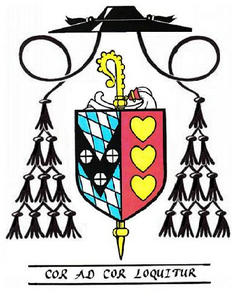
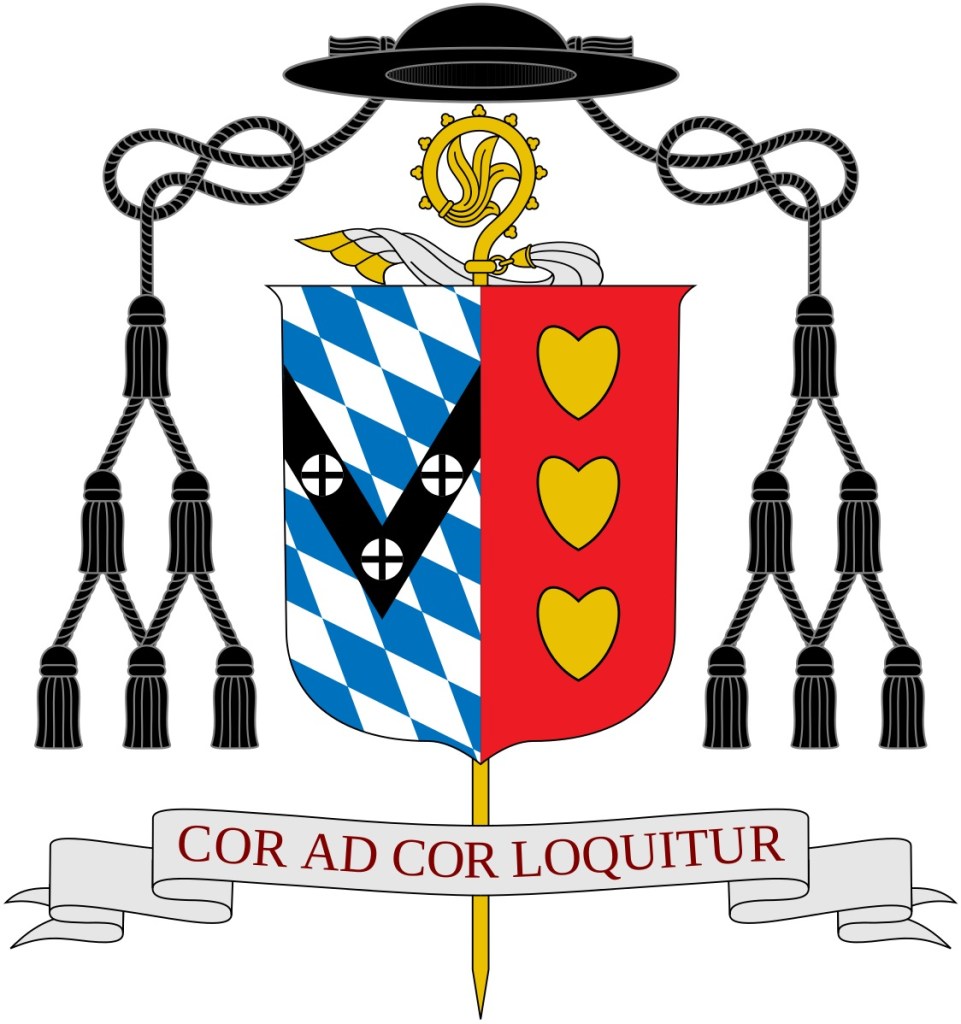
When he was elected in 1991 I was still a member of the monastic Community in Latrobe. My mentor—the late Géza Grosschmid, Ph.D.—and I were given the job of devising a coat of arms for the new Archabbot. Ultimately, Archabbot Douglas rejected the design Dr. Grosschmid suggested and went with a modified version of it devised by me. Essentially, it illustrated the motto, taken from St. John Henry Newman, “Cor Ad Cor Loquitur” which means “Heart Speaks To Heart”.
Above we see my original drawing of the coat of arms without the motto added. The dexter impalement depicts the coat of arms adopted by St. Vincent Archabbey in the early 20th Century under the abbatial term of the Rt. Rev. Alfred Koch, OSB, the 5th Archabbot of St. Vincent. It depicts the blue and silver elongated diamond-shaped fusils taken from the arms of the Royal House of Wittelsbach, the Kings of Bavaria. This alluded to the origin of the founding monk and first Archabbot of St. Vincent, Boniface Wimmer, OSB who was from St. Michael’s Abbey in Bavaria, as well as to the patronage and financial assistance given to the fledgling community through the Ludwigs-Missionverein, an organization established by King Ludwig I of Bavaria to support missionary efforts in the new world.
The black horizontal fess with three plates (white roundels) seen on the arms of William Penn is reshaped as an inverted chevron to form the letter “V” for Vincent and the three plates are charged with three crosses. The arms of the Archabbey are impaled—joined on the same shield—with the Archabbot’s personal arms. This marshaling of two separate coats of arms on the same shield employs the same method used for the coat of arms of two armigerous people who are married. It indicates the “marriage” of the armiger with the place of his jurisdiction with the arms of the jurisdiction occupying the place of the groom and the personal arms occupying the place of the bride.
The Archabbot’s personal arms, as I said, illustrate the motto.
I had also presented Archabbot Douglas with the option of displaying his arms ensigned by a galero with twenty tassels rather than merely twelve. In a manner similar to that of an archbishop using twenty tassels to a bishop’s twelve tassels, I proposed that as an Archabbot he also make use of this distinctive galero indicating his rank. Archabbots don’t actually have any greater jurisdiction or privileges over other Abbots (the one exception being that he may occupy a senior place in the procession whenever attending a gathering of several Abbots). In addition, none of the other previous ten Archabbots of St. Vincent made use of such a galero so, ultimately, he decided to honor that precedent and rejected the idea.
Although his two immediate predecessors had armorial achievements that did not display the usual veiled abbatial crozier Archabbot Douglas agreed with my suggestion he do so. When St. Paul VI reformed many things concerning the dress and externals of the hierarchy in 1969 one of his decisions included removing the mitre and crozier from the coats of arms of Cardinals, Archbishops and Bishops. They were seen as superfluous since episcopal coats of arms make use of the episcopal cross as the sign of the armiger holding the rank of (arch)bishop. However, it was not the intention to remove the use of the veiled crozier—a peculiarly abbatial heraldic symbol—from the coats of arms of Abbots. The veil became a symbol of abbatial croziers in a time before Abbots would have worn pontifical gloves when pontificating. The veil served the useful function of protecting the shaft of the crozier from dirt and oils from the hand. Later, even after pontifical gloves were used by Abbots, the veil, or sudarium, remained attached to the crozier to distinguish such a heraldic emblem from that of a bishop. Despite the reforms of St. Paul VI which referred to the coats of arms specifically of Cardinals, Archbishops and Bishops, the veiled crozier remains to this day as the heraldic emblem of Abbots and Abbesses.
As I said, Archabbot Douglas was happy to follow my advice in this regard. I noted on one of my subsequent visits to the Archabbey that the display of archabbatial coats of arms in the Archabbot’s outer office included a new rendering of Archabbot Douglas’ coat of arms with the veiled crozier omitted. It could be that there was simply an effort to have his coat of arms artistically conform to the pattern followed by his two immediate predecessors. One also is moved to wonder, however, if the person responsible was simply acting in ignorance? It would be hoped that the move was not a deliberate one. If it were, it would constitute an action displaying the most blatant ignorance of commonly accepted heraldic practices in the Church as laid out in the excellent and scholarly work of the late Bruno B. Heim, Heraldry in the Catholic Church, as well as in several other similar publications. In other words, don’t take my word for it! It’s verifiable independently of my opinion. In fact, my collaborator on this project for Archabbot Douglas, Dr. Grosschmid, was a close friend and collaborator of Archbishop Heim who was widely accepted as the foremost expert in Catholic ecclesiastical heraldry of his day. Dr. Grosschmid concurred with my assertion that the Archabbot’s coat of arms should employ the veiled crozier which is why I felt so comfortable advising the Archabbot in that way.
Nevertheless, in this later rendering it was omitted. I note, too, that Archabbot Douglas’ successor, Archabbot Martin de Porres Bartel, OSB, the twelfth Archabbot, similarly omits the veiled crozier from his armorial achievement, no doubt advised in the same manner that was (accidentally or deliberately) ignorant of the appropriate practices. I note, too, with some satisfaction that the Wikipedia article about Archabbot Douglas correctly displays his coat of arms according to the manner in which I designed it. (below)
The Most Rev. John J. McDermott (61), a priest of the Diocese of Burlington, Vermont who recently served—twice—as diocesan administrator in the interim times between bishops, was ordained a bishop and installed as the XI Bishop of Burlington on July 15th.
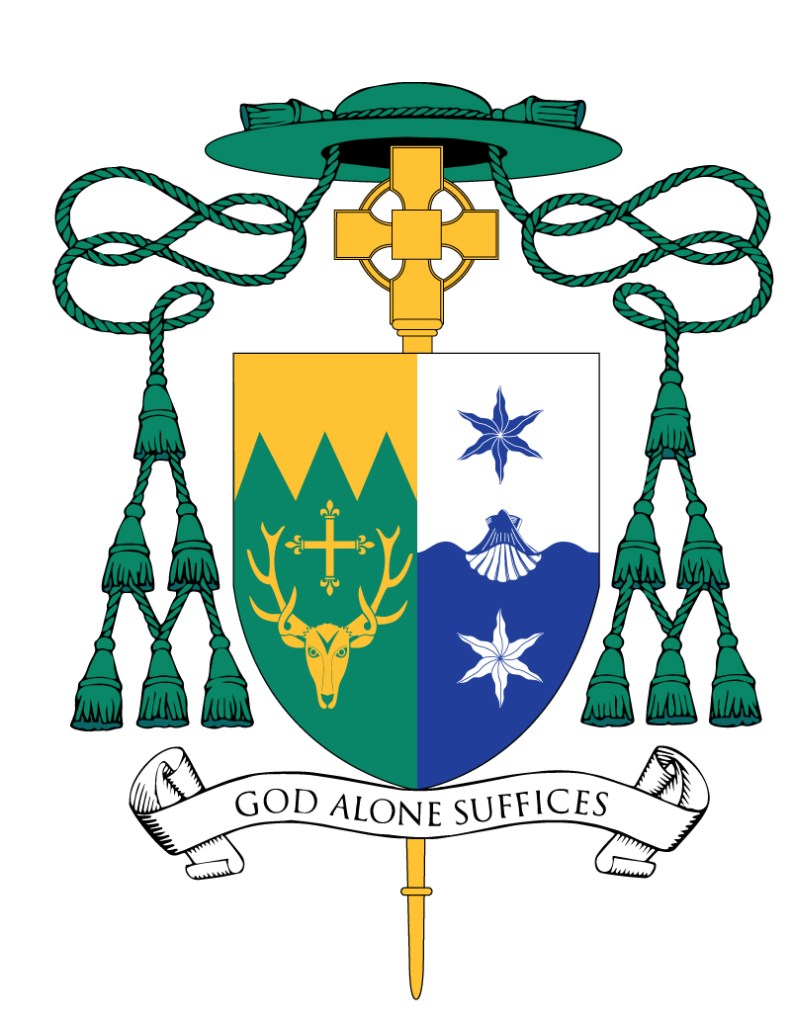
His assumed armorial bearings are understated and impale well with the rather nice coat of arms of the diocese.
According to information provided by the Diocese: “the Bishop’s personal coat of arms is divided horizontally by a wavy line (per fess wavy)into two sections painted respectively white and blue (argent and azure). Following high school, Bishop McDermott attended the United States Coast Guard Academy in New London, Connecticut, and this allusion to the sea refers to those days as they were important to his discernment to become a priest, as well as to the waters of Lake Champlain.
Two six-pointed wavy stars (estoilles) appear, one in the “sky” to refer to Our Lady,the Star of the Sea, and the other in the “sea” itself. A six-pointed star is a traditional symbol not only of Our Lady but also of Saint Joseph, as a descendant of the royal house of King David. Its position here depicts the holiness of Saint Joseph as a reflection of that of his Immaculate spouse.
Between the stars is a scallop shell, a traditional attribute of Saint John the Baptist, the Bishop’s baptismal patron saint. The shell is divided along the same wavy line as the shield, as if it were being dipped into the water at the moment of conferring Baptism. The shell and the stars are all painted counterchanged, that is, blue where the field is white, and white where the field is blue.“
A pleasant coat of arms which kept things nice and simple, that is to say, clear.
For quite a few years now I have collaborated with Messrs. Richard d’Apice, AM, KCSG, AIH and Sandy Turnbull on a small committee called the “Ecclesiastical Working Party” under the auspices of the Australian Heraldry Society. Together, we have created coats of arms for dioceses and bishops in Australia, and also in some other countries in the Pacific region, since some time around 2011.
Mr. d’Apice acts as the corresponding secretary, as it were, for the group. He is the point of contact and communication for the client with the group. In addition, an enthusiastic heraldist for much of his life, he has input into the designs we propose. That’s where I come in. Frequently I act as the consultant on the design either by proposing a different alternative to that of Mr. d’Apice; or by making suggestions to enhance or “tweak” his proposal. Together, we are able to reach consensus and present a single proposed design to the client. This, in turn, is still often modified further as the process continues. I also assist with the composition of the blazon.
For the artwork, we hand off to the talents of Mr. Turnbull. Occasionally, I might provide a sketch merely to illustrate the proposal or one of my suggestions. But, the initial draft as well as the final artwork is provided by Sandy.
He surprised me not long ago. After years of collaboration on numerous coats of arms he created a rendering in his own style of my armorial bearings and presented it to me. I’m very pleased with it and I’m happy to share it with you now.
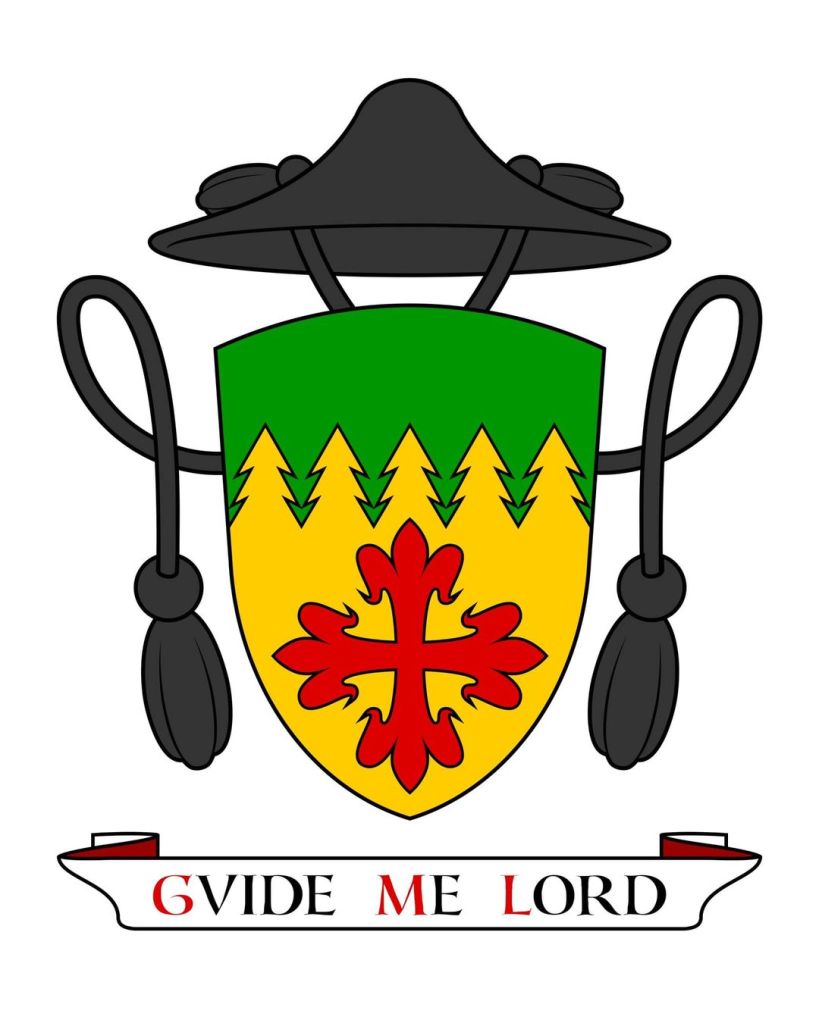
For those not already familiar with it the blazon is:
Or, a Greek cross fleury; a chief sapiné Vert.
The line of fir trees suggests my surname, Selvester (originally Silvestri and later anglicized after emigrating to the U.S.) which means a forest dweller, or woodsman. It represents my paternal Italian heritage. The colors green and gold allude to my maternal Irish ancestry. The red cross of faith is the single charge but its arms terminate in fleurs-de-lis as symbolic of both Our Lady and the Blessed Trinity. The motto is a pun on my given name, Guy, which means “a guide”. The shield is ensigned with the galero of a priest.
It’s always nice to have one’s coat of arms rendered by different artists in their own distinctive style. I am especially pleased with this one.
 EXARANDORUM