The Most Rev. Mario Dorsonville (63) a native of Bogotá, Colombia who incardinated as a priest of the Archdiocese of Washington, DC in 1999, and who also served as Auxiliary bishop of that same archdiocese from 2015-2023 before being appointed as the 5th Bishop of Houma-Thibodaux on February 1, 2023, sadly passed away on January 19, 2024. His funeral will take place on February 1 exactly one year after the announcement of his appointment as bishop of the diocese. May he rest in peace.
In accord with the longstanding custom of attributing armorial bearings to individuals who lived before heraldry existed it was/is commonplace to attribute armorial bearings even to individuals whose very existence can be questioned and cannot be proven. Such is the case with Kaspar, Melchior and Balthazar, collectively known as the Three Wise Men. Even as attributed arms they have a simplicity and clarity that is in keeping with the typical form of more ancient coats of arms. Have a great celebration of the “Little Christmas” known as Epiphany.
In continuing my exploration of the royal arms of Denmark, leading up to the Abdication of Margrethe II and the Accession of Frederik X on January 14 I note with interest (not necessarily with any great significance, but merely with interest) that the Danish royal arms, the version used by the House of Oldenburg-Glückburg, occasionally turns up in other royal houses as well.
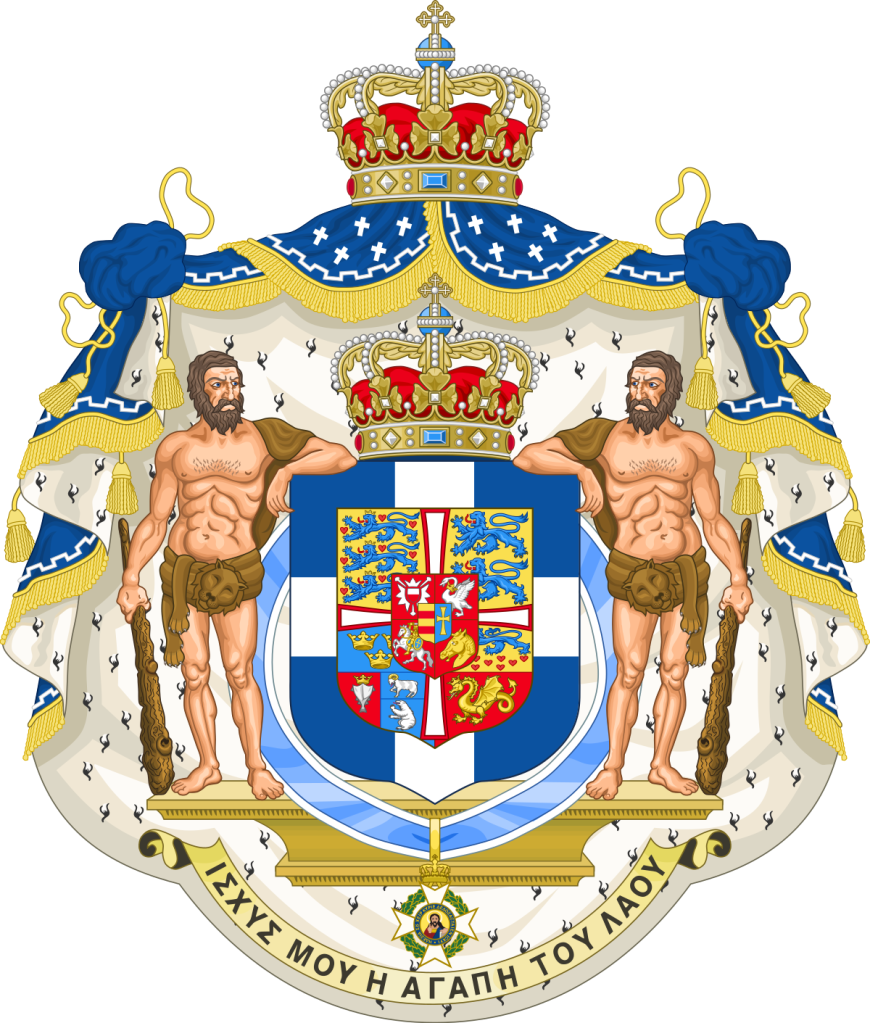
In particular, when the Greek monarchy was established in 1832 and offered to the Bavarian prince, Otto, whose reign lasted until his ouster in 1862, the Hellenic throne was then offered to Prince William of Denmark who ruled as George I of the Hellenes. The Wittlesbach arms placed at the center of the coat of arms of the Greek kingdom was replaced with a shield bearing the dynastic arms of the House of Glücksburg, a cadet branch of the House of Oldenburg. That was used during the next several reigns until the monarchy was abolished in 1924. Then, in 1935 when the monarchy was restored and King George II returned to the throne the coat of arms was modified again.
Now the center of the shield bore the greater coat of arms of the Danish royal house as used by his ancestor and King of Denmark, Christian IX from 1863-1903 before a modification of its own. In addition, the Greek coat of arms changed the two Woodwose supporters to depictions of Heracles as supporters. This coat of arms was then subsequently used by the remaining Greek kings until the monarchy was finally abolished in the 1973 referendum.
However, the last King of the Hellenes, Constantine II, had married Anne-Marie of Denmark, the daughter of King Frederik IX of Denmark and the sister of Queen Margrethe II. She bore the royal arms of Denmark as she inherited them from her father and the Danish royal arms made a double appearance in the reign of King Constantine II.
Through the Greek branch of the House of Oldenburg-Glücksburg the Danish royal arms also made their way to the UK. The late Prince Philip, husband of Elizabeth II, used the surname Mountbatten which he got from his mother, Princess Alice of Battenberg, later changed to Mountbatten, but he was born a prince of Greece (and Denmark). His father was Prince Andrew, the son King George I of the Hellenes and, himself, the son of King Christian IX of Denmark. So, the very first coat of arms devised for Philip Mountbatten, and used by him for only two years before adopting a different coat of arms, reflected his Greek and Danish heritage, as well as his mother’s British ancestry.
The Danish royal arms–as used by Christian IX– are on the dynastic shield in the center. In the dexter chief quarter the coat of arms of his grandmother, Princess Alice, Grand Duchess of Hesse and by Rhine, and the daughter of Queen Victoria, (but with the escutcheon in pretense of Saxony inherited from her father, Prince Albert of Saxe-Coburg and Gotha diplomatically removed) have been unusually and awkwardly added as a nod to his British ancestry, perhaps to quell any fears of the heiress presumptive, Elizabeth, marrying “a foreigner”. These were deemed unacceptable and in 1949 new arms were granted to him which he had a hand in designing.
This coat of arms includes quarters for Greece and Denmark (as well as Mountbatten and Edinburgh, his Dukedom) and make use of the Mountbatten lion supporter and crest, as well as the Greek Heracles supporter rather than the Danish Woodwose. You can tell because of the lion-skin loin cloth.
Another Greek Oldenburg-Glücksburg connection can be seen in the coat of arms of the Queen-Emerita of Spain, Sofia. She was born a princess of Greece (and Denmark), the eldest daughter of King Paul and Queen Frederika. Her coat of arms as Queen of Spain, wife of King Juan Carlos I is
Impaled with her husband’s coat of arms, Queen Sofia’s arms are those of the Greek royal house which she inherited from her father bearing the inescutcheon of the Danish royal arms as used by Christian IX. This shows the dynastic link to the Schleswig-Holstein-Sonderburg-Glücksburg dynasty; a shield containing the Dannebrog, a cross from the Danish flag, and quarterings representing Denmark, Schleswig, the former Kalmar Union, Iceland, the Faroe Islands, Greenland, Holstein, Stormarn, Dithmarschen, Lauenburg, Oldenburg, Delmenhorst, and the former Danish royal titles of King of the Wends and Goths.
Of course there is also the coats of arms of two sisters, both princesses of Denmark and daughters of Christian IX. Alexandra married the Prince of Wales and went on to become Queen of the UK as the spouse and consort of King Edward VII.
The other was Princess Dagmar who married Czar Alexander III and became Empress of Russia as Maria Feodorovna.
The Danish royal family has many connections to the other royal houses of Europe and the Danish Royal Arms, simplified once again by Queen Margrethe in 1972 to its present form, crops up in several different places which I simply find interesting.
I have already discussed the state coat of arms of Denmark in a previous post. Now I’d like to look at the Royal Coat of Arms which is much more complex. The current version was established by royal decree July 5, 1972. It is simpler than previous versions.
The blazon is: A shield quartered by a cross throughout Argent fimbriated Gules; first and fourth quarter Or, three lions passant in pale Azure crowned and armed Or langued Gules, nine hearts Gules (for Denmark); second quarter Or, two lions passant in pale Azure armed Or langued Gules (for Schleswig); third quarter Azure, party per fess, in base per pale; in chief three crowns Or (for the Kalmar Union), in dexter base a ram passant Argent armed and unguled Or (for the Faroe Islands), in sinister base a polar bear rampant Argent (for Greenland). Overall an escutcheon Or two bars Gules (for Oldenburg) the whole surrounded by the Collars of the Order of the Dannebrog and the Order of the Elephant. Supporters two woodwoses armed with clubs Proper standing on a pedestal. All surrounded by a mantle Gules doubled Ermine crowned with a royal crown and tied up with tasseled strings Or.
Since approximately 1960 the royal coat of arms has been reserved exclusively for use by the sovereign, the royal family, the royal guards and the royal court.
Among the simplifications from former versions was a reduction in quarterings for other territories and a much greater simplified inescutcheon overall.
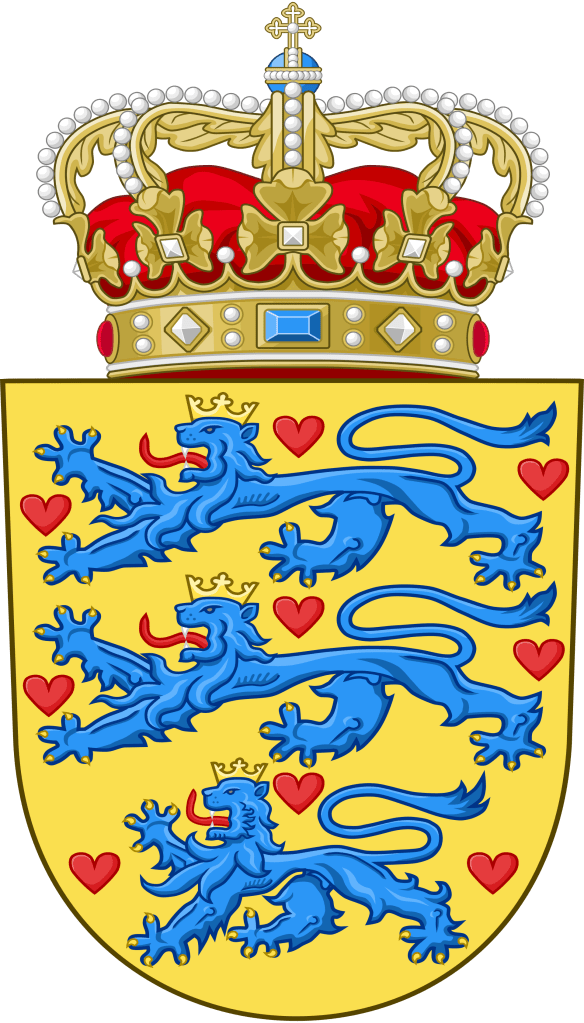
With the approaching abdication of Queen Margrethe II and the accession of King Frederik X of Denmark I’ve been reading up on the heraldry used by the country and the royal house. The state coat of arms consists of three pale blue lions passant wearing crowns accompanied by nine red lilypads (normally represented as heraldic hearts), all in a golden shield with the royal crown on top. The national coat of arms of Denmark is similar to the state coat of arms, but without the royal crown above the shield.
It is historically the coat of arms of the House of Estridsen, the dynasty which provided the kings of Denmark between 1047 and 1412. The current design was introduced in 1819, under Frederik VI. Previously, there had been no distinction between the “national” and the “royal” coat of arms. Since 1819, there has been a more complex royal coat of arms of Denmark separate from the national coat of arms. I’ll take a look at that in another post.
Historically, the lions faced the viewer rather than forward and the number of hearts was not regulated and could be much higher. The “heart” shapes originally represented waterlily pads; a royal decree of 1972 still specifies these figures as søblade (“lake leaves”). Frederik VI also fixed the number of hearts to nine and decreed that the heraldic beasts were lions, as opposed to leopards, and consequently facing forward in 1819. The blazon is: Or, three lions passant in pale azure crowned and armed Or langued gules, nine hearts Gules.




 EXARANDORUM