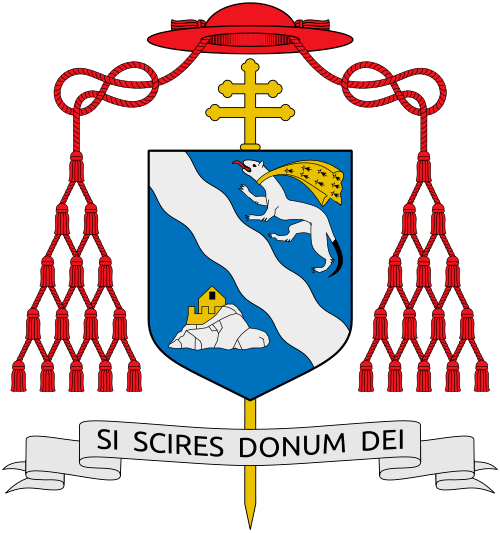
On September 30 Pope Francis held a Consistory in order to create new cardinals of the Holy Roman Church. Among those was the Frenchman from the Archdiocese of Rennes, Christophe Cardinal Pierre (77), who since 2016 has served as Apostolic Nuncio to the United States of America. He was named Cardinal Deacon of San Benedetto fuori Porta San Paolo. The arms he assumed on becoming a bishop in 1995 are now ensigned with the scarlet galero of a cardinal.
 EXARANDORUM
This nuncio is a Breton (Westpoint France), which regio has an own heraldry with as base “ermine”.
Beside the ermine shields and fields there is another markable heraldic charge: an ermine = beast. It is always white (proper) with a black-pointed tail. We see it as such in f..i. the coa’s of the Breton cities Saint-Malo and Vannes.
This ermine bears also a neck-tie, always ermine, doubled gold (Fr: cravate).
I think the designers of both the coa’s of nuncio Pierre created the tie’s incorrect.
In the pre-cardinal coa we see a cravate entirely gold. In the cardinals coa the tie has been charged with black ermine- tails so thet we get a cravate “erminois” doubled gold/or.
Could nt’ the designer better correct? >> a cravate ermine (white with black tails) doublé d’ or?
In the pre-cardinal coa we see in base a “pierre”proper. I liked that choice: it is simple-canting. In the cardinals coa we see a rock argent with a house (or chapel?)” gold. This is not per definition incorrect, but I preferred the single “Pierre”, canting.
The base of good heraldry is simplicity.
According to the French “Wikipedia”, Cardinal Pierre’s family hails from Rennes (no surprise), and from St. Malo. As Hans (above) noted, the stoat (ermine) is a charge in the c.o.a. of both the city of St. Malo, and of the Bretagne region. While I think that the nuncio might have wanted his c.o.a. to allude to his roots, he most probably did not want to directly “borrow” a c.o.a. that already existed. As a matter of fact, I can give you several examples of Austrian bishops c.o.a. that did vary the c.o.a. of their birthplace, apparently following a heraldic custom existing at the time. Nowadays, it is simply prudent not to usurp a c.o.a. of a public legal body like a city, a province or a (French) department, because doing so without consent of that body, such act could have all kinds of legal consequences. Furthermore, even leaving this point aside, using the “Gwenn ha du”, the colours of the c.o.a. and of the banner of Bretagne might have been seen as making a symbolic statement in French politics, i.e., taking the part of the Bretagne autonomy movement (against the French republic). And there are several brands of Breton autonomists, some even quite militant nationalists. Being thought to join with THEM certainly is not advisable to a bishop.
Regards,
Hermann