On September 26, in an unprecedented liturgy, the Archdiocese of Los Angeles received four new Auxiliary Bishops at the same time. While it is unusual for any diocese to receive so many new bishops at once it seems almost fitting for the U.S.’s largest archdiocese of well over 4 million Catholics to receive the needed assistance in episcopal ministry in order to serve the people of southern California adequately. Bishops Albert Bahhuth (66), Matthew Elshoff, OFM. Cap.(68), Brian Nunes (58) and Slawomir Szkredka (49) were all ordained to the episcopate by the Most Rev. José Gomez, Archbishop of Los Angeles.
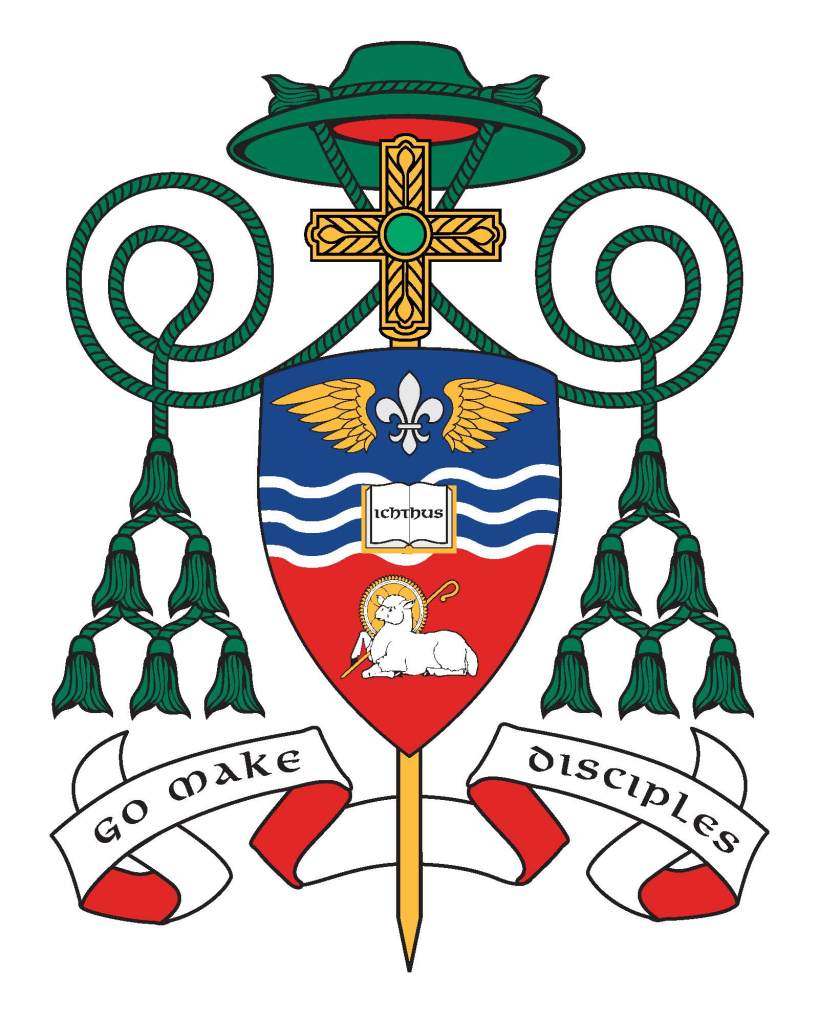
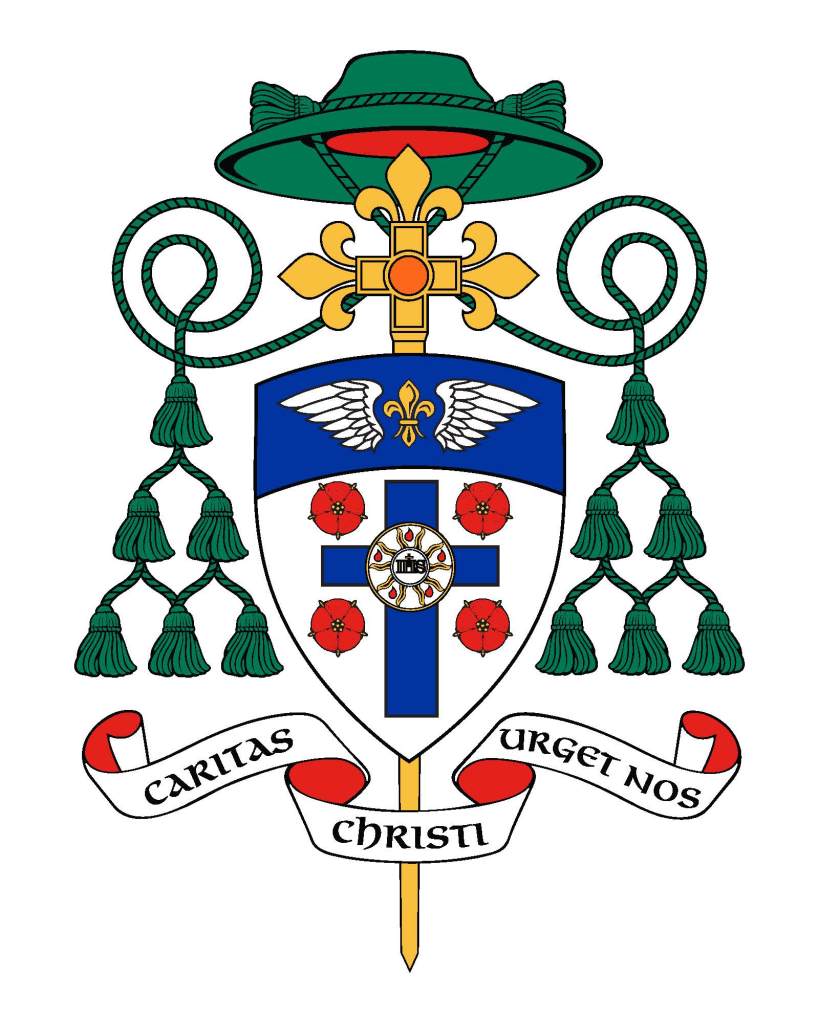
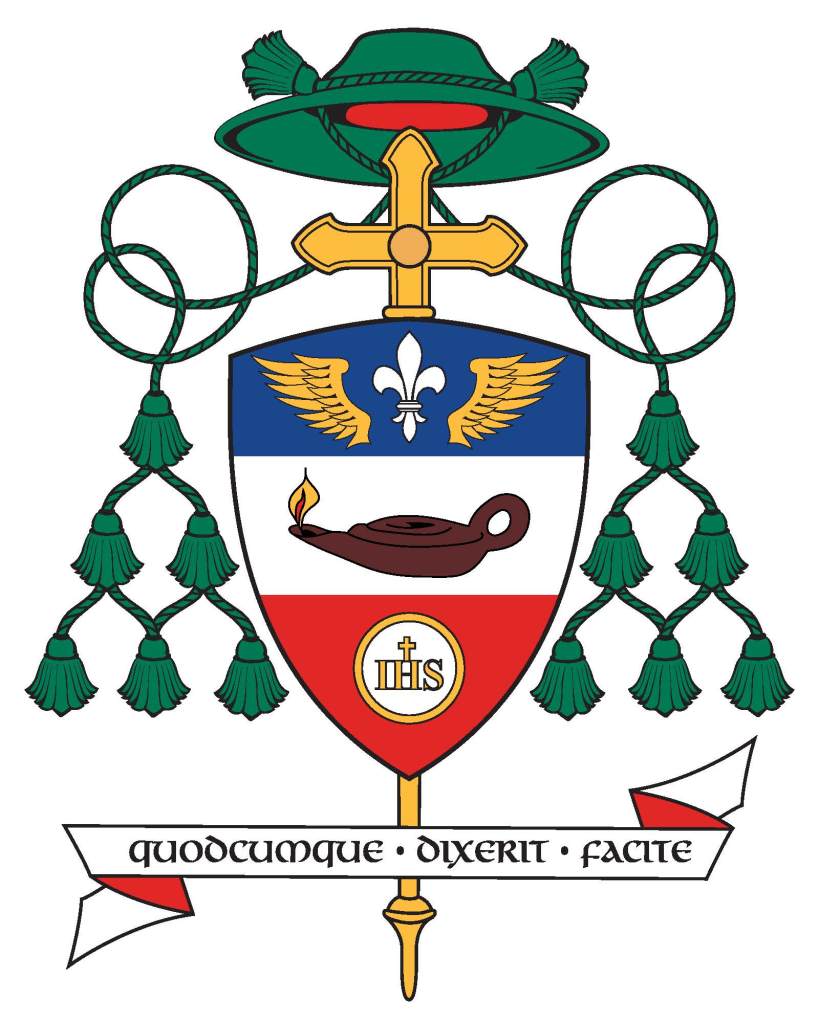
Their armorial bearings were all designed by James-Charles Noonan. As he usually does he makes a great deal about the shape of the episcopal cross in each achievement as well as the “significance” of the shape and color of the gemstone in each one. None of that is heraldically supportable. It may be his favorite idea but, as I have written about extensively in the past, the external ornaments in a coat of arms are not personalized not do they contain unique and special symbols particular to the armiger. That would require they be blazoned as such and would then have to be copied by any artist rendering the coat of arms. Only the charges on the shield are unique to the armiger.
Even there, Mr. Noonan has placed his own stamp on these four coats of arms. Acknowledging the unusual nature of four bishops being ordained at once he has included a similar chief in all four coats of arms as a means of tying them all together by the use of this similar charge. The idea in and of itself has some merit. The occasion was unique; something unique to mark it is a nice idea.
However, the coats of arms of auxiliary bishops do not contain charges that represent the jurisdiction in which they will serve as auxiliary bishop. A heraldic representation of possessing jurisdiction over a diocese belongs to the Ordinary of the diocese alone. In addition, a reference to the diocese (by borrowing a charge from the diocesan coat of arms) is quite common in heraldry. But, that isn’t what has occurred here. Instead of each coat of arms borrowing some charge from the arms of Los Angeles the four new bishop’s arms all bear an almost identical chief–an ordinary charge–in a manner not unlike those used to signify membership in a Religious Order or an Order of Chivalry.
Don’t misunderstand me: my criticism is not of the idea of heraldically marking the unusual circumstance of four bishops being ordained all at the same time. Rather, it is of the use of a near-identical charge, and one that sort of implies a kind of jurisdiction, that I am criticizing. It’s a clever devise. But, perhaps a bit “too clever” for its own good. In addition, one has to consider that all four of these bishops may not–indeed very likely will not–remain as auxiliaries of Los Angeles permanently. Once one of them is translated to another diocese the whole unifying symbolism uniting all four coats of arms begins to fall apart. Perhaps the use of a single similar charge employed differently in each of the coats of arms would have been a better solution?
The design of each of the rest of the four coats of arms is quite correct and very nice. As usual, Mr. Noonan’s regular collaborator in producing the artwork has shown herself capable of creating very fine work.
The following are the coats of arms of Bishops Bahhuth, Elshoff, Nunes and Szkredka:

 EXARANDORUM
The motto of the third coat of arms (mgr. Nunes) also provides an interesting example of a mishap which can be seen rather frequently, i.e. a fragment of Latin wrongly ‘snipped’ from its context. I assume the armiger wants ‘in mundum universum praedicate evangelium’ to mean something like ‘preach the Gospel to the entire world’.
However: this phrase has been cut out of its surrounding sentence (Mark 16:15) in a fashion that does not make sense on a grammatical level.
In the Vulgate, the text of Mark 16:15 is: ‘*euntes* in mundum universum, praedicate evangelium *omni creaturae*’. The preposition ‘in’ (+ accusative) is connected to the participle ‘euntes’ (from the verb ‘ire’, ‘to go’): ‘going *into all the world* …’, or, to translate more idiomatically, ‘go into all the world …’.
The verb ‘praedicate’, on the other hand, requires a dative as an indirect object: that is provided by ‘omni creaturae’: ‘… and preach the Gospel *to every creature* (or: to all of creation)’.
So, in short: as quoted in the motto to this coat of arms, the words ‘in mundum universum’ denote the direction to a verb of motion which is missing, and the words ‘praedicate evangelium’ lack mention of anyone to whom the preaching is addressed. Neither can the motto mean ‘preach the Gospel *in* the entire world’, since in that case the preposition ‘in’ should have governed an ablative case (‘in mundo universo’). Unfortunate.