Monthly Archives: September 2023

The L.A. “Quad”

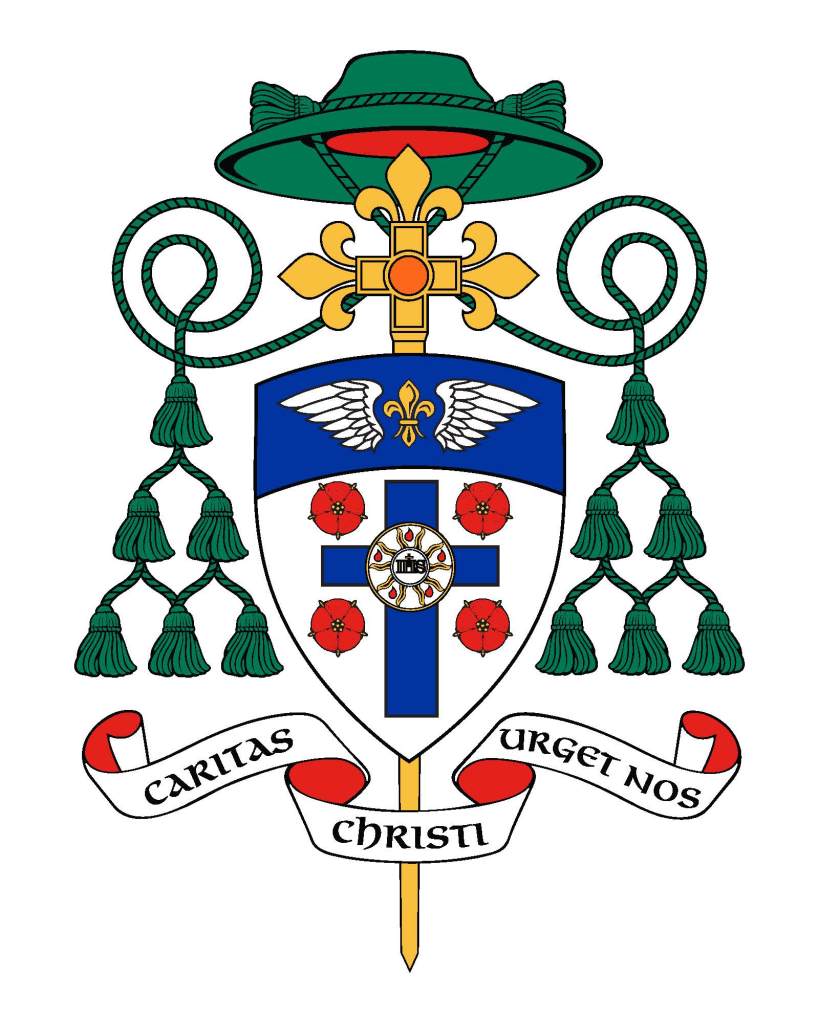
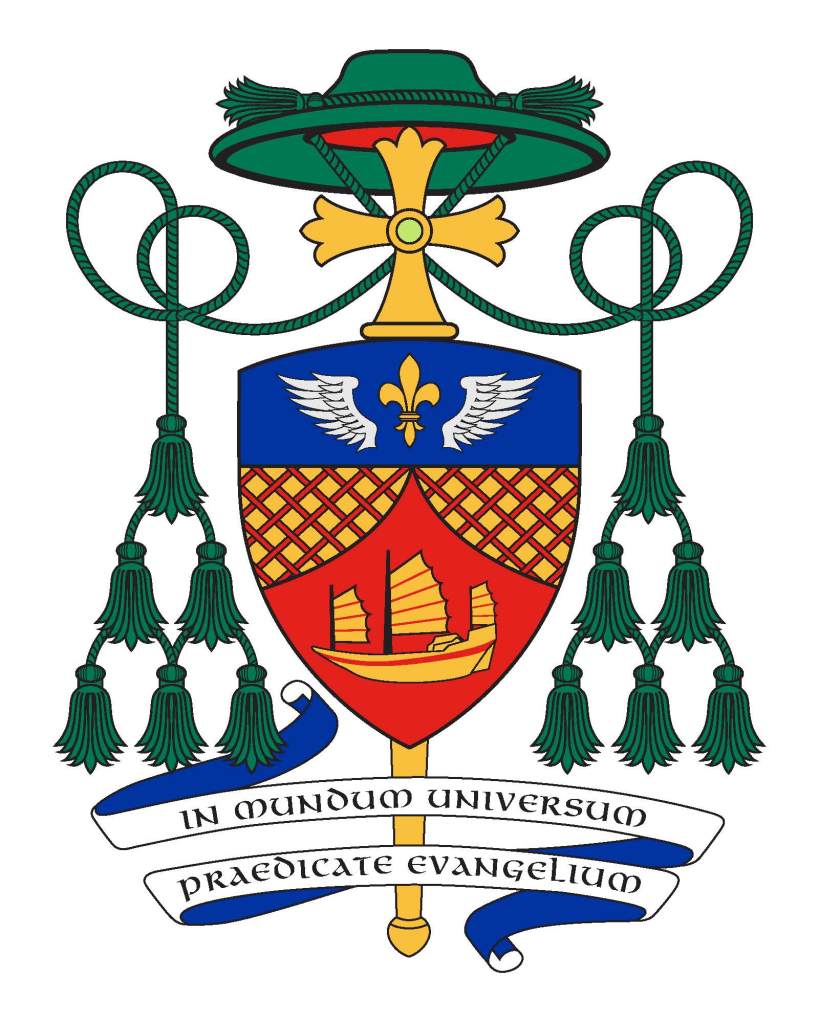
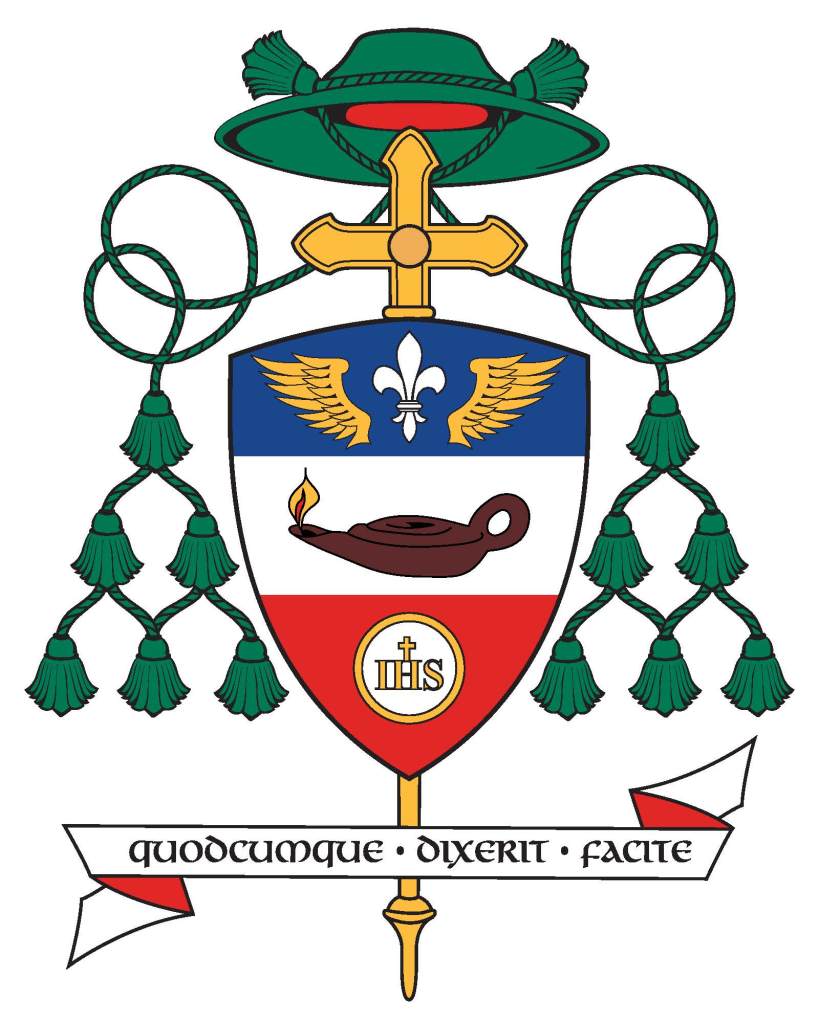
On September 26, in an unprecedented liturgy, the Archdiocese of Los Angeles received four new Auxiliary Bishops at the same time. While it is unusual for any diocese to receive so many new bishops at once it seems almost fitting for the U.S.’s largest archdiocese of well over 4 million Catholics to receive the needed assistance in episcopal ministry in order to serve the people of southern California adequately. Bishops Albert Bahhuth (66), Matthew Elshoff, OFM. Cap.(68), Brian Nunes (58) and Slawomir Szkredka (49) were all ordained to the episcopate by the Most Rev. José Gomez, Archbishop of Los Angeles.

Their armorial bearings were all designed by James-Charles Noonan. As he usually does he makes a great deal about the shape of the episcopal cross in each achievement as well as the “significance” of the shape and color of the gemstone in each one. None of that is heraldically supportable. It may be his favorite idea but, as I have written about extensively in the past, the external ornaments in a coat of arms are not personalized not do they contain unique and special symbols particular to the armiger. That would require they be blazoned as such and would then have to be copied by any artist rendering the coat of arms. Only the charges on the shield are unique to the armiger.

Even there, Mr. Noonan has placed his own stamp on these four coats of arms. Acknowledging the unusual nature of four bishops being ordained at once he has included a similar chief in all four coats of arms as a means of tying them all together by the use of this similar charge. The idea in and of itself has some merit. The occasion was unique; something unique to mark it is a nice idea.

However, the coats of arms of auxiliary bishops do not contain charges that represent the jurisdiction in which they will serve as auxiliary bishop. A heraldic representation of possessing jurisdiction over a diocese belongs to the Ordinary of the diocese alone. In addition, a reference to the diocese (by borrowing a charge from the diocesan coat of arms) is quite common in heraldry. But, that isn’t what has occurred here. Instead of each coat of arms borrowing some charge from the arms of Los Angeles the four new bishop’s arms all bear an almost identical chief–an ordinary charge–in a manner not unlike those used to signify membership in a Religious Order or an Order of Chivalry.

Don’t misunderstand me: my criticism is not of the idea of heraldically marking the unusual circumstance of four bishops being ordained all at the same time. Rather, it is of the use of a near-identical charge, and one that sort of implies a kind of jurisdiction, that I am criticizing. It’s a clever devise. But, perhaps a bit “too clever” for its own good. In addition, one has to consider that all four of these bishops may not–indeed very likely will not–remain as auxiliaries of Los Angeles permanently. Once one of them is translated to another diocese the whole unifying symbolism uniting all four coats of arms begins to fall apart. Perhaps the use of a single similar charge employed differently in each of the coats of arms would have been a better solution?

The design of each of the rest of the four coats of arms is quite correct and very nice. As usual, Mr. Noonan’s regular collaborator in producing the artwork has shown herself capable of creating very fine work.

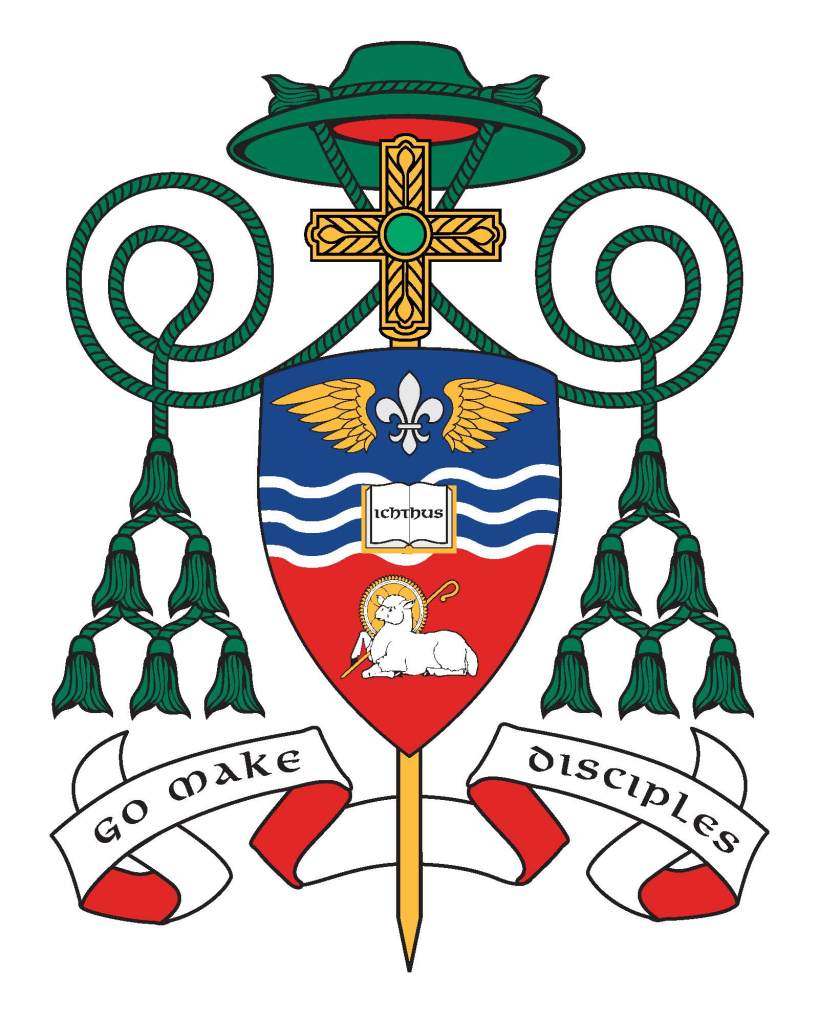
The following are the coats of arms of Bishops Bahhuth, Elshoff, Nunes and Szkredka:
Two for San Diego

On September 28 of this year the Most Rev. Michael Pham (56), a priest of the Diocese of San Diego, CA will be ordained a bishop and will serve as Titular Bishop of Cercina and Auxiliary Bishop of San Diego. On the same day, the Most Rev. Felipe Pulido (53), a priest of the Diocese of Yakima, WA will be ordained the Titular Bishop of Buffada and also serve as Auxiliary Bishop of San Diego.

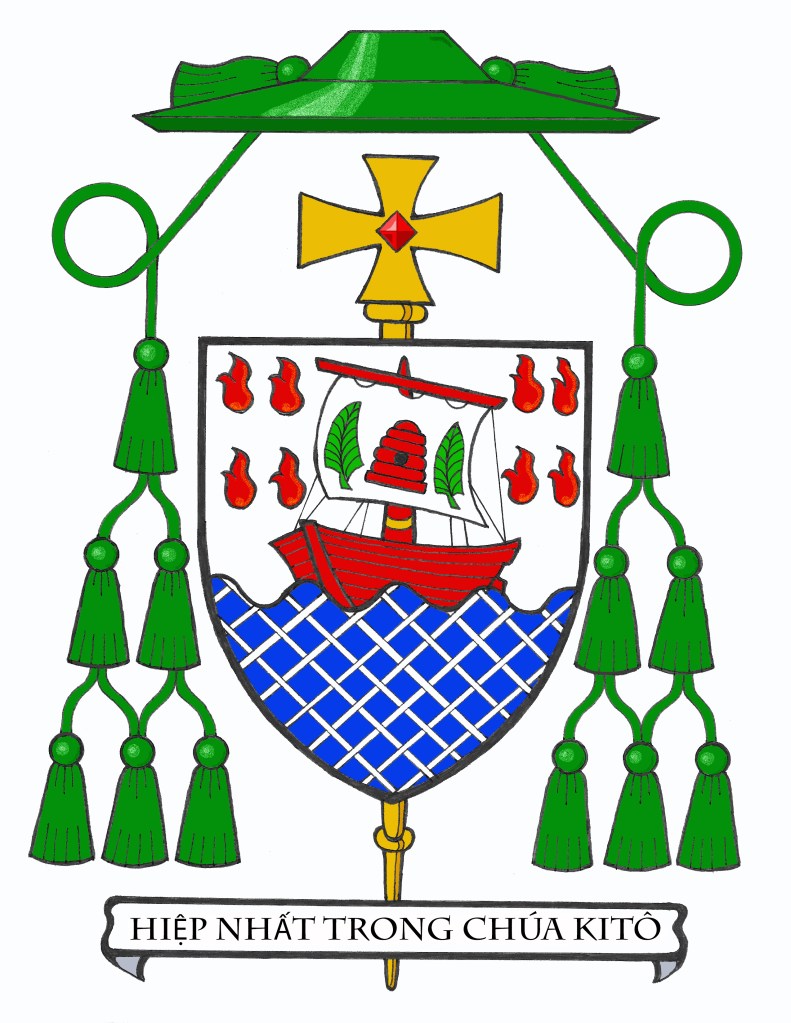
I was happy to assist both of these new bishops with the creation of their respective coats of arms. The armorial bearings of Bishop Pham are:

The shield is divided horizontally to depict a silver (white) sky above a blue wavy ocean. The ocean is criss-crossed by diagonal lines in order to create a pattern suggestive of a fisherman’s net. This has more than one meaning. First, it represents that after 1975 while still living in Vietnam the bishop’s father became a fisherman to provide for his family. In addition, the net indicates not only the task of an apostle (or a successor to an apostle) of being a “fisher of men” but it also alludes to the New Evangelization where we are exhorted to put out into the deep (Duc in Altum). This symbolizes both the bishop’s priestly and episcopal ministry. 

In the upper part of the shield the main charge is a boat on the waves under full sail. The boat also alludes to the work of a fisherman. In addition, a boat, in heraldry, is often used as a symbol of the Church itself, often referred to as the barque of Peter, who was a fisherman himself. On the sail of the boat in the center is a red beehive surrounded by two green palm branches. The beehive is a symbol of St. John Chrysostom, the bishop’s baptismal patron saint. Chrysostom was the archbishop of Constantinople and renowned for his inspiring preaching. So, he was known as a “honey-tongued” preacher, hence the beehive as his symbol. The palm branches are an ancient symbol of martyrdom. The bishop’s family comes from the first diocese in the north of Vietnam where his ancestors were among the first martyrs for the faith in that part of the world.

On either side of the boat are eight red tongues of fire which also have more than one meaning. First, they are symbols of the Holy Spirit which, the Sacred Scriptures remind us, descended on the Apostles as tongues of fire at Pentecost. This was the beginning of their ministry to go out into the world to preach the Gospel so it is another symbol of Evangelization. Throughout his priestly ministry the bishop has worked with various groups of different ethnic and cultural backgrounds. Many flames represent a diversity of communities. Bishop Pham strengthened the cultural communities found in the diocese and shared them with the larger Catholic community. He has served as Episcopal Vicar of the Office of Ethnic & Intercultural Communities. Six years ago, he launched the first-ever Pentecost Mass for All Peoples, which has come to attract more than 2,000 faithful annually. So, symbols of the Holy Spirit were seen to appropriately reflect this ministry. It also reflects how, on Pentecost, when the Holy Spirit descended, people from many different and various places, languages and cultures heard the Apostles speaking in their own languages. The red of the boat, the beehive and the tongues of fire is a further allusion to the blood of the martyrs.

The motto below the shield is, “Hiệp Nhất trong Chúa Kitô” which means “One in Christ” or “United in Christ” in Vietnamese. This motto reflects the work the bishop has done throughout his priesthood to help various communities and to work towards the unity of diverse cultures and groups within the People of God.

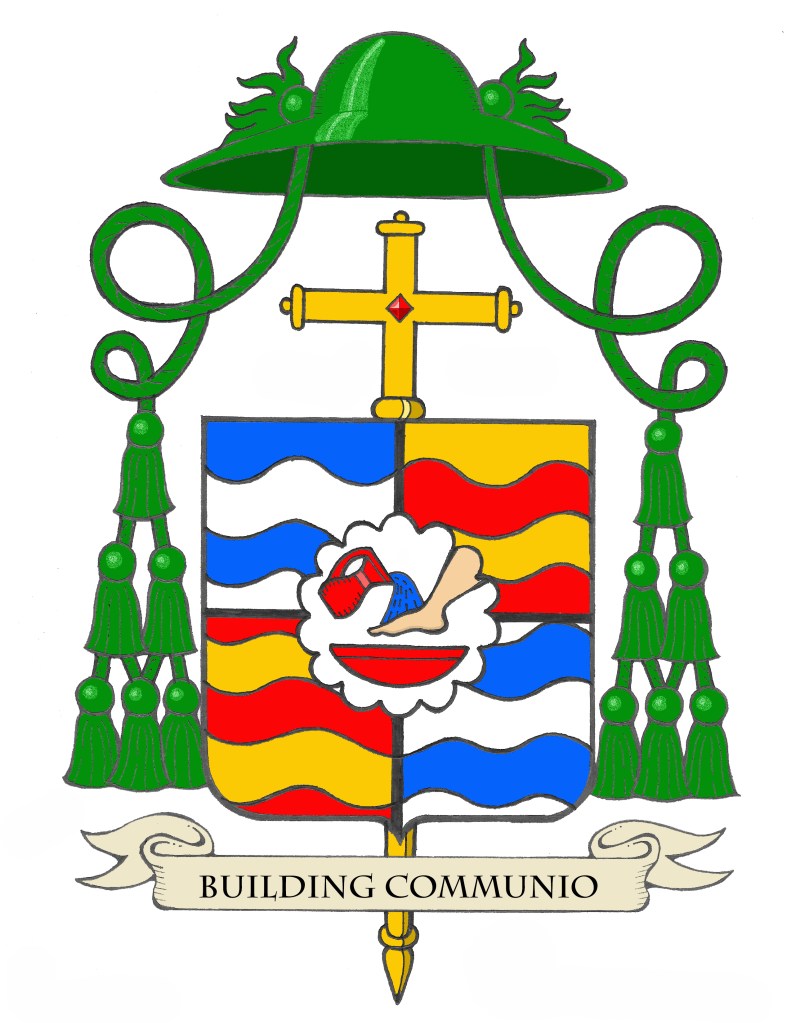
The armorial bearings of Bishop Pulido are:

The shield is divided into four quarters with wavy horizontal lines from top to bottom. In the first and fourth quarters the lines alternate blue and silver (white) while in the other two quarters they alternate red and gold (yellow).

The blue and white lines represent the Blessed Virgin Mary. In addition, they suggest water which also alludes to Jesus washing the feet of His disciples. In addition, they can be seen as referring to the waters of Baptism. The red and gold (yellow) lines represent the Holy Spirit and fire. In addition, the colors can be seen as referring to the Blood (as well as water) that poured from the side of the Lord at His crucifixion. They are also seen as referring to bread (gold/yellow) and wine (red) as a reference to the Eucharist. In this way these lines also refer back to the foot washing because Jesus was showing His disciples the kind of self-sacrificing service they were called to which was about to be played out in His sacrifice on the cross and would be experienced for them in the future whenever they came together to share the Eucharist.

At the center of the shield is a silver (white) roundel called a plate. On this plate is a simple symbolic representation of the Mandatum (washing of the feet). The outer edge of this roundel, or plate is a line composed of small humps. Such a line is called “invected” in heraldry. It is borrowed from the coat of arms of the Diocese of Yakima, WA where Bishop Pulido served as a priest before being named a bishop.

The motto below the shield is, “Building Communio” which is what the bishop sees as the purpose and goal of his episcopal ministry.

Mechelen-Brussel

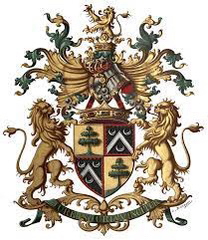
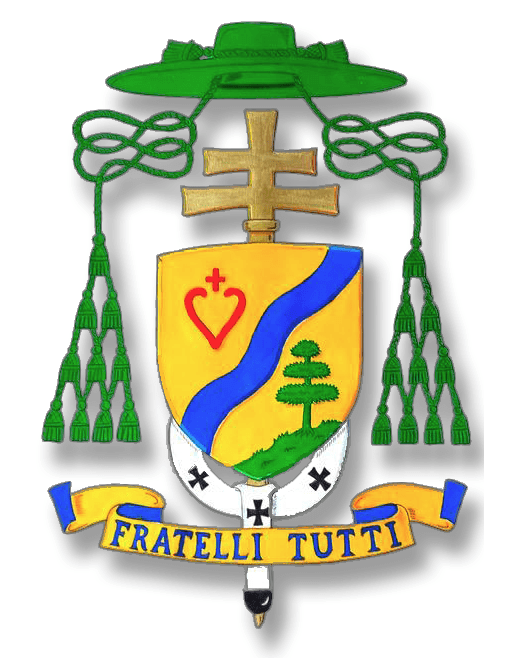
On September 3 the new Archbishop of Mechelen-Brussel (Malines-Bruxelles) was ordained a bishop and was installed as the 23rd Archbishop. The Most Reverend Luc Terlinden (54) is of the noble family of the viscounts and barons Terlinden. This makes him the first archbishop who is from the nobility since Mgr. de Méan (who was the last Prince-Bishop of Liège and died as Archbishop in 1830). There have been other nobles named as bishops in Belgium, however. It is disappointing that the archbishop chose to create and assume new arms (below) that only slightly refer to his noble family’s coat of arms (above, left). I’m sure many fine heraldist and genealogists are disappointed at that. The arms he has assumed aren’t bad, per se. Rather, it is that his ancestral arms are far better.