The Right Reverend Dom Cuthbert Brogan, OSB who first became Prior-Administrator of St. Michael’s Abbey at Farnborough in England in 1996 and was elected as its Abbot in 2006 has–at long last–finally become armigerous! Four years ago he was elected Abbot Visitor of the English-speaking Province of the Subiaco Congregation, to which his monastery belongs. At that time he finally decided to begin the process of applying for a grant of arms from HM College of Arms in London.
This is neither a quick (nor, I must admit an inexpensive) proposition. Nevertheless, those who live in countries where there is an official heraldic authority, such as the College of Arms, are subject to its jurisdiction and are not simply free to assume a coat of arms like those who live in places without a heraldic authority, like the USA for example. Here in the US an abbot may simply assume arms. In those places where there is a state-sponsored heraldic authority it may be illegal to do so, depending on the country.
Last week, Dom Cuthbert received his grant of arms and it is magnificent!
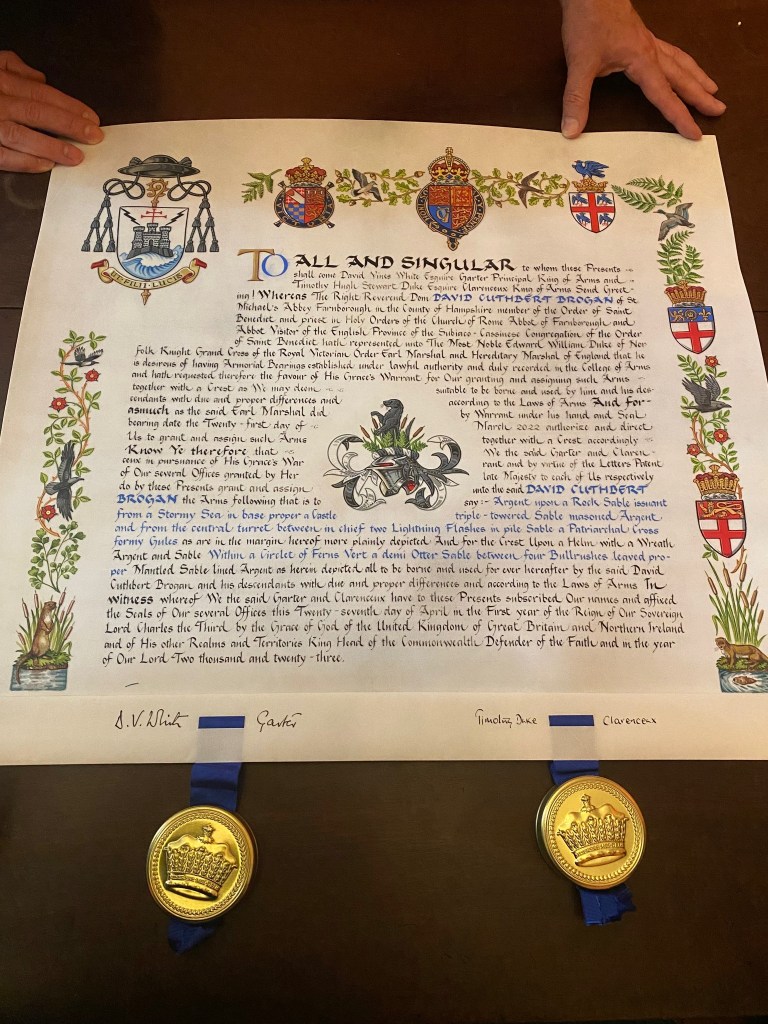
As is usually the custom (though not a necessity) a beautiful custom-made, illuminated document for the Letters Patent of the grant was produced. This one bears the royal arms at the top using the “Tudor style” crown preferred by His Majesty between the arms of the Earl marshal, the Duke of Norfolk and the College itself. The margins are decorated with the arms of office of Garter Principal King-of-Arms as well as Clarenceux King-of-Arms who also signed the Letters Patent. The margins also contain bullrushes and otters. The otters are symbolic of St. Cuthbert, the Abbot’s patron. He was born on the feast of St. Cuthbert. Otters warmed the saint’s feet with their breath when he emerged from the North Sea after a night of singing psalms. The bullrushes are for Rushmoor Borough, in which Farnborough Abbey is located. In addition, the raven is a symbol of St. Benedict, the roses are for England and the ducks are another animal alluding to St. Cuthbert.
The College of Arms is in the habit of also providing a crest even for their ecclesiastical clients despite the fact that the galero replaces helm, mantling and crest in the achievement of a cleric. Here the crest is also composed of a demi-otter and ferns and bullrushes (already explained). While it is not used in the achievement, the Abbot is free to use his crest as a stand alone symbol, or even adapt it and use it as a heraldic badge.
It is a nice touch, too, that the grant was dated March 21, 2022 which is the feast day commemorating the Death of St. Benedict.
The arms themselves are explained by Abbot Cuthbert thusly: “The fortress is the monastic life – the house built on rock of the gospels. This keeps in certain values and excludes others. The island represents a number of islands – England, Lindisfarne, Mont St Michel, and Caldey – all associated with me or our monastery. The island also represented the fuga mundi – separation from the world which marks the monastic life. The patriarchal cross is from the arms of the Subiaco Cassinese Congregation. The stormy sea expresses how the monastery stands unchanging amongst the vicissitudes of church and world. The two bolts of lightning recall assaults on my monastery from two sources in the past. But the house stood firm“.
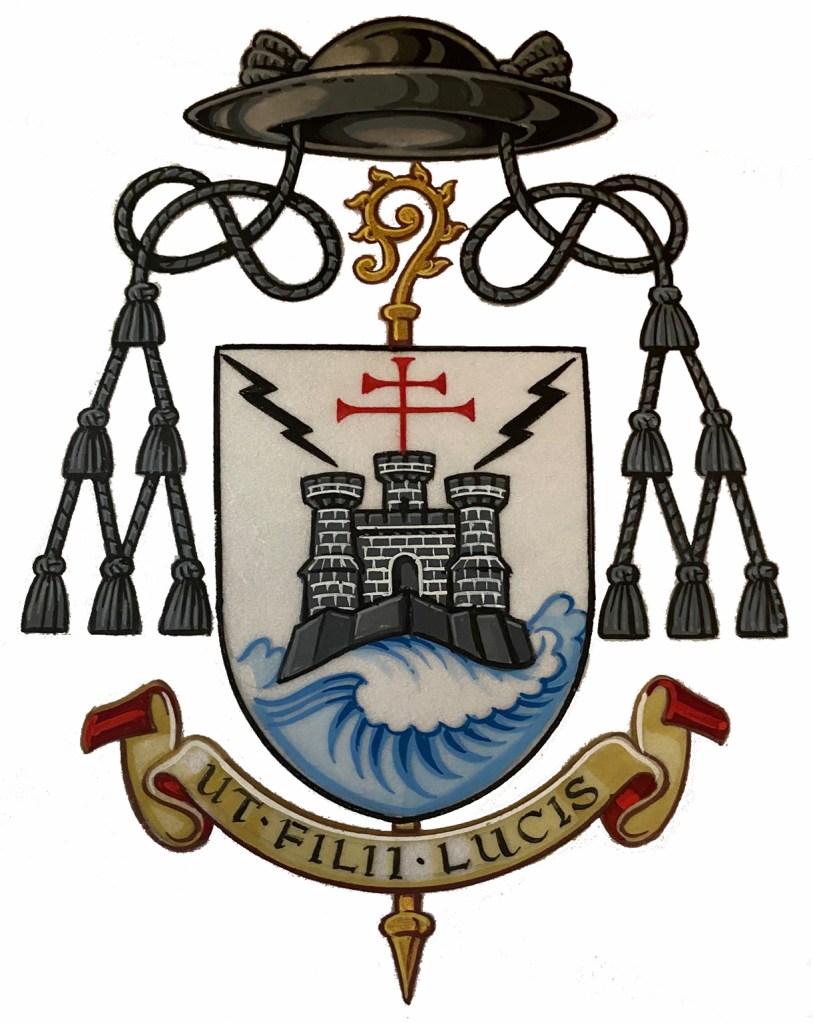
The motto below the shield translates as “The Children of Light”.
I am very pleased to say that I was one of the people encouraging Abbot Cuthbert over the years to apply for a grant of arms. It pleases me to no end that after quite a few years he did, indeed, follow my advice. I think the final result was worth the wait. The design is good; clear and simple. In addition, rather than falling prey to the temptation into which so many prelates fall by making their coat of arms a CV in pictures, this coat of arms is filled with significance while using simple imagery. The Abbot chose to symbolize concepts and events of significance to his life rather than his name, or his family name, or the many jobs and/or accomplishments or associations he has had. That’s where so many prelates fail. They insist on symbols of everything and everyone with whom they have been associated throughout theirs lives no matter how slight the association has been.
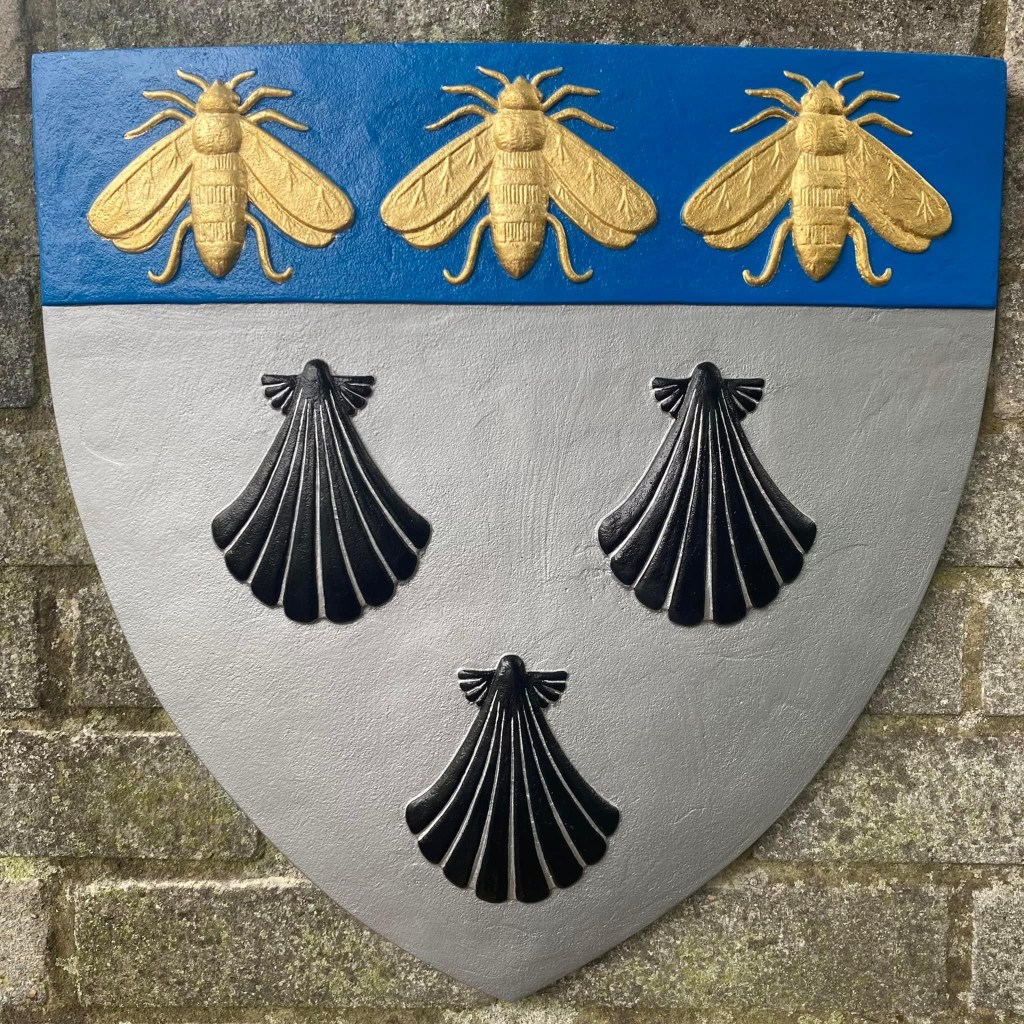
Abbot Cuthbert has avoided that pitfall and ended up with a bold, clear and very good coat of arms. His abbey also makes use of a fine coat of arms for the abbey itself (see below). Now I’ll have to start needling him to have a rendering done of his arms impaled with those of his abbey!
 EXARANDORUM
Dear Fr Guy,
This is most interesting. Thank you.
Regards,
Richard
Beautiful.
I think the design is great. However, why does the crozier not have a sudarium attached?
I don’t know. It’s probably a decision of the College of Arms. They may prefer not to use the sudarium.
Some very rich meaning behind the symbols. I especially appreciate that the grant was dated on March 21.
Beautiful arms, both of them. The wording of the diploma scroll, however, leaves a lot to be desired. “…a Priest of the Church of Rome…? Who wrote this? Henry VIII? Perhaps “…Priest of the Roman (or Latin) rite of the Holy Catholic Church…”
Additionally, the reference to “his descendants “ is amusing. Do they know something we don’t know?
I thought the descendants line was amusing too but there is a somewhat standardized form of the text. HM officers of arms wrote it and they get to word these Letters however they see fit. Also, I’d suggest that any problem with the wording of the description of Abbot Cuthbert’s priesthood lies more with you than them.
The cost of the Grant is a point of concern – is it a reasonable expense for any religious house? One hopes it was not an ego-massaging exercise.
Considering how long after becoming Abbot this occurred I hardly think it has anything to do with ego. The matter had been brought up to him numerous times and always dismissed. Most consecrated Religious that I know are usually the recipient of the assistance of a generous benefactor so there is no cost to the community.
Indeed – the cost of a personal grant of arms and crest is now GBP 8,950 – around USD 11,400. I can’t help thinking that there might have been a better use of the money, whoever it came from.
Your complaint about the high cost of a grant of arms should be made to the one charging such a fee rather than to those who pay it. Your dissatisfaction is better placed aimed at the College of Arms and, by extension, at the Crown itself. In England one is not free simply to assume arms legally. That being the case, then it should be possible—and more affordable—to receive a grant. Your comment clearly implies that it’s alright for a lay person to pay such fees but a cleric shouldn’t do so. Why not question why the College of Arms doesn’t provide a more amenable fee schedule to those whose means are limited, like a Catholic Religious? If the cleric in question is also a prelate and therefore should have a coat of arms, but cannot do so legally without a grant, and the grant costs a certain amount then what course of action do you propose? But, in any case the Abbot and his community are not to blame. The Abbot clearly showed himself patient and not at all eager to have a coat of arms with such an extended period of time elapsing between when he took office and when he received the grant. Perhaps he started a small fund added to occasionally with donations that people often give to a priest in the course of his work and he took years to save up the money? Perhaps, as I suspect, there was a generous benefactor who assisted in the endeavor? Regardless of how the funds were raised I find it particularly irritating and odd when others decide to dictate how people should spend their money. If there was a benefactor involved it’s entirely possible that he/she was willing to give the money ONLY for this expressed purpose. It’s called a “dedicated gift”. The implication that the Abbot and monastic Community are at fault by spending money that could best be used elsewhere is a bit offensive. Only when matters concern the clergy do people make such remarks. If you think heraldry is unimportant and an unnecessary expense then why are you reading a blog about heraldry? You would never think to make such a remark to a layman but you strongly imply that the Abbot is shirking his duties as a priest and a monk by this project, which is uncalled for. I recall that there is a figure in the Scriptures who once complained at the wasteful expense of something given to Christ, arguing the money could have been better spent elsewhere. It was Judas Iscariot.